中国沙漠 ›› 2026, Vol. 46 ›› Issue (2): 251-262.DOI: 10.7522/j.issn.1000-694X.2025.00166
• • 上一篇
周峻羽1( ), 常佩静2, 王海鹰2, 辛智鸣3, 袁子喧1, 朱文涛1, 闫玉洁1, 程一本1()
收稿日期:2025-10-09
修回日期:2025-12-01
出版日期:2026-03-20
发布日期:2026-04-13
通讯作者:
程一本
作者简介:周峻羽(1999—),女,江苏连云港人,硕士研究生,主要从事退化生态系统修复与管理相关研究。E-mail: zhoujunyu115@163.com
基金资助:
Junyu Zhou1(), Peijing Chang2, Haiying Wang2, Zhiming Xin3, Zixuan Yuan1, Wentao Zhu1, Yujie Yan1, Yiben Cheng1()
Received:2025-10-09
Revised:2025-12-01
Online:2026-03-20
Published:2026-04-13
Contact:
Yiben Cheng
摘要:
为评估荒漠区光伏电站对土壤粒径与土壤含水量变化的影响,本研究在乌兰布和沙漠4个不同运营年限电站内,按板间/板下与表层(0~20 cm)/深层(20~40 cm)布设320个粒度样点,并在典型站点布设5个几何位置(A~E)与2个深度(30/60 cm)的土壤水分传感器,联合板前汇流观测2024年4—11月的土壤水分动态。结果显示:(1)土壤粒径在场址尺度呈中心细、边缘粗格局,上风向板间出现细粒径中心,板下在面板底隙附近出现粗粒径中心。(2)与建站前对照相比,板间/板下的粒径均值总体呈下降趋势(即土壤粒径细化),细砂(100~250 μm)体积分数上升,且板间表层粒径离散程度随运营年限增长降低。(3)光伏板前檐倾斜且板中存在遮挡,导致降雨在前檐聚集,在板下正中间亏损。土壤含水量在光伏板前檐160 cm和前檐正下方浅表处达3.16%~3.22%,高于板下正中间浅表(约1.13%)。(4)表层土壤对降雨脉冲响应敏感,而深层土壤受缓慢渗透支配的影响。研究结果显示光伏电站对土壤粒径的影响具有年限效应,对水分的影响具有位置依赖,建议在站址边缘增设防护带并优化光伏板几何特征与导流设施,以减少外界对土壤粒径侵蚀程度和缓解光伏板板下正中间亏水,提升板前入渗。
中图分类号:
周峻羽, 常佩静, 王海鹰, 辛智鸣, 袁子喧, 朱文涛, 闫玉洁, 程一本. 乌兰布和沙漠光伏电站改变土壤粒径分布与降雨再分配过程[J]. 中国沙漠, 2026, 46(2): 251-262.
Junyu Zhou, Peijing Chang, Haiying Wang, Zhiming Xin, Zixuan Yuan, Wentao Zhu, Yujie Yan, Yiben Cheng. The Ulan Buh Desert photovoltaic power station alters soil particle size distribution and rainfall redistribution process[J]. Journal of Desert Research, 2026, 46(2): 251-262.
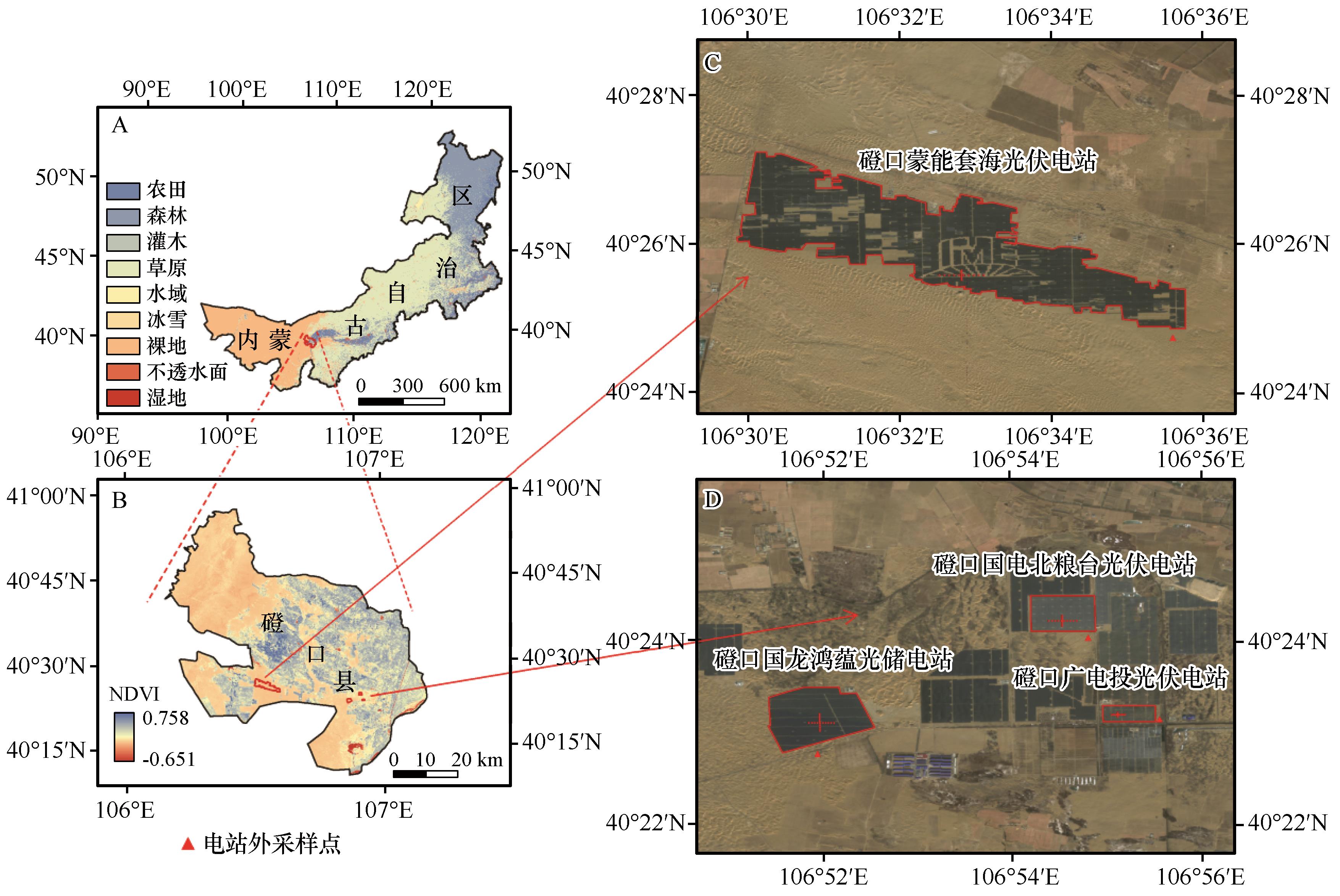
图1 研究区地理位置及电站内采样点位置注:基于自然资源部标准地图服务网站审图号GS(2019)1822号标准地图制作,底图边界无修改
Fig.1 Geographic location of the study area and location of sampling points within the power stations
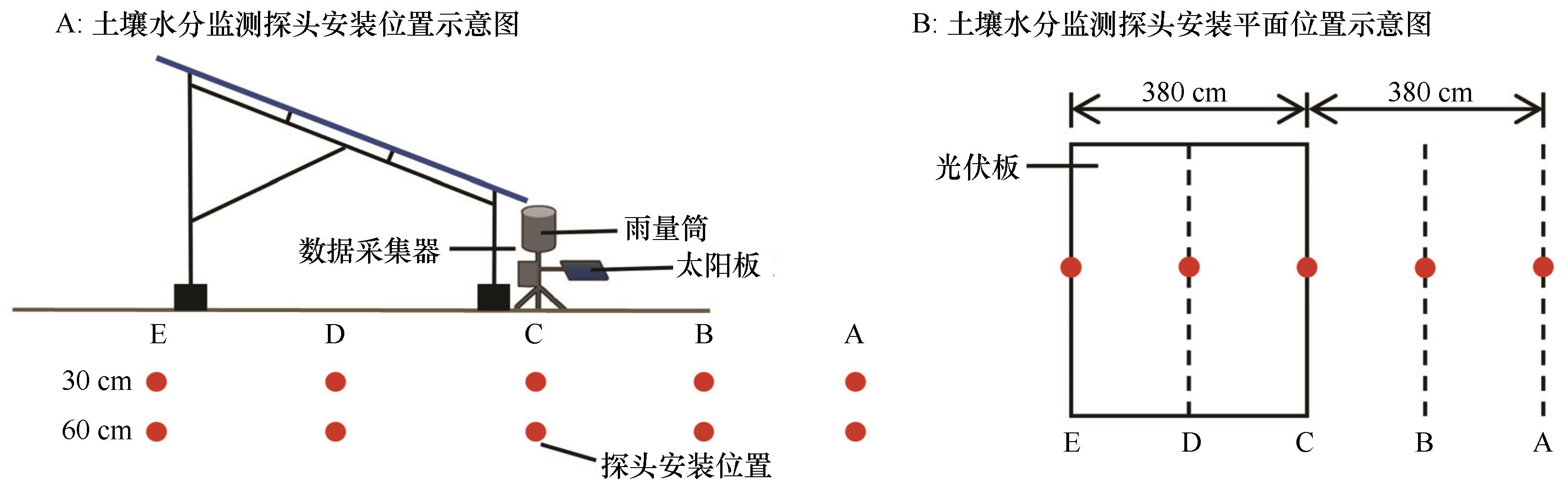
图2 土壤水分监测仪探头安装位置示意图
Fig.2 Schematic diagram of soil moisture monitor probes installation positions
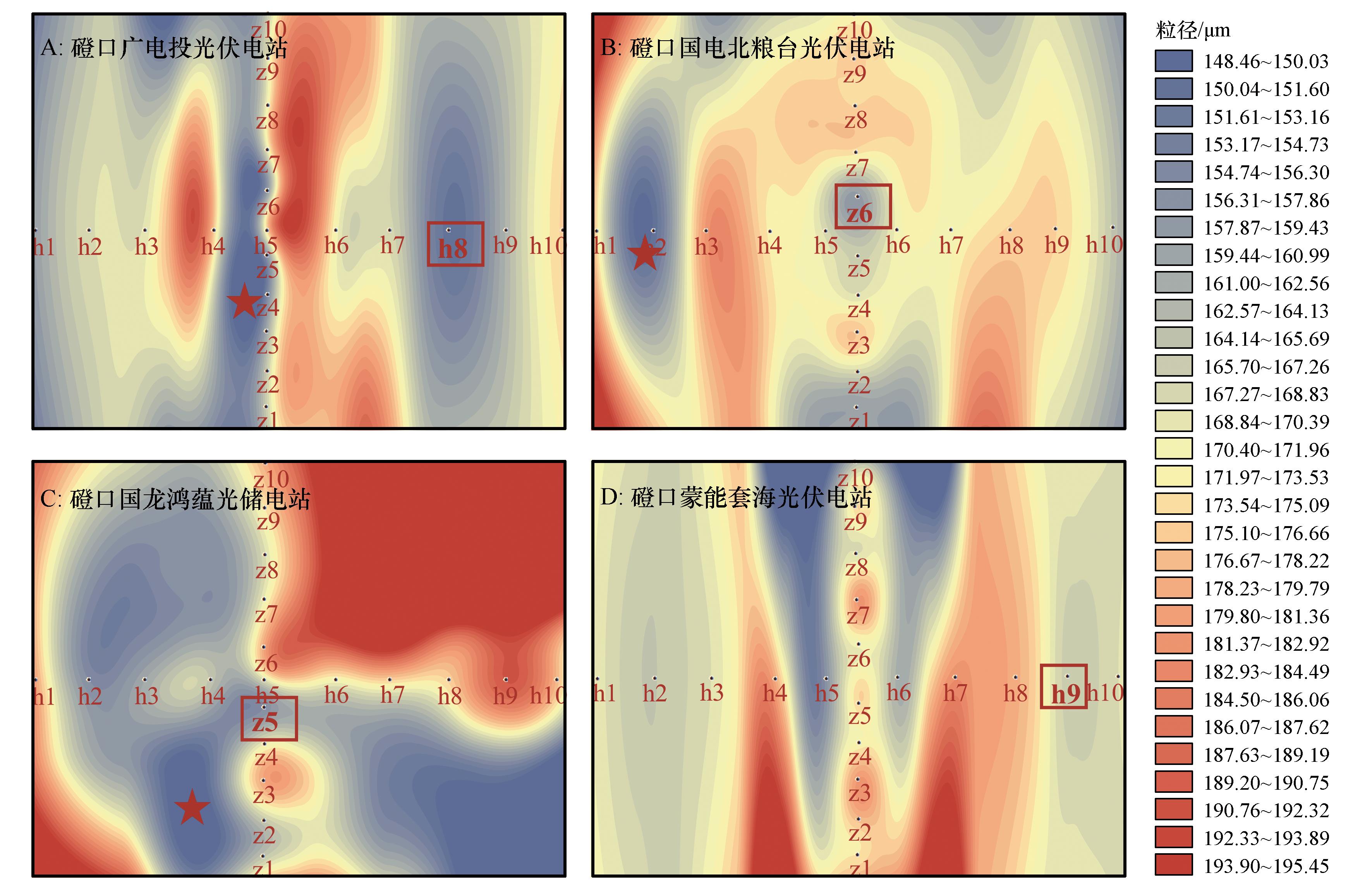
图3 板间表层土壤粒径均值空间分异注:h1~h10为横向采样点位置,z1~z10为纵向采样点位置,红框标注为光伏电站中心采样点位置;★为细粒径中心
Fig.3 Spatial variation pattern of mean particle size of inter-panel surface soil
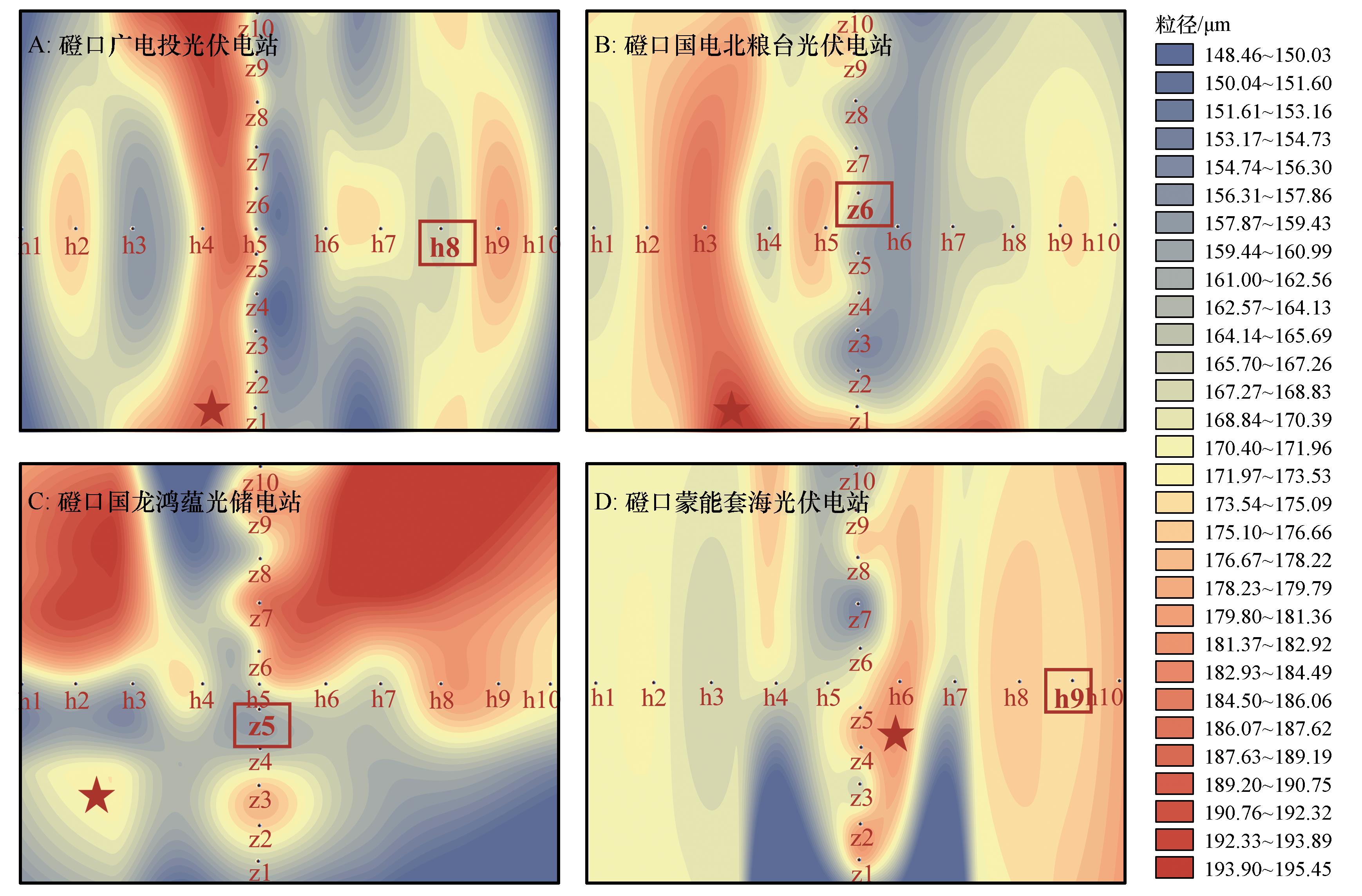
图4 板下表层土壤粒径均值空间分异注:h1~h10为横向采样点位置,z1~z10为纵向采样点位置,红框标注为光伏电站中心采样点位置;★为粗粒径中心
Fig.4 Spatial variation pattern of mean particle size of subsurface soil beneath panels
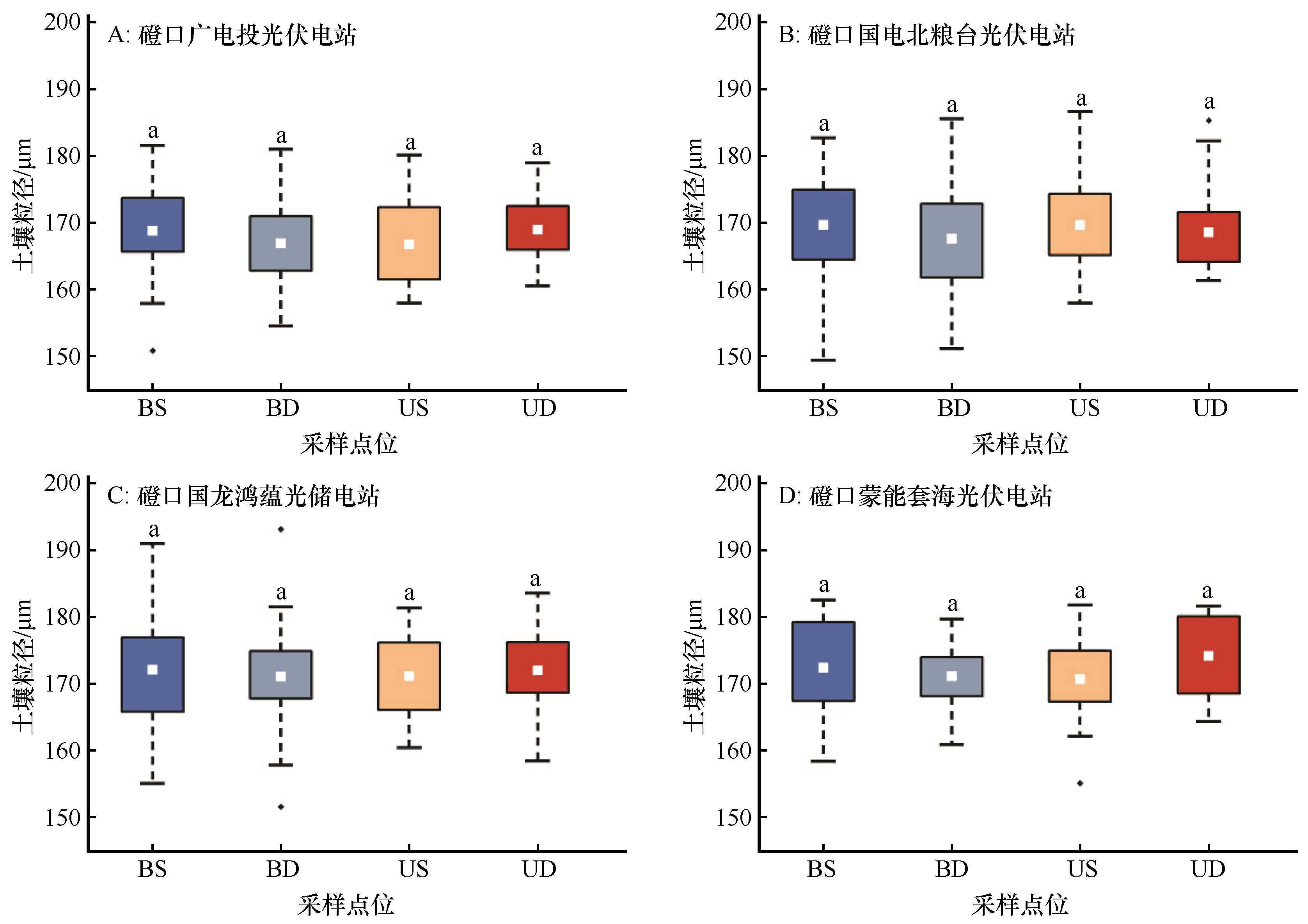
图5 光伏板不同位置土壤粒度均值箱线图注:BS、BD、US和UD分别表示板间表层、板间深层、板下表层和板下深层
Fig.5 Box plots of mean soil particle size at different positions of PV panels
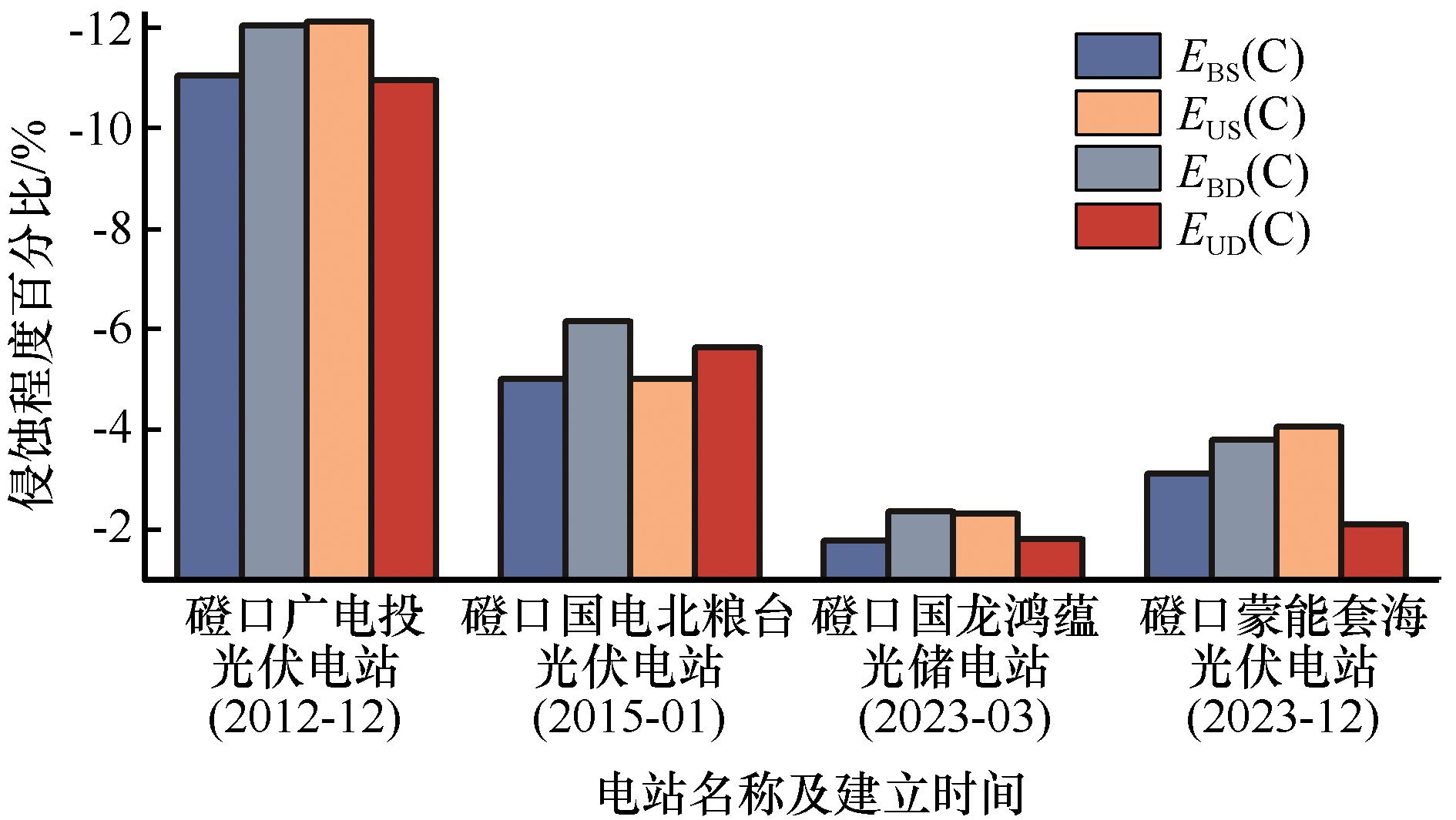
图6 光伏板不同位置土壤粒径相对于对照的减少百分比趋势注:EBS、EBD、EUS、EUD分别表示板间表层、板间深层、板下表层、板下深层土壤侵蚀程度(与对照样对比)
Fig.6 Trend diagram of soil particle size reduction percentage at different positions of PV panels relative to the control sample
| 电站名称 | 建立时间 | EBS/% | EBD/% | EUS/% | EUD/% | |||||
|---|---|---|---|---|---|---|---|---|---|---|
| 磴口广电投光伏电站 | 2012年12月 | 168.81 | 166.90 | 166.78 | 168.97 | 189.77 | -11.05 | -12.05 | -12.12 | -10.96 |
| 磴口国电北粮台光伏电站 | 2015年1月 | 169.67 | 167.63 | 169.66 | 168.55 | 178.61 | -5.01 | -6.15 | -5.01 | -5.63 |
| 磴口国龙鸿蕴光储电站 | 2023年3月 | 172.25 | 171.23 | 171.31 | 172.18 | 175.37 | -1.78 | -2.36 | -2.32 | -1.82 |
| 磴口蒙能套海光伏电站 | 2023年12月 | 172.53 | 171.33 | 170.85 | 174.33 | 178.07 | -3.11 | -3.79 | -4.06 | -2.10 |
表1 土壤粒径侵蚀程度百分比
Table 1 Percentage of erosion degree by soil particle size
| 电站名称 | 建立时间 | EBS/% | EBD/% | EUS/% | EUD/% | |||||
|---|---|---|---|---|---|---|---|---|---|---|
| 磴口广电投光伏电站 | 2012年12月 | 168.81 | 166.90 | 166.78 | 168.97 | 189.77 | -11.05 | -12.05 | -12.12 | -10.96 |
| 磴口国电北粮台光伏电站 | 2015年1月 | 169.67 | 167.63 | 169.66 | 168.55 | 178.61 | -5.01 | -6.15 | -5.01 | -5.63 |
| 磴口国龙鸿蕴光储电站 | 2023年3月 | 172.25 | 171.23 | 171.31 | 172.18 | 175.37 | -1.78 | -2.36 | -2.32 | -1.82 |
| 磴口蒙能套海光伏电站 | 2023年12月 | 172.53 | 171.33 | 170.85 | 174.33 | 178.07 | -3.11 | -3.79 | -4.06 | -2.10 |
| 电站名称 | 点位 | RL/%(<2 μm) | RM/%(2~50 μm) | RX/%(50~100 μm) | RF/%(100~250 μm) | RZ/%(250~500 μm) | RG/%(500~2 000 μm) | VM /% | VX /% | VF /% | VZ /% | VG /% |
|---|---|---|---|---|---|---|---|---|---|---|---|---|
| 磴口广电投光伏电站 | 板间表层 | — | 0.62±0.12 | 4.47±0.77 | 76.12±4.24 | 14.55±3.52 | 4.24±2.37 | |||||
| 板间深层 | — | 0.59±0.13 | 4.40±0.60 | 77.05±5.65 | 14.74±4.04 | 3.22±2.62 | 0.03 | 0.08 | -0.93 | -0.19 | 1.02 | |
| 对照样 | — | 0.34 | 2.26 | 65.14 | 24.22 | 8.04 | 0.28 | 2.21 | 10.98 | -9.67 | -3.80 | |
| 板下表层 | — | 0.61±0.14 | 4.37±0.69 | 77.41±4.97 | 14.00±4.22 | 3.61±2.35 | ||||||
| 板下深层 | — | 0.57±0.07 | 4.37±0.68 | 75.26±4.22 | 15.90±3.10 | 3.90±2.55 | 0.03 | 0.00 | 2.14 | -1.9 | -0.28 | |
| 对照样 | — | 0.34 | 2.26 | 65.14 | 24.22 | 8.04 | 0.27 | 2.11 | 12.27 | -10.22 | -4.43 | |
| 磴口国电北粮台光伏电站 | 板间表层 | — | 0.61±0.14 | 4.15±0.85 | 76.68±5.41 | 14.29±4.14 | 4.27±3.25 | |||||
| 板间深层 | — | 0.61±0.12 | 4.40±1.01 | 77.48±5.62 | 14.34±4.35 | 3.17±3.49 | 0.00 | -0.25 | -0.80 | -0.05 | 1.10 | |
| 对照样 | — | 0.35 | 2.99 | 75.29 | 15.37 | 6.00 | 0.26 | 1.16 | 1.39 | -1.08 | -1.74 | |
| 板下表层 | — | 0.61±0.10 | 4.49±0.77 | 76.10±6.26 | 14.22±3.64 | 4.58±4.16 | ||||||
| 板下深层 | — | 0.56±0.08 | 4.14±0.53 | 77.27±6.58 | 14.84±4.01 | 3.20±3.31 | 0.06 | 0.35 | -1.17 | -0.62 | 1.38 | |
| 对照样 | — | 0.35 | 2.99 | 75.29 | 15.37 | 6.00 | 0.26 | 1.50 | 0.81 | -1.15 | -1.42 | |
| 磴口国龙鸿蕴光储电站 | 板间表层 | — | 0.48±0.07 | 3.73±0.87 | 75.37±5.83 | 15.17±3.33 | 5.24±4.45 | |||||
| 板间深层 | — | 0.50±0.11 | 3.97±0.99 | 75.96±6.05 | 15.20±2.99 | 4.38±4.33 | -0.02 | -0.24 | -0.58 | -0.03 | 0.87 | |
| 对照样 | — | 0.40 | 2.99 | 74.56 | 18.03 | 4.02 | 0.08 | 0.74 | 0.81 | -2.86 | 1.22 | |
| 板下表层 | — | 0.47±0.07 | 3.67±0.61 | 76.40±4.12 | 15.33±3.73 | 4.14±2.55 | ||||||
| 板下深层 | — | 0.49±0.09 | 3.80±0.69 | 76.51±5.02 | 14.41±3.00 | 4.80±3.08 | -0.02 | -0.13 | -0.11 | 0.92 | -0.66 | |
| 对照样 | — | 0.40 | 2.99 | 74.56 | 18.03 | 4.02 | 0.07 | 0.68 | 1.84 | -2.70 | 0.12 | |
| 磴口蒙能套海光伏电站 | 板间表层 | — | 0.50±0.07 | 3.73±0.59 | 76.03±5.17 | 16.31±3.66 | 3.43±2.93 | |||||
| 板间深层 | — | 0.51±0.09 | 3.70±0.59 | 75.09±4.50 | 17.74±3.58 | 2.96±1.88 | -0.01 | 0.03 | 0.94 | -1.43 | 0.47 | |
| 对照样 | — | 0.39 | 3.20 | 72.34 | 14.72 | 9.35 | 0.11 | 0.53 | 3.69 | 1.59 | -5.92 | |
| 板下表层 | — | 0.51±0.08 | 4.07±0.80 | 76.08±4.46 | 15.86±3.27 | 3.48±2.87 | ||||||
| 板下深层 | — | 0.52±0.09 | 3.72±0.56 | 73.71±4.78 | 17.69±3.21 | 4.37±2.95 | -0.01 | 0.35 | 2.38 | -1.83 | -0.89 | |
| 对照样 | — | 0.39 | 3.20 | 72.34 | 14.72 | 9.35 | 0.12 | 0.87 | 3.74 | 1.14 | -5.87 |
表2 土壤粒度组成以及侵蚀程度百分比差值
Table 2 Soil particle size composition and percentage differences of erosion degree
| 电站名称 | 点位 | RL/%(<2 μm) | RM/%(2~50 μm) | RX/%(50~100 μm) | RF/%(100~250 μm) | RZ/%(250~500 μm) | RG/%(500~2 000 μm) | VM /% | VX /% | VF /% | VZ /% | VG /% |
|---|---|---|---|---|---|---|---|---|---|---|---|---|
| 磴口广电投光伏电站 | 板间表层 | — | 0.62±0.12 | 4.47±0.77 | 76.12±4.24 | 14.55±3.52 | 4.24±2.37 | |||||
| 板间深层 | — | 0.59±0.13 | 4.40±0.60 | 77.05±5.65 | 14.74±4.04 | 3.22±2.62 | 0.03 | 0.08 | -0.93 | -0.19 | 1.02 | |
| 对照样 | — | 0.34 | 2.26 | 65.14 | 24.22 | 8.04 | 0.28 | 2.21 | 10.98 | -9.67 | -3.80 | |
| 板下表层 | — | 0.61±0.14 | 4.37±0.69 | 77.41±4.97 | 14.00±4.22 | 3.61±2.35 | ||||||
| 板下深层 | — | 0.57±0.07 | 4.37±0.68 | 75.26±4.22 | 15.90±3.10 | 3.90±2.55 | 0.03 | 0.00 | 2.14 | -1.9 | -0.28 | |
| 对照样 | — | 0.34 | 2.26 | 65.14 | 24.22 | 8.04 | 0.27 | 2.11 | 12.27 | -10.22 | -4.43 | |
| 磴口国电北粮台光伏电站 | 板间表层 | — | 0.61±0.14 | 4.15±0.85 | 76.68±5.41 | 14.29±4.14 | 4.27±3.25 | |||||
| 板间深层 | — | 0.61±0.12 | 4.40±1.01 | 77.48±5.62 | 14.34±4.35 | 3.17±3.49 | 0.00 | -0.25 | -0.80 | -0.05 | 1.10 | |
| 对照样 | — | 0.35 | 2.99 | 75.29 | 15.37 | 6.00 | 0.26 | 1.16 | 1.39 | -1.08 | -1.74 | |
| 板下表层 | — | 0.61±0.10 | 4.49±0.77 | 76.10±6.26 | 14.22±3.64 | 4.58±4.16 | ||||||
| 板下深层 | — | 0.56±0.08 | 4.14±0.53 | 77.27±6.58 | 14.84±4.01 | 3.20±3.31 | 0.06 | 0.35 | -1.17 | -0.62 | 1.38 | |
| 对照样 | — | 0.35 | 2.99 | 75.29 | 15.37 | 6.00 | 0.26 | 1.50 | 0.81 | -1.15 | -1.42 | |
| 磴口国龙鸿蕴光储电站 | 板间表层 | — | 0.48±0.07 | 3.73±0.87 | 75.37±5.83 | 15.17±3.33 | 5.24±4.45 | |||||
| 板间深层 | — | 0.50±0.11 | 3.97±0.99 | 75.96±6.05 | 15.20±2.99 | 4.38±4.33 | -0.02 | -0.24 | -0.58 | -0.03 | 0.87 | |
| 对照样 | — | 0.40 | 2.99 | 74.56 | 18.03 | 4.02 | 0.08 | 0.74 | 0.81 | -2.86 | 1.22 | |
| 板下表层 | — | 0.47±0.07 | 3.67±0.61 | 76.40±4.12 | 15.33±3.73 | 4.14±2.55 | ||||||
| 板下深层 | — | 0.49±0.09 | 3.80±0.69 | 76.51±5.02 | 14.41±3.00 | 4.80±3.08 | -0.02 | -0.13 | -0.11 | 0.92 | -0.66 | |
| 对照样 | — | 0.40 | 2.99 | 74.56 | 18.03 | 4.02 | 0.07 | 0.68 | 1.84 | -2.70 | 0.12 | |
| 磴口蒙能套海光伏电站 | 板间表层 | — | 0.50±0.07 | 3.73±0.59 | 76.03±5.17 | 16.31±3.66 | 3.43±2.93 | |||||
| 板间深层 | — | 0.51±0.09 | 3.70±0.59 | 75.09±4.50 | 17.74±3.58 | 2.96±1.88 | -0.01 | 0.03 | 0.94 | -1.43 | 0.47 | |
| 对照样 | — | 0.39 | 3.20 | 72.34 | 14.72 | 9.35 | 0.11 | 0.53 | 3.69 | 1.59 | -5.92 | |
| 板下表层 | — | 0.51±0.08 | 4.07±0.80 | 76.08±4.46 | 15.86±3.27 | 3.48±2.87 | ||||||
| 板下深层 | — | 0.52±0.09 | 3.72±0.56 | 73.71±4.78 | 17.69±3.21 | 4.37±2.95 | -0.01 | 0.35 | 2.38 | -1.83 | -0.89 | |
| 对照样 | — | 0.39 | 3.20 | 72.34 | 14.72 | 9.35 | 0.12 | 0.87 | 3.74 | 1.14 | -5.87 |
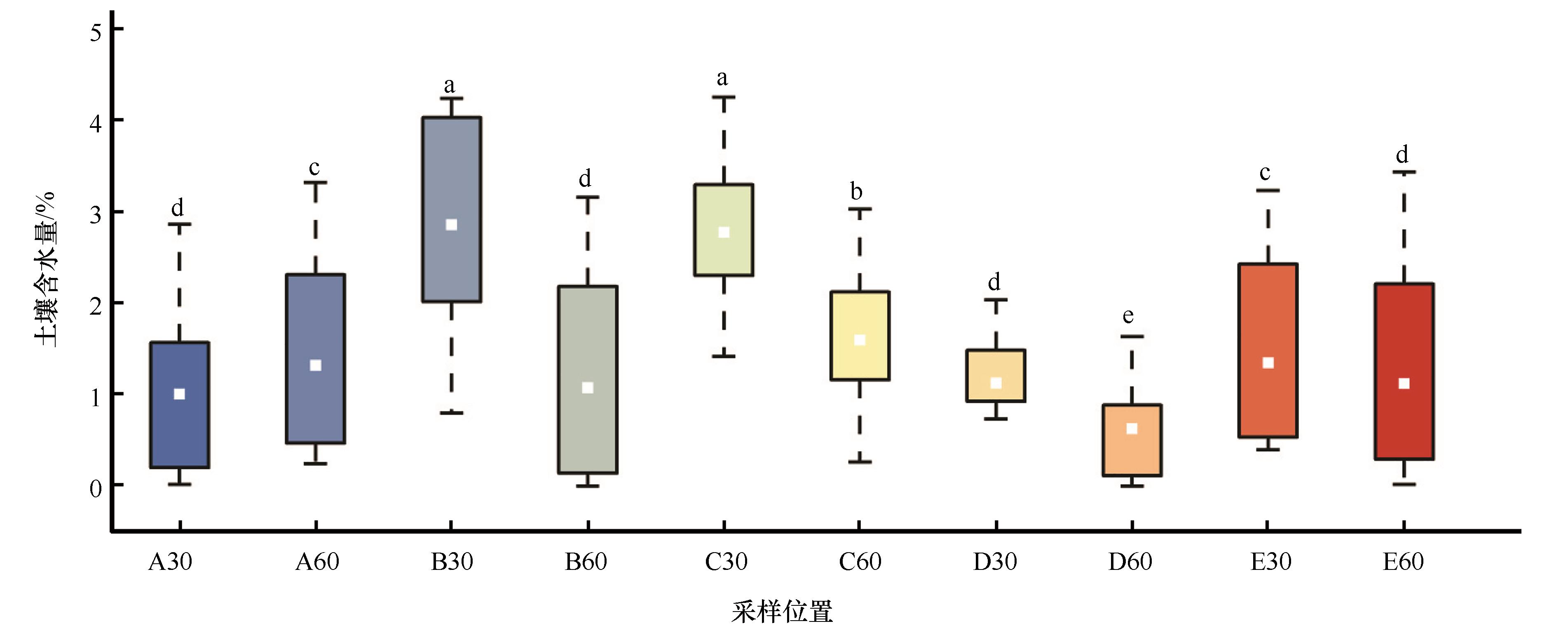
图7 光伏板不同位置土壤含水量箱线图注:A30、B30、C30、D30、E30分别表示距光伏板前檐380 cm和160 cm、前檐正下方、光伏板下正中间、后檐处30 cm深度土壤含水量;A60、B60、C60、D60、E60分别为对应位置60 cm深度土壤含水量
Fig.7 Boxplot of soil water content at different positions of PV panels
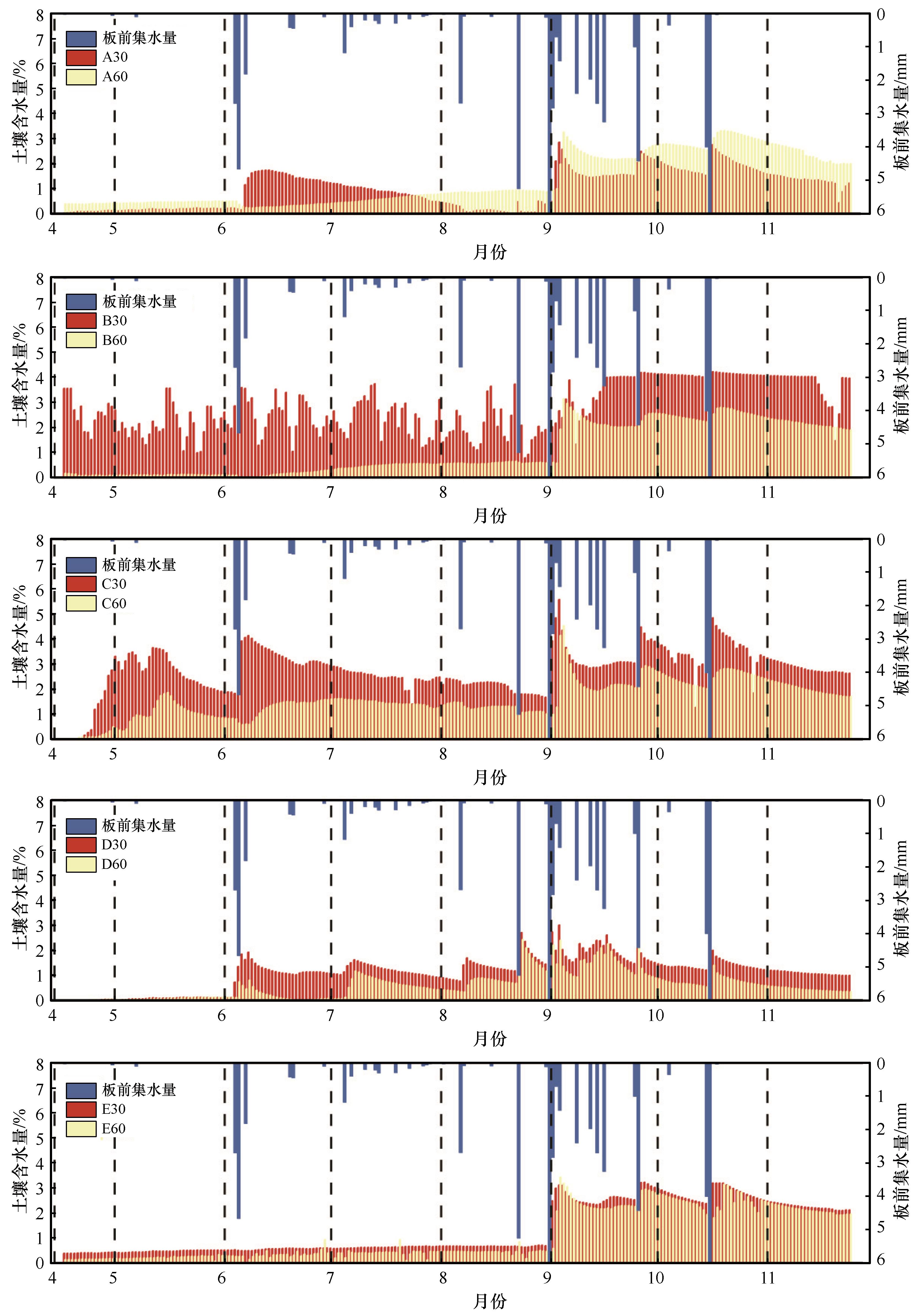
图8 各月份光伏板不同位置表层和深层土壤含水量日动态分布图(2024-04-01—11-30)注:A30、B30、C30、D30、E30分别表示距光伏板前檐380 cm和160 cm、前檐正下方、光伏板下正中间、后檐处30 cm深度土壤含水量;A60、B60、C60、D60、E60分别为对应位置60 cm深度土壤含水量
Fig.8 Monthly daily dynamics of soil moisture content in surface and deep layers at different positions of PV panels (2024-04-01—11-30)
| [1] | 王丽敏,王庆丰,刘晓慧.中国“十四五”时期可再生能源发展预测分析[J].科技管理研究,2024,44(5):209-215. |
| [2] | 姚玉璧,郑绍忠,杨扬,等.中国太阳能资源评估及其利用效率研究进展与展望[J].太阳能学报,2022,43(10):524-535. |
| [3] | 赵延岩,应江,李振朝,等.戈壁光伏电站气象要素特征[J].高原气象,2022,41(4):977-987. |
| [4] | 郑志远,韦志刚,李振朝,等.敦煌荒漠戈壁地区裸土地表反照率参数化研究[J].大气科学,2014,38(2):297-308. |
| [5] | 刘天胜.荒漠化地区大气环境对光伏板发电性能影响研究[D].银川:宁夏大学,2020. |
| [6] | Meng R, Meng Z, Jia R,et al.Positive soil responses to different vegetation restoration measures in desert photovoltaic power stations[J].Frontiers in Plant Science,2025,16:1607404. |
| [7] | Lv S, Wang Z, Liu H,et al.Changes of plant diversity under different functional classifications in desert steppe[J].Global Ecology and Conservation,2025,62:e03851. |
| [8] | 杨世荣,蒙仲举,党晓宏,等.库布齐沙漠生态光伏电站不同覆盖类型下土壤粒度特征[J].水土保持研究,2020,27(1):112-118. |
| [9] | Zhou L, Tian Y, Roy B S,et al.Impacts of wind farms on land surface temperature[J].Nature Climate Change,2012,2(7):539-543. |
| [10] | 王世婷,章妮,陈克龙,等.温性荒漠草原生长季光伏电站地表能量交换特征[J].中国沙漠,2024,44(6):249-257. |
| [11] | 刘坤,王波,张发国,等.光伏电站建设的生态效应:光伏治沙研究进展与展望[J].中国沙漠,2025,45(1):277-291. |
| [12] | 鲍莉莉,李锦荣,韩兆恩,等.基于无人机多源数据的梭梭(Holoxylon ammodendron)地上生物量估算[J].中国沙漠,2024,44(5):50-59. |
| [13] | Tong Y, Ding Q, Xu C,et al.Quantitative analyses of multidimensional ecological impacts of Talatan photovoltaic power plant on desert ecosystems in Northwestern China[J].Environmental Research Letters,2025,20(9):094035. |
| [14] | 石涛,蒙仲举,崔向新,等.库布齐沙漠光伏电站内芦苇沙障的防风固沙效益[J].水土保持通报,2020,40(5):166-171. |
| [15] | 李国庆, Armstrong A,刘哲.光伏电场对地表温度的影响研究[J].太阳能学报,2020,41(12):117-123. |
| [16] | 左强,杨昊天,杨奕颖,等.沙漠光伏建设模式通过土壤水分影响固沙草本植物生长特征[J].中国沙漠,2025,45(3):291-301. |
| [17] | Jubayer M C, Hangan H.Numerical simulation of wind effects on a stand-alone ground mounted photovoltaic (PV) system[J].Journal of Wind Engineering & Industrial Aerodynamics,2014,134:56-64. |
| [18] | Yiben C, Xinle L, Yunqi W,et al.New measures of deep soil water recharge during the vegetation restoration process in semi-arid regions of Northern China[J].Hydrology and Earth System Sciences,2020,24(12):5875-5890. |
| [19] | 白旭赢,王玉杰,王云琦,等.毛乌素沙地水体面积变化及驱动因子[J].中国沙漠,2023,43(2):65-73. |
| [20] | Hernandez R, Easter S, Murphy-Mariscal M,et al.Environmental impacts of utility-scale solar energy[J].Renewable and Sustainable Energy Reviews,2014,29:766-779. |
| [21] | 杨文斌,王涛,熊伟,等.低覆盖度治沙理论的核心水文原理概述[J].中国沙漠,2021,41(3):75-80. |
| [22] | 周火艳,赵晓迪.乌兰布和沙漠沙蒿灌丛的潜在适宜区及其自然驱动力[J].北京林业大学学报,2023,45(2):96-107. |
| [23] | 李博,周瑶,焦晋川,等.光伏板阵列对退化草地生态环境和植被的影响[J].草学,2025(3):42-47. |
| [24] | 王云正,王伊蒙,刘建国,等.巴丹吉林沙漠及周边地区光伏电站适宜性分区与生态建设建议[J].中国沙漠,2025,45(1):173-184. |
| [25] | 吕仁猛.乌兰布和沙漠绿洲农田防护林结构配置及其防风效果研究[D].北京:北京林业大学,2014. |
| [26] | 刘雅丹,郭子健,卢佳雪,等.乌兰布和沙漠东北缘风况环境及不同防沙措施下沉积物粒度特征[J].中国水土保持科学(中英文),2025,23(4):142-153. |
| [27] | 王怡雯,马瑶瑶,史培军,等.干旱区光伏电站运营对局地生态环境的影响[J].干旱区研究,2024,41(8):1423-1433. |
| [28] | 常茜,鹿化煜,吕娜娜,等.1992-2015年中国沙漠面积变化的遥感监测与气候影响分析[J].中国沙漠,2020,40(1):57-63. |
| [29] | 丁延龙,高永,蒙仲举,等.希拉穆仁荒漠草原风蚀地表颗粒粒度特征[J].土壤,2016,48(4):803-812. |
| [30] | 赵鹏宇,高永,党晓宏,等.乌兰布和沙漠东北缘光伏电站表层土壤颗粒空间异质特征[J].内蒙古林业科技,2016,42(2):11-14. |
| [31] | 刘雅婧,王丹阳,常旭,等.光伏电站建设对西北荒漠区生态环境的影响研究进展[J].中国水土保持科学(中英文),2025,23(2):9-17. |
| [32] | Wang Y, Wang C, Li Z,et al.Quantifying greening trends in Talatan Gobi: assessing the distinct impact of photovoltaic power plant construction and climate change through remote sensing[J].Human and Ecological Risk Assessment:An International Journal,2025,31(5/6):761-782. |
| [33] | 王浩,李生宇,王海峰,等.沙漠光伏电站地表蚀积发生机制实验研究[J].干旱区研究,2025,42(2):349-359. |
| [34] | Yan Y, Cheng Y, Xin Z,et al.Impacts of climate change and human activities on vegetation dynamics on the Mongolian Plateau,East Asia from 2000 to 2023[J].Journal of Arid Land,2024,16(8):1062-1079. |
| [35] | 乔慧,蒙仲举.荒漠光伏电站对地表土壤机械组成分布的影响[J].绿色科技,2023,25(8):11-16. |
| [36] | 赵鹏宇.光伏板对地表土壤颗粒及小气候的影响[D].呼和浩特:内蒙古农业大学,2016. |
| [37] | 刘任涛,杨新国,宋乃平,等.荒漠草原区固沙人工柠条林生长过程中土壤性质演变规律[J].水土保持学报,2012,26(4):108-112. |
| [38] | 麻文章,史常青,胡平,等.西北干旱荒漠区典型露天煤矿不同下垫面风沙流特征[J].农业工程学报,2022,38(7):146-154. |
| [39] | 李思瑶,蒙仲举.风水交互作用下乌兰布和沙漠东缘地表沉积物粒度特征[J].水土保持学报,2025,39(4):139-147. |
| [40] | 云景铎,崔向新,蒙仲举,等.库布齐沙漠200 MWp太阳能基地内光伏板下表层土壤粒度特征研究[J].内蒙古林业科技,2019,45(2):22-29. |
| [41] | 田政卿,张勇,刘向,等.光伏电站建设对陆地生态环境的影响:研究进展与展望[J].环境科学,2024,45(1):239-247. |
| [42] | 猛克,蒙仲举.沙漠地区光伏电站典型格状沙障防风固沙综合效益评估[J].中国沙漠,2025,45(5):360-368. |
| [43] | 郝晓珍,于航,吴星叶,等.青藏高原荒漠区典型光伏电站建设对植被属性和土壤性质的影响[J].生态学报,2025,45(11):5510-5526. |
| [44] | 李梦超,屈建军,谭立海,等.毛乌素沙地大型光伏电站对近地表微气象的影响:以陕西省靖边县伊当湾光伏电站为例[J].水土保持通报,2025,45(2):211-222. |
| [45] | 李振洋,张宏伟,尚思汝,等.戈壁光热电站内风沙环境特征及运动规律[J].中国沙漠,2025,45(2):17-28. |
| [46] | 包晓英,党梦娇,钟鑫鑫,等.可追踪式光伏阵列内甘草的生长与生理适应性研究[J].干旱区资源与环境,2023,37(8):162-168. |
| [47] | Velloso A F M, Martins R F, Pereira B E.Case study for hybrid power generation combining hydro and photovoltaic energy resources in the Brazilian semiarid region[J].Clean Technologies and Environmental Policy,2019,21(5):941-952. |
| [48] | 张景波,李新乐,刘雅婧,等.“光伏+生态治理”模式的实践挑战与策略建议[J].中国沙漠,2025,45(5):92-101. |
| [49] | Charabi Y, Gastli A.Integration of temperature and dust effects in siting large PV power plant in hot arid area[J].Renewable Energy,2013,57:635-644. |
| [50] | 翟波,党晓宏,陈曦,等.内蒙古典型草原区光伏板降水再分配与土壤水分蒸散分异规律[J].中国农业大学学报,2020,25(9):144-155. |
| [51] | 吴丽丽,程一本,杨文斌,等.毛乌素沙地流动沙丘不同深度土壤渗漏特征[J].生态学报,2018,38(22):7960-7967. |
| [52] | 朱少康,王珊,张军涛,等.光伏阵列的微气候特征及其对站区植物生长特性的影响[J].生态学杂志,2021,40(10):3078-3087. |
| [53] | 周茂荣,王喜君.光伏电站工程对土壤与植被的影响:以甘肃河西走廊荒漠戈壁区为例[J].中国水土保持科学,2019,17(2):132-138. |
| [54] | 赵晶,关世羽,张有新,等.植被恢复后光伏电站内土壤团聚体分布特征和稳定性研究[J].干旱区资源与环境,2021,35(11):172-177. |
| [55] | Li X, Mauzerall L D, Bergin H M.Global reduction of solar power generation efficiency due to aerosols and panel soiling[J].Nature Sustainability,2020,3(9):720-727. |
| [56] | Brown S C, Bedford B L.Restoration of wetland vegetation with transplanted wetland soil:an experimental study[J].Wetlands,1997,17(3):424-437. |
| [57] | Cheng Y B, Zhan H B, Yang W B,et al.On change of soil moisture distribution with vegetation reconstruction in Mu Us Sandy Land of China,with newly designed Lysimeter[J].Frontiers in Plant Science,2021,12:609529. |
| [1] | 陈炫廷, 周海, 杨淇越, 任珩, 顾虎利, 范明彦. 柠条(Caragana korshinskii)、花棒(Hedysarum scoparium)根系生长对土壤含水量的响应[J]. 中国沙漠, 2026, 46(1): 252-261. |
| [2] | 刁二龙, 曹广超, 刘英, 赵美亮. 黑河源区主要下垫面土壤粒径分形特征及其影响因素[J]. 中国沙漠, 2025, 45(6): 279-288. |
| [3] | 周尚哲, 席磊, 崔梦淳, 崔桂鹏, 孔维远, 高攀, 卢琦. 乌兰布和沙漠北部典型植被的叶蜡正构烷烃特征及指示[J]. 中国沙漠, 2025, 45(5): 45-54. |
| [4] | 曹昱轩, 李锦荣, 杨旭, 娜玛罕, 武恒博, 屈鹏程. 乌兰布和沙漠植被因子对风沙活动特征的影响[J]. 中国沙漠, 2025, 45(2): 37-46. |
| [5] | 李锦荣, 韩兆恩, 崔崴, 金筱霖, 豆春花. 沙丘冻结表面风沙传输特征的风洞模拟研究[J]. 中国沙漠, 2025, 45(1): 229-241. |
| [6] | 雍天, 张金霞, 陈丽娟, 席海洋, 张斌武, 甘开元. 乌兰布和沙漠沿黄河段土壤水盐空间分异特征及其成因[J]. 中国沙漠, 2024, 44(3): 247-258. |
| [7] | 乌友罕, 殷婕, 武子丰, 哈斯额尔敦. 巴丹吉林-乌兰布和沙漠输沙带新月形沙丘动态[J]. 中国沙漠, 2024, 44(2): 78-89. |
| [8] | 李永山, 贾晓鹏, 王海兵, 王建, 马启民. 1966—2019年黄河乌兰布和沙漠宽谷段河道深泓横向摆动特征[J]. 中国沙漠, 2023, 43(5): 59-65. |
| [9] | 甘开元, 张金霞, 陈丽娟, 席海洋, 张斌武, 雍天, 卫雨西. 乌兰布和沙漠沿黄河段植物群落特征及空间分异[J]. 中国沙漠, 2023, 43(4): 180-190. |
| [10] | 李映坤, 李锦荣, 董雷, 罗祥英, 韩兆恩, 王茹. 乌兰布和沙漠周边典型植物群落防风阻沙效果[J]. 中国沙漠, 2022, 42(6): 65-73. |
| [11] | 李星, 马媛, 李星, 高君亮, 辛智鸣, 卢琦. 乌兰布和沙漠植物群落相异性及其影响因素[J]. 中国沙漠, 2022, 42(5): 187-194. |
| [12] | 刘雅莉, 白建华, 熊伟, 韩雨晴, 廉泓林, 郭浩, 辛智鸣, 刘湘杰, 刘怀远. 乌兰布和沙漠梭梭( Haloxylon ammodendron )夜间液流特征及其环境驱动机制[J]. 中国沙漠, 2022, 42(5): 195-203. |
| [13] | 牛震敏, 王乃昂, 温鹏辉, 苏贤保, 于昕冉, 张文佳. 巴丹吉林沙漠湖泊对浅层沙含水量的影响[J]. 中国沙漠, 2022, 42(2): 142-152. |
| [14] | 肖建华, 司建华, 刘淳, 李学军, 席海洋, 鱼腾飞, 张成琦, 赵春彦, 朱猛, 贾冰. 沙漠能源生态圈概念、内涵及发展模式[J]. 中国沙漠, 2021, 41(5): 11-20. |
| [15] | 李亚红, 卜崇峰, 郭琦, 韦应欣. 毛乌素沙地藓、藻结皮生态功能对比[J]. 中国沙漠, 2021, 41(2): 138-144. |
| 阅读次数 | ||||||
|
全文 |
|
|||||
|
摘要 |
|
|||||
©2018中国沙漠 编辑部
地址: 兰州市天水中路8号 (730000)
电话:0931-8267545
Email:caiedit@lzb.ac.cn;desert@lzb.ac.cn


 甘公网安备 62010202000688号