
- CN 62-1070/P
- ISSN 1000-694X
- Bimonthly 1981
Journal of Desert Research ›› 2026, Vol. 46 ›› Issue (4): 333-342.DOI: 10.7522/j.issn.1000-694X.2025.00294
Previous Articles Next Articles
Jiliang Liu1( ), Yongzhen Wang1, Yilin Feng2, Wenzhi Zhao1, Zhibin He1, Xiaogan Zhou3, Xiuzhen Zhao3, Chengchen Pan1()
Received:2025-09-26
Revised:2025-12-16
Online:2026-07-20
Published:2026-08-27
Contact:
Chengchen Pan
CLC Number:
Jiliang Liu, Yongzhen Wang, Yilin Feng, Wenzhi Zhao, Zhibin He, Xiaogan Zhou, Xiuzhen Zhao, Chengchen Pan. Effects of Haloxylon ammodendron afforestation on ground arthropod diversity in mobile sand dunes[J]. Journal of Desert Research, 2026, 46(4): 333-342.
Add to citation manager EndNote|Ris|BibTeX
URL: http://www.desert.ac.cn/EN/10.7522/j.issn.1000-694X.2025.00294
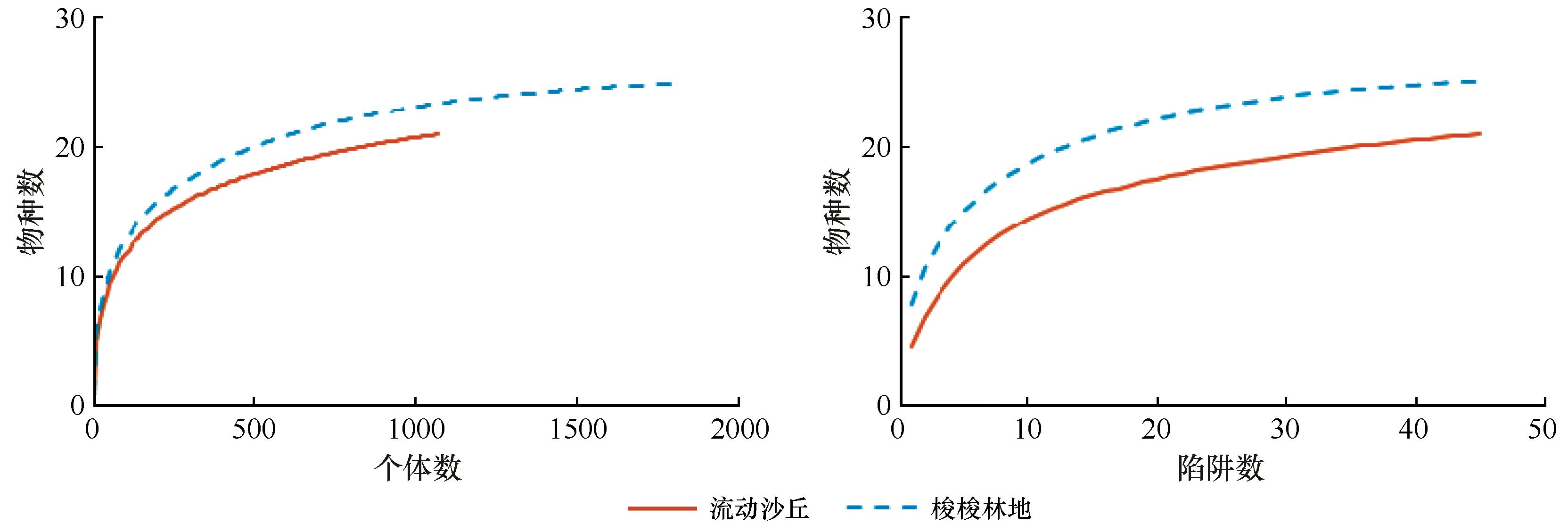
Fig.1 Estimated species richness of ground arthropods based individual and sample rarefaction in the mobile sandy dunes and Haloxylon ammodendron plantations
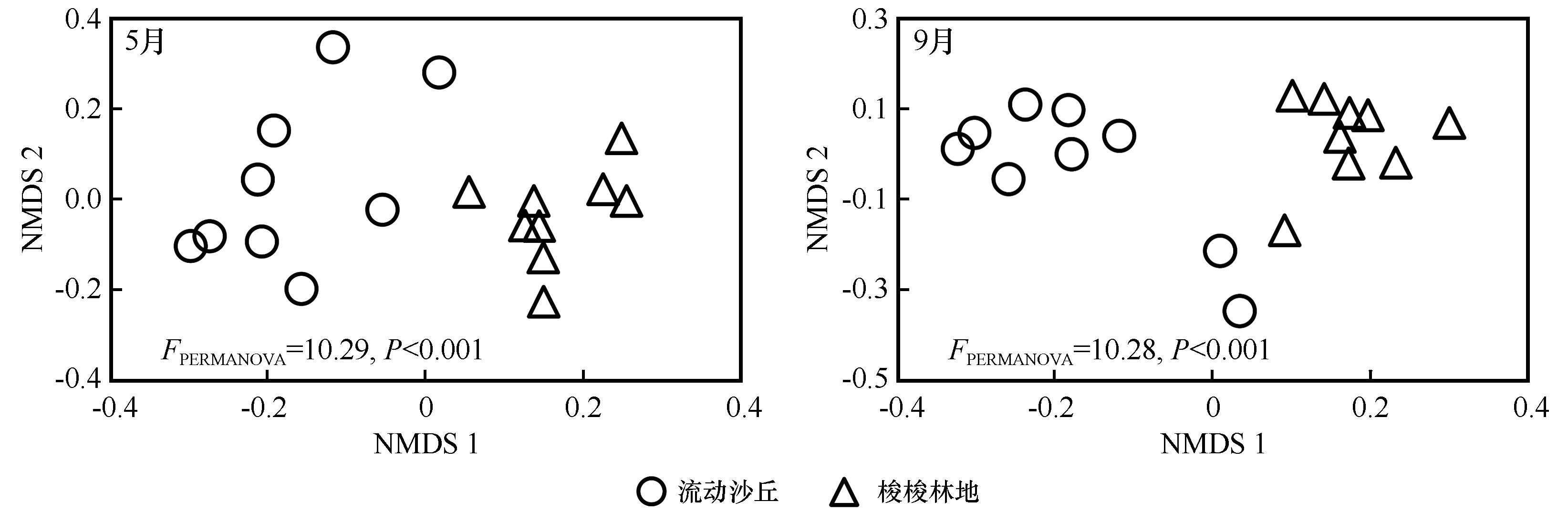
Fig.2 Non-metric multidimensional scaling (NMDS) plots indicating 2-dimensional distances of ground arthropods of the mobile sandy dunes and Haloxylon ammodendron plantations
| 分类 | 项目(物种) | 采样期(SP) | 生境类型(HT) | SP×HT | |||
|---|---|---|---|---|---|---|---|
| F1,36 | P | F1,36 | P | F1,36 | P | ||
| 地表节肢动物 | 数量 | 99.89 | <0.001 | 16.07 | <0.001 | 0.04 | 0.849 |
| 物种丰富度 | 9.79 | 0.004 | 27.79 | <0.001 | 0.24 | 0.626 | |
| 多样性 | 1.3 | 0.263 | 9.28 | 0.005 | 0.27 | 0.608 | |
| 均匀度 | 18.87 | <0.001 | 0.39 | 0.535 | 0.04 | 0.836 | |
| 捕食者 | 数量 | 3.20 | 0.083 | 7.79 | 0.009 | 1.21 | 0.281 |
| 物种丰富度 | 0.89 | 0.353 | 12.97 | <0.001 | 0.89 | 0.353 | |
| 植食者 | 数量 | 0.85 | 0.363 | 3.04 | 0.091 | 0.52 | 0.478 |
| 物种丰富度 | 1.40 | 0.246 | 2.56 | 0.119 | 0.82 | 0.372 | |
| 杂食者 | 数量 | 96.02 | <0.001 | 14.20 | <0.001 | 0.02 | 0.890 |
| 物种丰富度 | 9.26 | 0.005 | 20.17 | <0.001 | 0.89 | 0.351 | |
| 主要地表节肢动物种 | 戈壁琵甲Blaps gobiensis | 2.46 | 0.127 | 37.40 | <0.001 | 0.01 | 0.975 |
| 克氏扁漠甲Sternotrigon kraatzi | 142.09 | <0.001 | 118.99 | <0.001 | 99.12 | <0.001 | |
| 谢氏宽漠王 Mantichorula semenowi | 153.80 | <0.001 | 13.50 | <0.001 | 13.50 | <0.001 | |
| 尖尾东鳖甲 Anatolica mucronata | 83.26 | <0.001 | 24.66 | <0.001 | 0.04 | 0.852 | |
| 东鳖甲属 Anatolica sp. | 42.57 | <0.001 | 70.47 | <0.001 | 0.25 | 0.621 | |
| 巴丹东鳖甲 Anatolica badainica | 2.02 | 0.165 | 6.17 | 0.018 | 0.79 | 0.380 | |
| 平腹蛛 Gnaphosa spp. | 0.01 | 0.938 | 3.22 | 0.082 | 0 | 1.000 | |
| 荒漠收获蚁Messor desertora | 2.45 | 0.128 | 2.45 | 0.128 | 2.45 | 0.128 | |
| 蚁属1种 Formica sp. | 4.91 | 0.034 | 0.003 | 0.958 | 0.04 | 0.843 | |
| 透明箭蚁 Cataglyphis pallida | 5.16 | 0.030 | 0.80 | 0.377 | 0.03 | 0.866 | |
| 艾箭蚁Cataglyphis aenescens | 7.89 | 0.008 | 7.25 | 0.011 | 6.63 | 0.015 | |
Table 1 Results of two-way ANOVA of variance of sampling periods and habitat types effected on community structure, trophic structure, and dominant species of ground arthropods
| 分类 | 项目(物种) | 采样期(SP) | 生境类型(HT) | SP×HT | |||
|---|---|---|---|---|---|---|---|
| F1,36 | P | F1,36 | P | F1,36 | P | ||
| 地表节肢动物 | 数量 | 99.89 | <0.001 | 16.07 | <0.001 | 0.04 | 0.849 |
| 物种丰富度 | 9.79 | 0.004 | 27.79 | <0.001 | 0.24 | 0.626 | |
| 多样性 | 1.3 | 0.263 | 9.28 | 0.005 | 0.27 | 0.608 | |
| 均匀度 | 18.87 | <0.001 | 0.39 | 0.535 | 0.04 | 0.836 | |
| 捕食者 | 数量 | 3.20 | 0.083 | 7.79 | 0.009 | 1.21 | 0.281 |
| 物种丰富度 | 0.89 | 0.353 | 12.97 | <0.001 | 0.89 | 0.353 | |
| 植食者 | 数量 | 0.85 | 0.363 | 3.04 | 0.091 | 0.52 | 0.478 |
| 物种丰富度 | 1.40 | 0.246 | 2.56 | 0.119 | 0.82 | 0.372 | |
| 杂食者 | 数量 | 96.02 | <0.001 | 14.20 | <0.001 | 0.02 | 0.890 |
| 物种丰富度 | 9.26 | 0.005 | 20.17 | <0.001 | 0.89 | 0.351 | |
| 主要地表节肢动物种 | 戈壁琵甲Blaps gobiensis | 2.46 | 0.127 | 37.40 | <0.001 | 0.01 | 0.975 |
| 克氏扁漠甲Sternotrigon kraatzi | 142.09 | <0.001 | 118.99 | <0.001 | 99.12 | <0.001 | |
| 谢氏宽漠王 Mantichorula semenowi | 153.80 | <0.001 | 13.50 | <0.001 | 13.50 | <0.001 | |
| 尖尾东鳖甲 Anatolica mucronata | 83.26 | <0.001 | 24.66 | <0.001 | 0.04 | 0.852 | |
| 东鳖甲属 Anatolica sp. | 42.57 | <0.001 | 70.47 | <0.001 | 0.25 | 0.621 | |
| 巴丹东鳖甲 Anatolica badainica | 2.02 | 0.165 | 6.17 | 0.018 | 0.79 | 0.380 | |
| 平腹蛛 Gnaphosa spp. | 0.01 | 0.938 | 3.22 | 0.082 | 0 | 1.000 | |
| 荒漠收获蚁Messor desertora | 2.45 | 0.128 | 2.45 | 0.128 | 2.45 | 0.128 | |
| 蚁属1种 Formica sp. | 4.91 | 0.034 | 0.003 | 0.958 | 0.04 | 0.843 | |
| 透明箭蚁 Cataglyphis pallida | 5.16 | 0.030 | 0.80 | 0.377 | 0.03 | 0.866 | |
| 艾箭蚁Cataglyphis aenescens | 7.89 | 0.008 | 7.25 | 0.011 | 6.63 | 0.015 | |
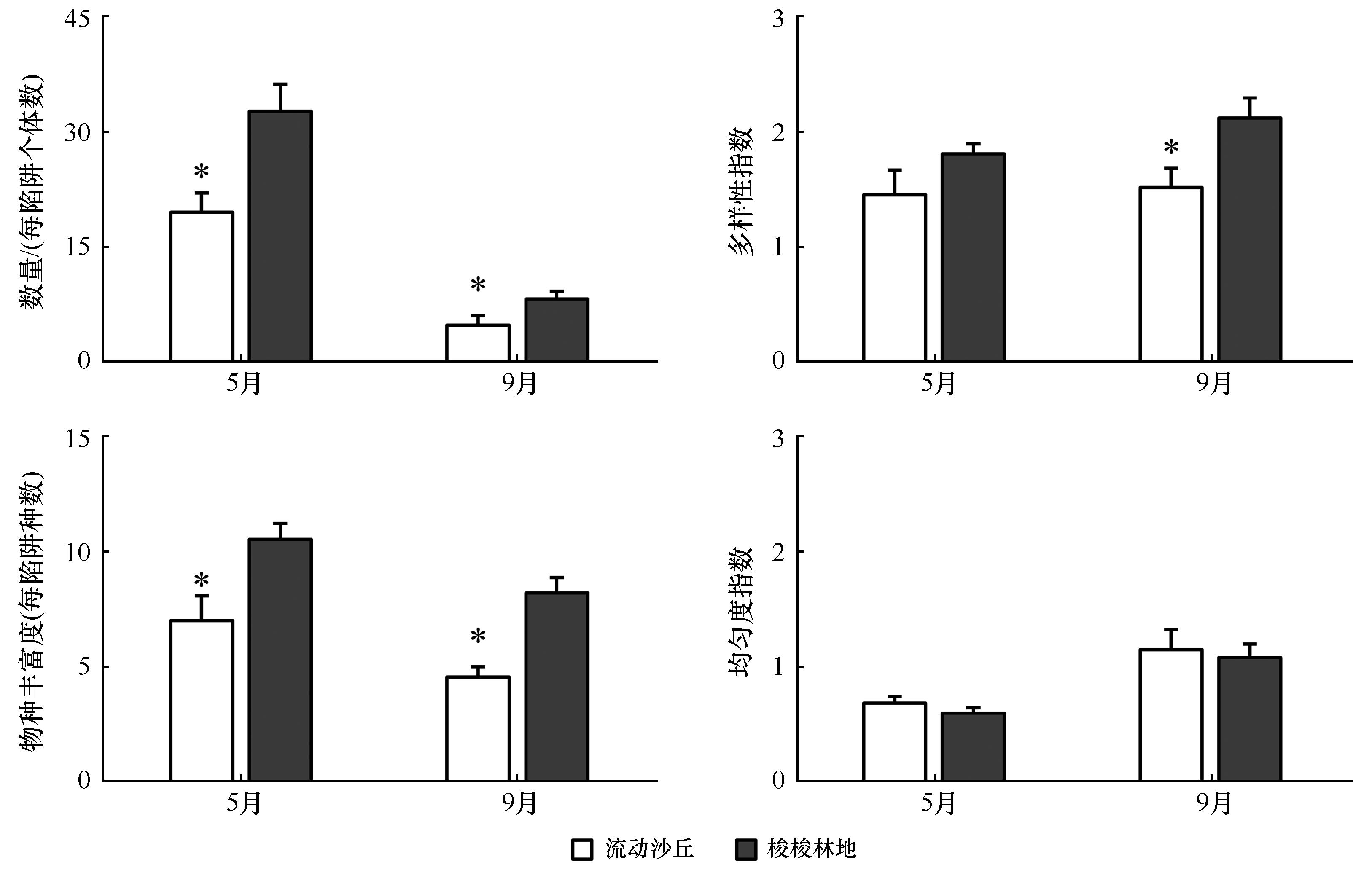
Fig.3 The abundance, species richness, diversity and evenness index of ground arthropods between mobile sandy dunes and Haloxylon ammodendron plantations
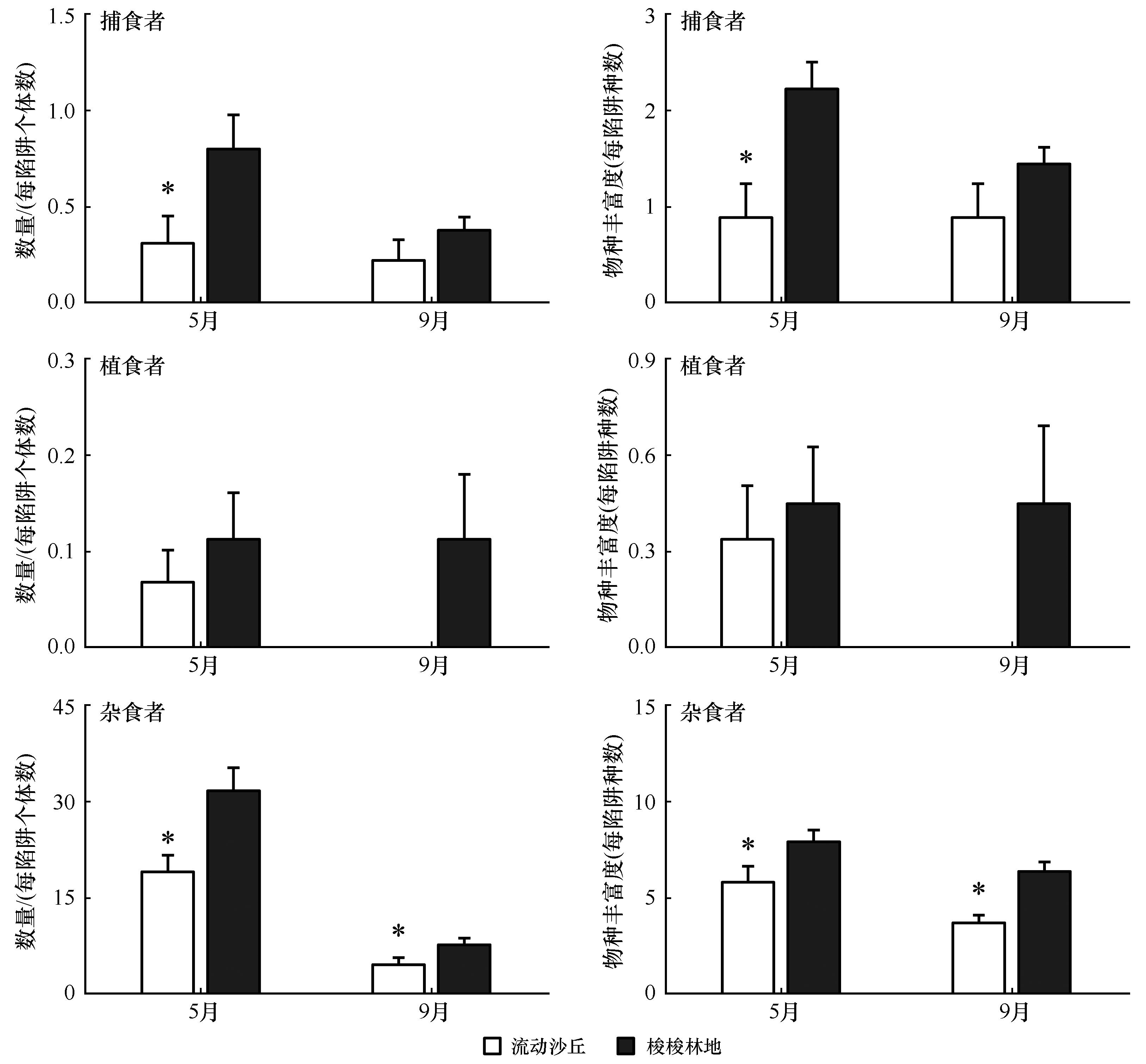
Fig.4 The abundance and species richness of predators, herbivores, and omnivores between mobile sandy dunes and Haloxylon ammodendron plantations
| 主要地表节肢动物种 | 5月 | 9月 | ||
|---|---|---|---|---|
| 流动沙丘 | 梭梭林地 | 流动沙丘 | 梭梭林地 | |
| 戈壁琵甲Blaps gobiensis | 0.11±0.05b | 0.91±0.21a | 0.27±0.07b | 1.13±0.18a* |
| 克氏扁漠甲Sternotrigon kraatzi | 0.24±0.16b | 6.64±1.02a* | 0±0a | 0.09±0.04a |
| 谢氏宽漠王 Mantichorula semenowi | 2.87±0.73b | 10.36±2.78a* | 0±0a | 0±0a |
| 尖尾东鳖甲 Anatolica mucronata | 11.07±2.61a | 4.22±0.73b | 1.62±0.36a* | 0.11±0.08b |
| 东鳖甲属1种 Anatolica sp. | 1.84±0.33b | 7.76±1.25a* | 0.31±0.11b | 2.71±0.61a* |
| 巴丹东鳖甲 Anatolica badainica | 0.87±0.48a | 0.07±0.05a | 0.22±0.11a | 0±0b |
| 平腹蛛 Gnaphosa spp. | 0.11±0.06a | 0.29±0.15a | 0.11±0.07a | 0.24±0.06a |
| 荒漠收获蚁Messor desertora | 0±0a | 0±0a | 0±0a | 0.76±0.61a |
| 蚁属1种 Formica sp. | 0.11±0.09a | 0.07±0.05a | 1.78±1.29a | 1.07±0.63a |
| 透明箭蚁 Cataglyphis pallida | 1.22±0.93a | 0.98±0.42a | 0±0b | 0.20±0.06a |
| 艾箭蚁Cataglyphis aenescens | 0.16±0.10a | 0.16±0.07a | 0.20±0.13b | 1.29±0.36a |
Table 2 The abundance of Dominant arthropod species between mobile sandy dunes (MSD) and Haloxylon ammodendron plantations (HAP) in May and September
| 主要地表节肢动物种 | 5月 | 9月 | ||
|---|---|---|---|---|
| 流动沙丘 | 梭梭林地 | 流动沙丘 | 梭梭林地 | |
| 戈壁琵甲Blaps gobiensis | 0.11±0.05b | 0.91±0.21a | 0.27±0.07b | 1.13±0.18a* |
| 克氏扁漠甲Sternotrigon kraatzi | 0.24±0.16b | 6.64±1.02a* | 0±0a | 0.09±0.04a |
| 谢氏宽漠王 Mantichorula semenowi | 2.87±0.73b | 10.36±2.78a* | 0±0a | 0±0a |
| 尖尾东鳖甲 Anatolica mucronata | 11.07±2.61a | 4.22±0.73b | 1.62±0.36a* | 0.11±0.08b |
| 东鳖甲属1种 Anatolica sp. | 1.84±0.33b | 7.76±1.25a* | 0.31±0.11b | 2.71±0.61a* |
| 巴丹东鳖甲 Anatolica badainica | 0.87±0.48a | 0.07±0.05a | 0.22±0.11a | 0±0b |
| 平腹蛛 Gnaphosa spp. | 0.11±0.06a | 0.29±0.15a | 0.11±0.07a | 0.24±0.06a |
| 荒漠收获蚁Messor desertora | 0±0a | 0±0a | 0±0a | 0.76±0.61a |
| 蚁属1种 Formica sp. | 0.11±0.09a | 0.07±0.05a | 1.78±1.29a | 1.07±0.63a |
| 透明箭蚁 Cataglyphis pallida | 1.22±0.93a | 0.98±0.42a | 0±0b | 0.20±0.06a |
| 艾箭蚁Cataglyphis aenescens | 0.16±0.10a | 0.16±0.07a | 0.20±0.13b | 1.29±0.36a |
| [1] | 常学礼,韩艳,孙小艳,等.干旱区绿洲扩展过程中的景观变化分析[J].中国沙漠,2012,32(3):857-862. |
| [2] | 钱大文,巩杰,贾珍珍.绿洲化-荒漠化土地时空格局变化对比研究:以黑河中游临泽县为例[J].干旱区研究,2016,33(1):80-88. |
| [3] | 赵文智,杨荣,刘冰,等.中国绿洲化及其研究进展[J].中国沙漠,2016,36(1):1-5. |
| [4] | 常学礼,季树新,乔荣荣,等.基于NDVI绿洲-荒漠过渡带宽度识别:以河西走廊中部荒漠绿洲为例[J].生态学报,2020,40(15):5327-5336. |
| [5] | Zhao W Z, Chang X L.The effect of hydrologic process changes on NDVI in the desert-oasis ecotone of the Hexi Corridor[J].Science China Earth Sciences,2014,57(12):3107-3117. |
| [6] | Zhang Y Y, Wang L X, Zhao W Z,et al.Rapid global artificial oasis expansion and consequences in arid regions over the last 20 years.Science Bulletin,2025,70(12):1949-1952. |
| [7] | 冯起,白光祖,李宗省,等.加快构建西北地区生态保护新格局[J].中国科学院院刊,2022,37(10):1457-1470. |
| [8] | 刘继亮,冯怡琳,王永珍,等.黑河中游人工固沙植被恢复对爬行类和兽类动物多样性的影响[J].中国沙漠,2024,44(6):167-177. |
| [9] | 周晓甘,罗永忠,马全林,等.梭梭人工林建植对荒漠土壤特征的长期影响[J].中国沙漠,2025,45(5):68-77. |
| [10] | Wang Z T, Liu J L, Luo Y Z,et al.Changes in tenebrionid beetle and ant assembly influenced by different-aged Haloxylon ammodendron plantations in Northwest China[J].Land Degradation & Development,2025,36(9):2940-2954. |
| [11] | 刘继亮,李锋瑞,刘七军,等.黑河流域干旱荒漠土壤动物群落组成与多样性的季节变异[J].中国沙漠,2010,30(2):342-349. |
| [12] | Ren J L, Feng Y L, Wang Y Z,et al.Spatial and temporal distribution patterns of ants (Hymenoptera:Formicidae) in gobi desert ecosystems,Northwest China[J].Research in Cold and Arid Regions,2024,16(5):229-238. |
| [13] | Ren J L, Zhao W Z, Feng Y L,et al.Temporal and spatial dynamics of tenebrionid beetles (Coleoptera:Tenebrionidae) in the gobi desert,Northwest China[J].Journal of Arid Land,2025,17:112-129. |
| [14] | Polis G.Complex trophic interactions in deserts:an empirical critique of food-web theory[J].The American Naturalist,1991,138(1):123-155. |
| [15] | Vonshak M, Dayan T, Kronfeld-Schor N.Arthropods as a prey resource:patterns of diel,seasonal,and spatial availability[J].Journal of Arid Environments,2009,73(4/5):458-462. |
| [16] | Sagi N, Hawlena D.Arthropods as the engine of nutrient cycling in Arid Ecosystems[J].Insects,2021,12(8):726. |
| [17] | 刘继亮,巴义彬,牛瑞雪,等.河西走廊天然固沙植被区地表甲虫多样性及其对沙漠化的指示作用[J].生态学报,2021,41(13):5435-5445. |
| [18] | 王永珍,林永一,冯怡琳,等.沙障对流动沙丘区地表节肢动物分布及多样性的影响[J].生态学报,2022,42(16):6768-6777. |
| [19] | Ren J L, Wang Y Z, Zhou X G,et al. Haloxylon ammodendron plantations:enhancing multi-trophic arthropod diversity and soil multifunctionality in arid deserts[J].Journal of Environmental Management,2025,393:127140. |
| [20] | Pan C C, Wang Z T, Wang Y Z,et al.Long-term impact of Haloxylon ammodendron plantations on the trophic structure of ground arthropods in a desert-oasis ecotone[J].Global Ecology and Conservation,2025,62:e03786. |
| [21] | 任国栋,于有志.中国荒漠半荒漠的拟步甲科昆虫[M].河北保定:河北大学出版社,1999. |
| [22] | 郑乐怡,归鸿.昆虫分类[M].南京:南京师范大学出版社,1999. |
| [23] | Song D X, Zhu M S, Chen J.The Spiders of China[M].Shijiazhuang:Hebei Science and Technology Publishing House,1999. |
| [24] | Clarke K R, Gorley R N.PRIMER v6:user manual/tutorial (Plymouth routines in multivariate ecological research)[Z].Plymouth:Primer-E Ltd,2006. |
| [25] | Huang N, Li X Y, Liu H Y,et al.Effects of stand structure on ecological benefits and tree growth of Haloxylon ammodendron plantations:a meta-analysis[J].Land Degradation & Development,2024,35:4406-4418. |
| [26] | Zheng Y, Zhao W Z, Zhang G F.Spatial analysis of a Haloxylon ammodendron plantation in an oasis-desert ecotone in the Hexi corridor,northwestern China[J].Forests,2017,8:200. |
| [27] | Liu J L, Zhao W Z, Li F R.Effects of shrub presence and shrub species on ground beetle assemblages (Carabidae,Curculionidae and Tenebrionidae) in a sandy desert,northwestern China[J].Journal of Arid Land,2015,7:110-121. |
| [28] | Groner E, Ayal Y.The interaction between bird predation and plant cover in determining habitat occupancy of darkling beetles[J].Oikos,2001,93(1):22-31. |
| [29] | Batchuluun B, Wunderlich J, Schmitt M.Diversity of beetles (Coleoptera) in natural and planted saxaul forests (Haloxylon ammodendron) in the South Gobi Desert,Mongolia[J].ZooKeys,2020,1000:59-70. |
| [30] | 安芳娇,苏永中,牛子儒,等.干旱区荒漠绿洲过渡带建植梭梭(Haloxylon ammodendron)林后土壤线虫群落演变[J].中国沙漠,2024,44(2):133-142. |
| [31] | 安芳娇,牛子儒,刘婷娜,等.西北荒漠绿洲过渡带土壤细菌结构和氮代谢对梭梭恢复的响应[J].生态学报,2023,43(20):8454-8464. |
| [32] | Freekman D W, Whitford W G, Steinberger Y.Effect of irrigation on nematode population dynamics and activity in desert soils[J].Biology and Fertility of Soils,1987,3(1/2):3-10. |
| [33] | Whitford W G.Abiotic controls on the functional structure of soil food webs[J].Biology and Fertility of Soils,1989,8:1-6. |
| [34] | Ferguson S H, Joly D O.Dynamics of springtail and mite populations:the role of density dependence,predation,and weather[J].Ecological Entomology,2002,27(5):565-573. |
| [35] | Decker O, Egidi E, Hopkins A J,et al.Reintroduction of threatened digging mammals influences soil microbial communities differently along a rainfall gradient[J].Pedobiologia,2023,9-10:150889. |
| [36] | Feng Y L, Wang Y Z, Ren J L,et al.Ground arthropod assemblages shaped by ant nests and shrub microhabitats in Gobi Desert ecosystems[J].Applied Soil Ecology,2025,202:106118. |
| [37] | Kang N, Guo J, Jiang L,et al.Biology,parasitoid complex and potential distribution of saxaul’s dominant defoliators,Teia dubia (Lepidoptera:Lymantriidae)[J].Bulletin of Entomological Research,2022,112:162-170. |
| [38] | Feng Q, Li R, Liu J L,et al.Ground-dwelling arthropod community response to native grassland conversion in a temperate desert of northwestern China[J].Journal of Insect Conservation,2015,19:105-117. |
| [39] | 张大治,于有志,任建治.谢氏宽漠王的生物学特性及行为[J].昆虫知识,2003,40(4):334-339. |
| [40] | 吕昭智,钟晓英,苏延乐,等.中华漠王Platyope proctoleuca chinensis(鞘翅目:拟步甲科)对微生境的选择[J].生态学杂志,2010,29(11):2199-2203. |
| [41] | Ayal Y.Trophic structure and the role of predation in shaping hot desert communities[J].Journal of Arid Environments,2007,68(2):171-187. |
| [42] | Liu J L, Li F R, Liu C A,et al.Influences of shrub vegetation on distribution and diversity of a ground beetle community in a gobi desert ecosystem[J].Biodiversity and Conservation,2012,21:2601-2619. |
| [1] | Xiaogan Zhou, Yongzhong Luo, Quanlin Ma, Jiliang Liu, Jialong Ren, Ziting Wang, Qihan Yan, Chang Qin, Jiaqi Zhai. Long-term effects of the introduction of Haloxylon ammodendron on desert soil characteristics [J]. Journal of Desert Research, 2025, 45(5): 68-77. |
| [2] | Ziting Wang, Jiliang Liu, Yongzhong Luo, Quanlin Ma, Xiaogan Zhou, Xin Luo, Wenzhen Zong. Long-term effects of Haloxylon ammodendron plantations on topsoil carbon, nitrogen, phosphorus stoichiometry and stocks in the desert-oasis ecotone [J]. Journal of Desert Research, 2025, 45(5): 241-252. |
| [3] | Xinping Liu, Hongjiao Hu, Yuhui He, Yuanzhi Xu, Jiaqi Jing, Yao Zhang. Response of key plant populations dynamics to precipitation changes in Horqin Sandy Grassland [J]. Journal of Desert Research, 2025, 45(4): 43-56. |
| [4] | Chang Qin, Jiliang Liu, Jialong Ren, Qihan Yan, Wenzhi Zhao, Jing Fang, Weidong Xin. Short-term response of spiders, mites and springtails to increased rainfall in arid desert ecosystems [J]. Journal of Desert Research, 2025, 45(1): 141-150. |
| [5] | Jiliang Liu, Yilin Feng, Yongzhen Wang, Chengchen Pan, Tianling Bao, Jialong Ren, Wenzhi Zhao. Effects of restoration of artificial sand-fixing vegetation on the diversity of reptiles and mammals in the middle reaches of the Heihe River Basin [J]. Journal of Desert Research, 2024, 44(6): 167-177. |
| [6] | xu Bin. THE TWINSPAN QUANTITATIVE ANALYSIS FOR SAND DUNE PLANT COMMUNITY IN HORQIN SANDY LAND [J]. JOURNAL OF DESERT RESEARCH, 1995, 15(3): 233-236. |
| Viewed | ||||||
|
Full text |
|
|||||
|
Abstract |
|
|||||
©2018Journal of Desert Research
Tel:0931-8267545
Email:caiedit@lzb.ac.cn;desert@lzb.ac.cn
Support:Magtech
