

The influence of vegetation coverage on the wind sand flow structure and sediment transport rate
Received date: 2023-05-19
Revised date: 2023-06-19
Online published: 2024-03-19
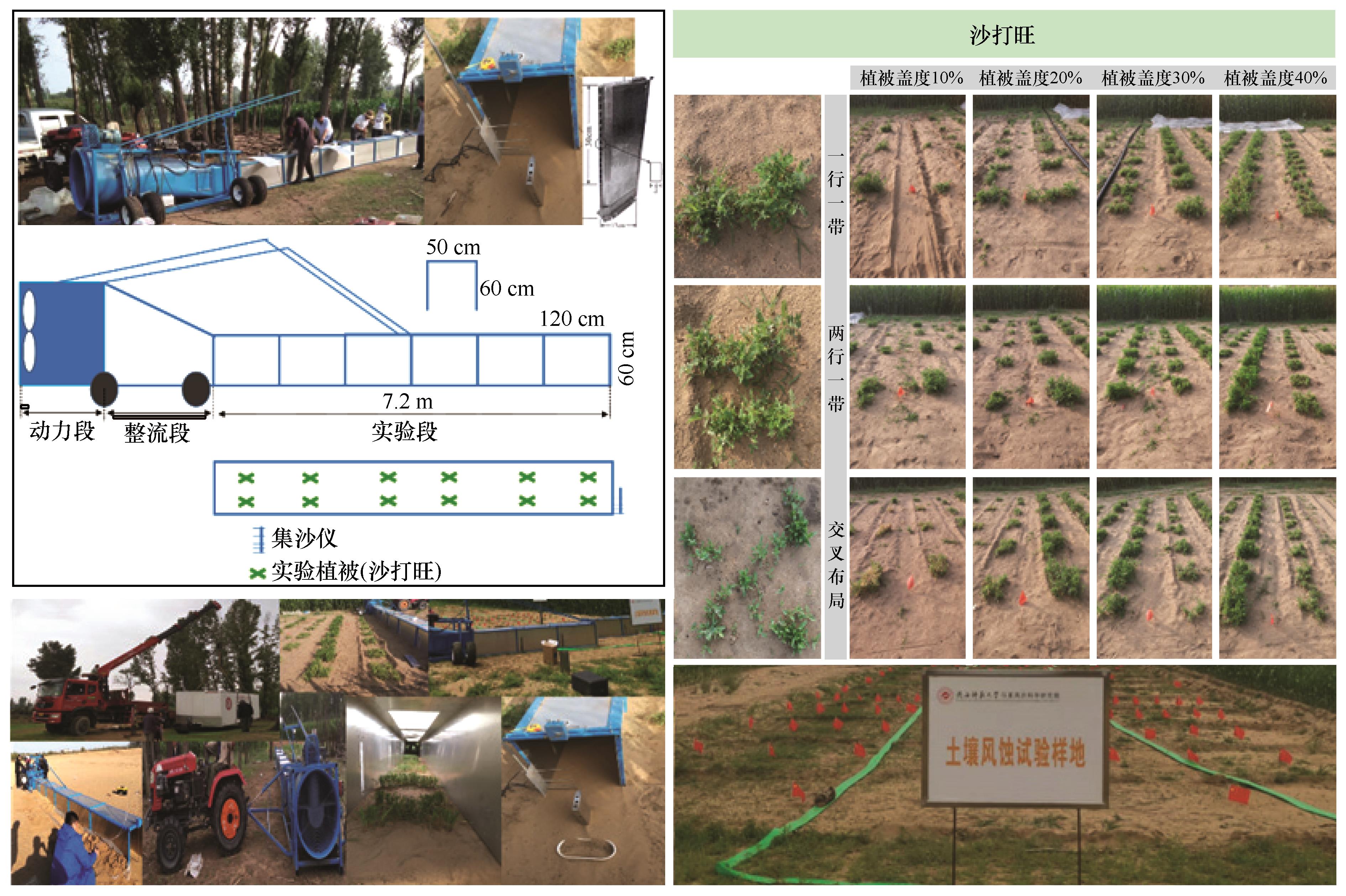
Soil wind erosion is an important threat to the global ecological and environmental security of arid and semi-arid area. Vegetation can effectively reduce the risk of soil wind erosion by reducing wind speed and capturing soil particles. At present, people's understanding of the optimal pattern and coverage of vegetation controlling soil wind erosion still needs to be deepened. With the help of a mobile wind tunnel in the field, this article measured the response of surface sediment transport rate and wind sand flow structure to the coverage of herbaceous plants (Astragalus adsurgens). The results show that: (1) When the vegetation coverage is small, the distribution curve of wind sand flow structure follows the exponential function distribution law. With the increase of vegetation coverage, the curve shape appears differentiation. (2) Vegetation coverage can effectively reduce the intensity of soil wind erosion and raise the height of sand transport. (3) The surface aerodynamic roughness and vegetation coverage follow a logarithmic function variation law, and their growth rate gradually decreases and eventually approaches zero with the increase of vegetation coverage. There is a threshold phenomenon in the aerodynamic roughness of the underlying surface. (4) The optimal coverage of Astragalus adsurgens for controlling soil wind erosion is about 30%, which can effectively suppress about 90% of wind erosion below a height of 20 cm.
Ziyi Bai , Zhibao Dong , Weige Nan , Fengjun Xiao , Chao Li , Tianjie Shao , Lingling Kong , Xiaokang Liu , Aiming Liang , Zheng Chi . The influence of vegetation coverage on the wind sand flow structure and sediment transport rate[J]. Journal of Desert Research, 2024 , 44(2) : 25 -34 . DOI: 10.7522/j.issn.1000-694X.2023.00088
| 1 | Bagnold R A.The Physics of Blown Sand and Desert Dunes[M].London,UK:Methuen,1941:170-172. |
| 2 | Dong Z B, Lv P, Zhang Z C,et al.Aeolian transport in the field:a comparison of the effects of different surface treatments[J].Journal of Geophysical Research,2012,117:D09210. |
| 3 | Dong Z B, Gao S, Fryrear D W.Drag coefficients,roughness length and zero-plane displacement height as disturbed by artificial standing vegetation[J].Journal of Arid Environment,2001,49:485-505. |
| 4 | Burri K, Gromke C, Lehning M,et al.Aeolian sediment transport over vegetation canopies:a wind tunnel study with live plants[J].Aeolian Research,2011,3(2):205-213. |
| 5 | Leenders J K, Boxel J H V, Sterk G.The effect of single vegetation elements on wind speed and sediment transport in the Sahelian zone of Burkina Faso[J].Earth Surface Processes and Landforms,2007,32(10):1454-1474. |
| 6 | Abulaiti A, Kimura R,KodamaY.Effect of flexible and rigid roughness elements on aeolian sand transport [J].Arid Land Research and Management,2017,31:111-124. |
| 7 | Liu J Q, Kimura R J, Miyawaki M,et al.Effects of plants with different shapes and coverage on the blown-sand flux and roughness length examined by wind tunnel experiments[J].Catena,2021,197:104976. |
| 8 | Miri A, Dragovich D, Dong Z B.Vegetation morphologic and aerodynamic characteristics reduce aeolian erosion[J].Scientifc Reports,2017,7(1):12831. |
| 9 | Miri A, Dragovich D, Dong Z B.The response of live plants to airflow:implication for reducing erosion[J].Aeolian Research,2018,33:93-105. |
| 10 | Miri A, Dragovich D, Dong Z B.Wind-borne sand mass flux in vegetated surfaces:wind tunnel experiments with live plants[J].Catena,2019,172:421-434. |
| 11 | Kinugasa T, Sagayama T, Gantsetseg B,et al.Effect of simulated grazing on sediment trapping by single plants:a wind-tunnel experiment with two grassland species in Mongolia[J].Catena,2021,202:105262. |
| 12 | Suter-Burri K, Gromke C, C.Leonard Katherine,et al.Spatial patterns of aeolian sediment deposition in vegetation canopies:observations from wind tunnel experiments using colored sand[J].Aeolian Research,2013,8:65-73. |
| 13 | Bhutto S L, Miri A, Zhang Y,et al.Experimental study on the effect of four single shrubs on aeolian erosion in a wind tunnel[J].Catena,2022,212:106097. |
| 14 | Dong Z B, Liu X P, Wang X M.Aerodynamic roughness of gravel surfaces[J].Geomorphology,2002,43:17-31. |
| 15 | Dong Z B, Liu X P, Wang H T,et al.Aeolian sand transport:a wind tunnel model[J].Sedimentary Geology,2003,161:71-83. |
| 16 | 董治宝,陈渭南,董光荣,等.植被对风沙土风蚀作用的影响[J].环境科学学报,1996(4):437-443. |
| 17 | 邢恩德,马少薇,郭建英,等.植被盖度对典型草原区地表风沙流结构及风蚀量影响[J].水土保持研究,2015,22(6):331-334. |
| 18 | 余沛东,陈银萍,李玉强,等.植被盖度对沙丘风沙流结构及风蚀量的影响[J].中国沙漠,2019,39(5):29-36. |
| 19 | Zhang J M, Yu X X, Jia G D,et al.Determination of optimum vegetation type and layout for soil wind erosion control in desertified land in North China[J].Ecological Engineering,2021,171:106383. |
| 20 | 朱震达.中国沙漠、沙漠化、荒漠化及其治理的对策[M].北京:中国环境科学出版社,1999:108-136. |
| 21 | 吴正.风沙地貌与治沙工程学[M].北京:科学出版社,2003:61-69. |
| 22 | Dong Z B, Luo W Y, Qian G Q,et al.Wind tunnel simulation of the three-dimensional airflow patterns around shrubs[J].Journal of Geophysical Research,2008,113:F02016. |
| 23 | 拓宇.可移动式土壤风蚀风洞的设计与应用[D].西安:陕西师范大学,2021. |
| 24 | 李立国,赵政才.中华人民共和国政区大典·陕西省卷(下)[M].北京:中国社会出版社,2016:1767-1768. |
| 25 | 李超.土壤根系含量对风蚀影响的风洞模拟研究[D].西安:陕西师范大学,2016. |
| 26 | 李刚,韩杰,王帆.风洞变频调速系统对热线风速仪的影响及解决方法研究[J].测控技术,2022,41(11):78-83. |
| 27 | MacDonald R W, Griffiths R F, Hall D J.An improved method for the estimation of surface roughness of obstacle arrays[J].Atmospheric Environment,1998,32:1857-1864. |
| 28 | Meng Z J, Dang X H, Gao Y,et al.Wang,M.Interactive effects of wind speed,vegetation coverage and soil moisture in controlling wind erosion in a temperate desert steppe,Inner Mongolia of China[J].Journal of Arid Land,2018,10:534-547. |
| 29 | 杨文斌,杨红艳,卢琦,等.低覆盖度灌木群丛的水平配置格局与固沙效果的风洞试验[J].生态学报,2008,38(7):2998-3007. |
| 30 | 徐高兴,徐先英,王立,等.梭梭不同密度与配置固沙效果风洞模拟试验[J].干旱区资源与环境,2019,33(9):189-195. |
/
| 〈 |
|
〉 |