中国沙漠 ›› 2026, Vol. 46 ›› Issue (3): 262-274.DOI: 10.7522/j.issn.1000-694X.2026.00047
宋琳琳1,3( ), 和玉君2(), 王斌1,4()
收稿日期:2026-02-23
修回日期:2026-04-06
出版日期:2026-05-20
发布日期:2026-06-11
通讯作者:
和玉君,王斌
作者简介:宋琳琳(1984—),女,辽宁辽阳人,博士研究生,主要从事次季节-季节尺度预测耦合同化研究。E-mail: songlinlin@mail.iap.ac.cn
基金资助:
Linlin Song1,3(), Yujun He2(), Bin Wang1,4()
Received:2026-02-23
Revised:2026-04-06
Online:2026-05-20
Published:2026-06-11
Contact:
Yujun He, Bin Wang
摘要:
次季节至季节(Subseasonal-to-Seasonal, S2S)预测介于短期天气预报与长期气候预测之间,其预报技巧在很大程度上取决于气候系统模式的初始化质量。与短期天气预报信号主要来源于初值、季节至年际预测受初值和外强迫的共同影响不同,S2S预测的可预报性来源于对流层大气快变过程与海洋、陆面、平流层等慢变过程的相互作用。如何在初始化中兼顾不同时间尺度过程、增强系统内部一致性,是提高S2S预测能力的关键。本文综述了S2S预测初始化方法的研究进展,依据耦合程度归纳为非耦合、弱耦合和强耦合初始化三类。基于对国内外主要业务中心18个预测系统的分析,当前弱耦合同化在物理一致性、数值稳定性和预报精度等方面均取得了较好的效果,已成为当前业务初始化系统的主流方向。进一步从MJO、ENSO、平流层—对流层耦合、陆面记忆和海冰等可预报性来源出发,讨论了不同同化策略的作用及其对极端事件次季节预测的影响,并对强耦合同化面临的方法学挑战及未来发展方向进行了展望。
中图分类号:
宋琳琳, 和玉君, 王斌. 次季节至季节(S2S)预测初始化方法及其对预报技巧的影响[J]. 中国沙漠, 2026, 46(3): 262-274.
Linlin Song, Yujun He, Bin Wang. Research progress on initialization methods for subseasonal-to-seasonal (S2S) prediction and their impacts on forecast skill[J]. Journal of Desert Research, 2026, 46(3): 262-274.
| 机构 | 预测系统 | 模式分量 | 初始化 方法 | 大气初始化 | 海洋初始化 | 陆面初始化 | 海冰初始化 | 参考文献 |
|---|---|---|---|---|---|---|---|---|
| BoM | POAMA P24 | 气/海/陆 | 非耦合 | 单独大气模式向再分析资料Nudging | PEODAS再分析资料 | 单独大气模式向再分析资料Nudging | — | ECMWF网站https://confluence.ecmwf.int/display/S2S/ |
| CMA | BCC-CPS-S2Sv2 | 气/海/陆/冰 | 非耦合 | ECMWF分析资料 | EnOI | 无 | OI | |
| 弱耦合 | Nudging | |||||||
| CNR-ISAC | GLOBO 2023.0 | 气/陆 | 非耦合 | ERA5再分析资料 | — | ERA5再分析资料 | — | |
| GEFS分析资料 | GEFS分析资料 | |||||||
| CNRM | S2S-SYS3 | 气/海/陆/冰 | 非耦合 | ERA5再分析资料 | GLORYS12V1再分析资料 | ERA5再分析资料 | 无 | |
| IFS HRES分析资料 | GLO12分析资料 | ECMWF分析资料 | GLO12分析资料 | |||||
| CPTEC | BAM-1.2 | 气/陆 | 非耦合 | ERA-Interim再分析资料 | — | 无 | — | |
| GDS分析资料 | 气候态 | |||||||
| ECCC | GEPS8 | 气/海/陆/冰 | 非耦合 | ERA5再分析资料 | ORAS5再分析资料 | 离线表面预测系统在大气资料强迫下的运行结果 | 数字化海冰图,HadISST | |
| 分析资料 | ECCC分析资料 | 分析资料 | ECCC分析资料 | |||||
| ECMWF | CY49R1 | 气/海/陆/冰/浪 | 非耦合 | ERA5再分析资料 | ORAS5再分析资料 | 无 | 无 | |
| 非耦合 | 4DVar | 3DVar | SEKF | 3DVar | ||||
| HMCR | EK40 | 气/陆 | 非耦合 | ERA5再分析资料 | — | SEKF、OI | — | |
| 3DVar、OI | SEKF | |||||||
| IAP-CAS | CAS-FGOALS-f2-V1.4 | 气/海/陆/冰 | 弱耦合 | Nudging | Nudging | 无 | 无 | |
| JMA | CPS4 | 气/海/陆/冰 | 非耦合 | JRA-3Q再分析资料 | MOVE-G3分析资料 | 单独陆面模式在JRA-3Q大气资料强迫下运行结果 | MOVE-G3分析资料 | |
| GA分析资料 | MOVE-G3分析资料 | 单独陆面模式在JRA-3Q和GA大气资料强迫下运行结果 | MOVE-G3分析资料 | |||||
| KMA | GloSea6-GC3.2 | 气/海/陆/冰 | 非耦合 | ERA-Interim再分析资料 | 英国气象局海洋同化系统 | ERA-Interim再分析资料 | 无 | |
| 4DVar | GODAPS2分析资料 | 单独陆面模式在大气资料强迫下运行结果、KMA数值天气预报全球分析资料 | GODAPS2分析资料 | |||||
| NCEP | CFSv2 | 气/海/陆/冰 | 弱耦合 | 3DVar | 3DVar、Nudging | 半耦合陆面同化系统在CFSR大气同化输出和观测降水强迫下的运行结果 | 同化观测海冰资料 | Saha[ |
| UKMO | GloSea6 | 气/海/陆/冰 | 非耦合 | ERA-Interim再分析资料 | NEMOVAR再分析资料 | ERA-Interim再分析资料 | NEMOVAR再分析资料 | ECMWF网站 |
| 4DVar | 单独陆面模式在大气分析资料强迫下的运行结果 | |||||||
| ECMWF | Cy50r1 | 气/海/陆/冰/浪 | 准强耦合 | En4D-Var+EDA(耦合外循环) | ORAS6集合分析 | 离线(SEKF)+再分析 | 耦合同化 | Laloyaux[ |
| GFDL | SPEAR | 气/海/陆/冰 | 弱耦合 | Nudging | EAKF | 无 | EAKF | Lu[ |
| NASA | GEOS-S2S-3 | 气/海/陆/冰 | 弱耦合 | 3D-EnVar+Replay | LETKF | 离线(Catchment) | 无 | Lim[ |
| Navy | ESPC-E v1 | 气/海/冰 | 弱耦合 | En4D-Var | NCODA 3DVar | — | NCODA 3DVar | Barton[ |
| NUIST | CFS 1.1 | 气/海 | 弱耦合 | Nudging | Nudging | — | — | Wu[ |
表1 S2S预测比较计划最新预测系统及部分其他S2S研究机构后报和实时预测试验的初始化方法
Table 1 Initialization methods in the latest S2S Prediction Project forecasting systems and in hindcast and real-time forecast experiments at several other S2S research centers
| 机构 | 预测系统 | 模式分量 | 初始化 方法 | 大气初始化 | 海洋初始化 | 陆面初始化 | 海冰初始化 | 参考文献 |
|---|---|---|---|---|---|---|---|---|
| BoM | POAMA P24 | 气/海/陆 | 非耦合 | 单独大气模式向再分析资料Nudging | PEODAS再分析资料 | 单独大气模式向再分析资料Nudging | — | ECMWF网站https://confluence.ecmwf.int/display/S2S/ |
| CMA | BCC-CPS-S2Sv2 | 气/海/陆/冰 | 非耦合 | ECMWF分析资料 | EnOI | 无 | OI | |
| 弱耦合 | Nudging | |||||||
| CNR-ISAC | GLOBO 2023.0 | 气/陆 | 非耦合 | ERA5再分析资料 | — | ERA5再分析资料 | — | |
| GEFS分析资料 | GEFS分析资料 | |||||||
| CNRM | S2S-SYS3 | 气/海/陆/冰 | 非耦合 | ERA5再分析资料 | GLORYS12V1再分析资料 | ERA5再分析资料 | 无 | |
| IFS HRES分析资料 | GLO12分析资料 | ECMWF分析资料 | GLO12分析资料 | |||||
| CPTEC | BAM-1.2 | 气/陆 | 非耦合 | ERA-Interim再分析资料 | — | 无 | — | |
| GDS分析资料 | 气候态 | |||||||
| ECCC | GEPS8 | 气/海/陆/冰 | 非耦合 | ERA5再分析资料 | ORAS5再分析资料 | 离线表面预测系统在大气资料强迫下的运行结果 | 数字化海冰图,HadISST | |
| 分析资料 | ECCC分析资料 | 分析资料 | ECCC分析资料 | |||||
| ECMWF | CY49R1 | 气/海/陆/冰/浪 | 非耦合 | ERA5再分析资料 | ORAS5再分析资料 | 无 | 无 | |
| 非耦合 | 4DVar | 3DVar | SEKF | 3DVar | ||||
| HMCR | EK40 | 气/陆 | 非耦合 | ERA5再分析资料 | — | SEKF、OI | — | |
| 3DVar、OI | SEKF | |||||||
| IAP-CAS | CAS-FGOALS-f2-V1.4 | 气/海/陆/冰 | 弱耦合 | Nudging | Nudging | 无 | 无 | |
| JMA | CPS4 | 气/海/陆/冰 | 非耦合 | JRA-3Q再分析资料 | MOVE-G3分析资料 | 单独陆面模式在JRA-3Q大气资料强迫下运行结果 | MOVE-G3分析资料 | |
| GA分析资料 | MOVE-G3分析资料 | 单独陆面模式在JRA-3Q和GA大气资料强迫下运行结果 | MOVE-G3分析资料 | |||||
| KMA | GloSea6-GC3.2 | 气/海/陆/冰 | 非耦合 | ERA-Interim再分析资料 | 英国气象局海洋同化系统 | ERA-Interim再分析资料 | 无 | |
| 4DVar | GODAPS2分析资料 | 单独陆面模式在大气资料强迫下运行结果、KMA数值天气预报全球分析资料 | GODAPS2分析资料 | |||||
| NCEP | CFSv2 | 气/海/陆/冰 | 弱耦合 | 3DVar | 3DVar、Nudging | 半耦合陆面同化系统在CFSR大气同化输出和观测降水强迫下的运行结果 | 同化观测海冰资料 | Saha[ |
| UKMO | GloSea6 | 气/海/陆/冰 | 非耦合 | ERA-Interim再分析资料 | NEMOVAR再分析资料 | ERA-Interim再分析资料 | NEMOVAR再分析资料 | ECMWF网站 |
| 4DVar | 单独陆面模式在大气分析资料强迫下的运行结果 | |||||||
| ECMWF | Cy50r1 | 气/海/陆/冰/浪 | 准强耦合 | En4D-Var+EDA(耦合外循环) | ORAS6集合分析 | 离线(SEKF)+再分析 | 耦合同化 | Laloyaux[ |
| GFDL | SPEAR | 气/海/陆/冰 | 弱耦合 | Nudging | EAKF | 无 | EAKF | Lu[ |
| NASA | GEOS-S2S-3 | 气/海/陆/冰 | 弱耦合 | 3D-EnVar+Replay | LETKF | 离线(Catchment) | 无 | Lim[ |
| Navy | ESPC-E v1 | 气/海/冰 | 弱耦合 | En4D-Var | NCODA 3DVar | — | NCODA 3DVar | Barton[ |
| NUIST | CFS 1.1 | 气/海 | 弱耦合 | Nudging | Nudging | — | — | Wu[ |
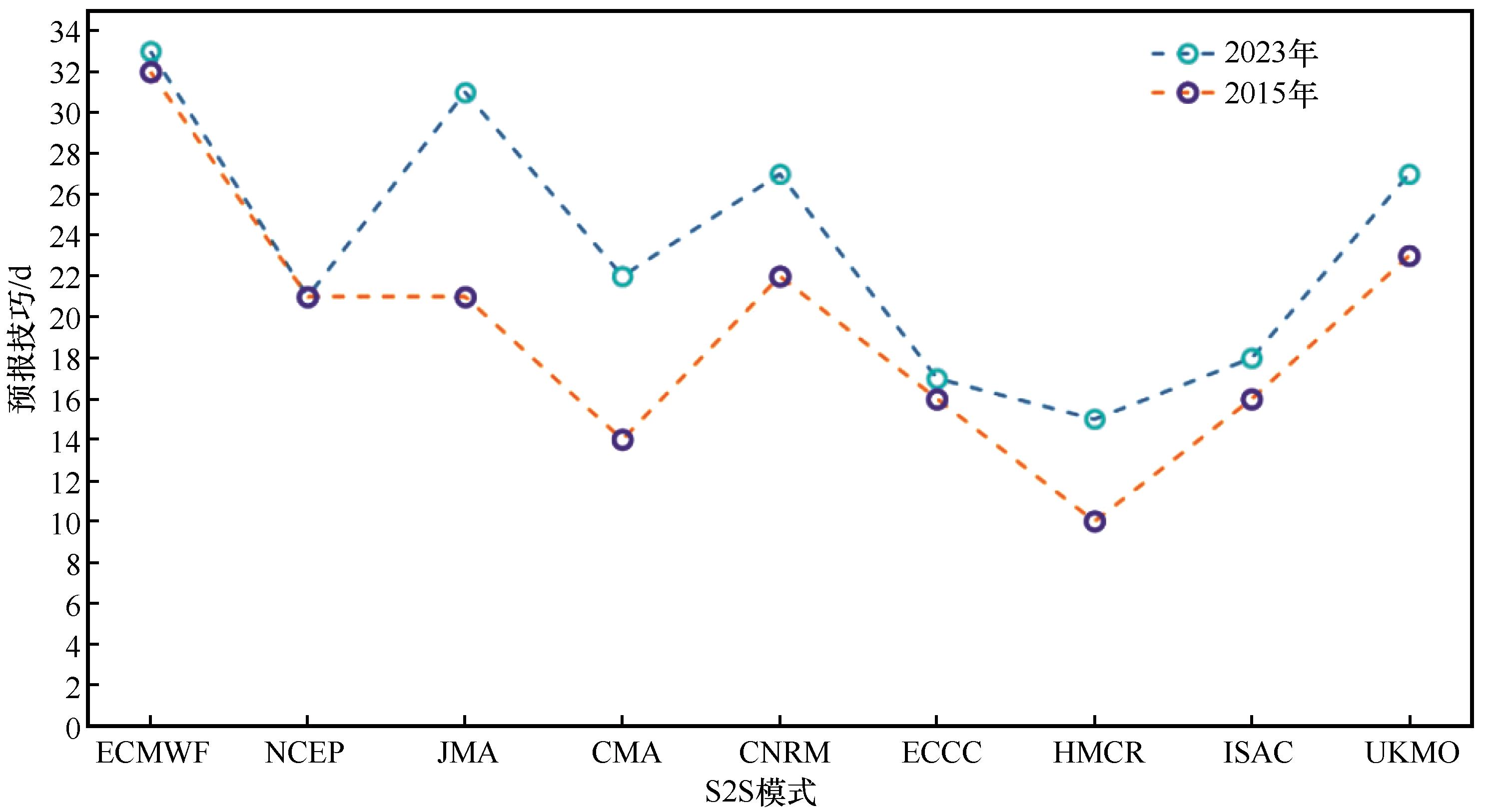
图1 S2S比较计划中各模式的MJO 预报技巧,基于11月至次年3月(1999—2010 年)回报结果,图引自Vitart等人2025年的论文[2]。青色虚线(橙色虚线)分别代表 2023 年(2015 年)所使用的业务预报模型的表现。
Fig. 1 MJO prediction skill of the models in the S2S comparison project, based on hindcasts for November to March (1999-2010). The cyan dashed line and the orange dashed line represent the performance of the operational forecast models used in 2023 and 2015, respectively
| [1] | White C J, Carlsen H, Robertson A W,et al.Potential applications of subseasonal-to-seasonal (S2S) predictions[J].Meteorological Applications,2017,24(3):315-325. |
| [2] | Vitart F, Robertson A W, Brookshaw A,et al.The WWRP/WCRP S2S project and its achievements[J].Bulletin of the American Meteorological Society,2025,106(5):791-808. |
| [3] | Vitart F, Ardilouze C, Bonet A,et al.The subseasonal to seasonal (S2S) prediction project database[J].Bulletin of the American Meteorological Society,2017,98(1):163-173. |
| [4] | Pegion K, Kirtman B P, Becker E,et al.The Subseasonal Experiment (SubX):a multimodel subseasonal prediction experiment[J].Bulletin of the American Meteorological Society,2019,100(10):2043-2060. |
| [5] | Meehl G A, Richter J H, Teng H Y,et al.Initialized Earth system prediction from subseasonal to decadal timescales[J].Nature Reviews Earth & Environment,2021,2(5):340-357. |
| [6] | Mulholland D P, Laloyaux P, Haines K,et al.Origin and Impact of Initialization shocks in coupled atmosphere-ocean forecasts[J].Monthly Weather Review,2015,143(11):4631-4644. |
| [7] | Lea D J, Mirouze I, Martin M J,et al.Assessing a new coupled data assimilation system based on the met office coupled atmosphere-land-ocean-sea ice model[J].Monthly Weather Review,2015,143(11):4678-4694. |
| [8] | Browne P A, De Rosnay P, Zuo H,et al.Weakly Coupled ocean-atmosphere data assimilation in the ECMWF NWP System[J].Remote Sensing,2019,11(3):234. |
| [9] | Trémole Y, Auligné T.The joint effort for data assimilation integration (JEDI)[N].Joint Center for Satellite Data Assimilation (JCSDA) Quarterly Newsletter,2020. |
| [10] | Sluka T C, Penny S G, Kalnay E,et al.Assimilating atmospheric observations into the ocean using strongly coupled ensemble data assimilation[J].Geophysical Research Letters,2016,43(2):752-9. |
| [11] | 鲍艳,吕世华.干旱、半干旱区陆-气相互作用的研究进展[J].中国沙漠,2006,26(3):454-460. |
| [12] | 朱德琴,高晓清,陈文.陆面模式(SSiB)对敦煌荒漠戈壁下垫面陆面过程的模拟及敏感性试验[J].中国沙漠,2006,26(3):466-472. |
| [13] | 程姗岭,于海鹏,任钰,等.中国干旱半干旱区气候异常影响机理研究进展[J].中国沙漠,2023,43(3):21-35. |
| [14] | Penny S G, Akella S, Buehner M,et al.Coupled Data Assimilation for Integrated Earth System Analysis and Prediction:Goals,Challenges,and Recommendations[R].2017. |
| [15] | Zhang S Q, Liu Z Y, Zhang X F,et al.Coupled data assimilation and parameter estimation in coupled ocean-atmosphere models:a review[J].Climate Dynamics,2020,54(11):5127-5144. |
| [16] | Hersbach H, Bell B, Berrisford P,et al.The ERA5 global reanalysis[J].Quarterly Journal of the Royal Meteorological Society,2020,146(730):1999-2049. |
| [17] | Laloyaux P, Balmaseda M, Dee D,et al.A coupled data assimilation system for climate reanalysis[J].Quarterly Journal of the Royal Meteorological Society,2016,142(694):65-78. |
| [18] | Fujii Y, Yoshida T, Sugimoto H,et al.Evaluation of a global ocean reanalysis generated by a global ocean data assimilation system based on a four-dimensional variational (4DVAR) method[J].Frontiers in Climate,2023,4:1019673. |
| [19] | Saha S, Moorthi S, Pan H L,et al.The NCEP climate forecast system reanalysis[J].Bulletin of the American Meteorological Society,2010,91(8):1015-58. |
| [20] | Choi N, Lee M I, Ham Y G,et al.Reducing initialization shock by atmosphere-ocean coupled data assimilation and its impacts on the subseasonal prediction skill[J].Journal of Climate,2025,38(6):1389-1401. |
| [21] | Barton N, Metzger E J, Reynolds C A,et al.The navy's earth system prediction capability:a new global coupled atmosphere-ocean-sea ice prediction system designed for daily to subseasonal forecasting[J].Earth and Space Science,2021,8(4):e2020EA001199. |
| [22] | Mogensen K, Weaver A, Balmaseda M.The NEMOVAR ocean data assimilation system as implemented in the ECMWF ocean analysis for System 4[R]:ECMWF,2012. |
| [23] | Penny S G, Kalnay E, Carton J A,et al.The local ensemble transform Kalman filter and the running-in-place algorithm applied to a global ocean general circulation model[J].Nonlinear Processes in Geophysics,2013,20(6):1031-1046. |
| [24] | Hackert E, Akella S, Ren L,et al.Impact of the TAO/TRITON array on reanalyses and predictions of the 2015 El Niño[J].Journal of Geophysical Research:Oceans,2023,128(11):e2023JC020039. |
| [25] | Liu X, Yao J, Wu T,et al.Development of coupled data assimilation with the BCC climate system model:highlighting the role of sea-ice assimilation for global analysis[J].Journal of Advances in Modeling Earth Systems,2021,13(4):e2020MS002368. |
| [26] | Molod A, Hackert E, Vikhliaev Y,et al.GEOS-S2S Version 2:The GMAO high-resolution coupled model and assimilation system for seasonal prediction[J].Journal of Geophysical Research:Atmospheres,2020,125(5):e2019JD031767. |
| [27] | Liu Y K, Bao Q, He B,et al.Dynamical madden-julian oscillation forecasts using an ensemble subseasonal-to-seasonal forecast system of the IAP-CAS model[J].Geoscientific Model Development,2024,17(16):6249-6275. |
| [28] | Wu T W, Yu R C, Lu Y X,et al.BCC-CSM2-HR:a high-resolution version of the Beijing climate center climate system model[J].Geoscientific Model Development,2021,14(5):2977-3006. |
| [29] | Lu F, Harrison M J, Rosati A,et al.GFDL's SPEAR seasonal prediction system:initialization and ocean tendency adjustment (OTA) for coupled model predictions[J].Journal of Advances in Modeling Earth Systems,2020,12(12):e2020MS002149. |
| [30] | Wu J Y, Li Y, Luo J J,et al.Prediction and predictability of boreal winter MJO using a multi-member subseasonal to seasonal forecast system of NUIST (NUIST CFS 1.1)[J].Climate Dynamics,2024,62(5):3003-3026. |
| [31] | Zeng L J, Bao Q, Wu X F,et al.Impacts of humidity initialization on MJO prediction:a study in an operational sub-seasonal to seasonal system[J].Atmospheric Research,2023,294:106946. |
| [32] | Kettleborough J A, Davis P J, Comer R E,et al.Global seasonal forecasting system 6 (GloSea6):a large ensemble seasonal forecasting system[J].Monthly Weather Review,2026,154(1):39-57. |
| [33] | Buehner M, Caya A, Carrieres T,et al.Assimilation of SSMIS and ASCAT data and the replacement of highly uncertain estimates in the environment canada regional ice prediction system[J].Quarterly Journal of the Royal Meteorological Society,2016,142(695):562-73. |
| [34] | Tondeur M, Carrassi A, Vannitsem S,et al.On Temporal Scale Separation in Coupled Data Assimilation with the Ensemble Kalman Filter[J].Journal of Statistical Physics,2020,179(5):1161-1185. |
| [35] | Kalnay E, Sluka T, Yoshida T,et al.Review article:towards strongly coupled ensemble data assimilation with additional improvements from machine learning[J].Nonlin Processes Geophys,2023,30(2):217-236. |
| [36] | Smith P J, Fowler A M, Lawless A S.Exploring strategies for coupled 4D-Var data assimilation using an idealised atmosphere-ocean model[J].Tellus A:Dynamic Meteorology and Oceanography,2015,67(1):27025. |
| [37] | Smith P J, Lawless A S, Nichols N K.The role of cross-domain error correlations in strongly coupled 4D-Var atmosphere-ocean data assimilation[J].Quarterly Journal of the Royal Meteorological Society,2020,146(730):2450-2465. |
| [38] | Yoshida T, Kalnay E.Correlation-cutoff method for covariance localization in strongly coupled data assimilation[J].Monthly Weather Review,2018,146(9):2881-2889. |
| [39] | Miwa N, Sawada Y.Strongly versus weakly coupled data assimilation in coupled systems with various inter-compartment interactions[J].Journal of Advances in Modeling Earth Systems,2024,16(3):e2022MS003113. |
| [40] | Goodliff M, Penny S G.Developing 4D-Var for strongly coupled data assimilation using a coupled atmosphere-ocean quasigeostrophic model[J].Monthly Weather Review,2022,150(9):2443-2458. |
| [41] | De Andrade F M, Coelho C a S, Cavalcanti I F A.Global precipitation hindcast quality assessment of the Subseasonal to Seasonal (S2S) prediction project models[J].Climate Dynamics,2019,52(9):5451-75. |
| [42] | Liu X F, Zhu Z W, Chen S J,et al.Do the S2S models have prediction skills beyond the weather timescale for winter snowfall over eastern China?[J].Advances in Atmospheric Sciences,2026,43(4):874-888. |
| [43] | Richter J H, Glanville A A, King T,et al.Quantifying sources of subseasonal prediction skill in CESM2[J].npj Climate and Atmospheric Science,2024,7(1):59. |
| [44] | Koster R D, Mahanama S P P, Yamada T J,et al.The Second phase of the global land-atmosphere coupling experiment:soil moisture contributions to subseasonal forecast skill[J].Journal of Hydrometeorology,2011,12(5):805-822. |
| [45] | Demott C A, Klingaman N P, Woolnough S J.Atmosphere-ocean coupled processes in the Madden-Julian oscillation[J].Reviews of Geophysics,2015,53(4):1099-1154. |
| [46] | Bengtsson L, Tulich S N, Dias J,et al.The crucial role of the initial state in MJO prediction[J].Geophysical Research Letters,2025,52(8):e2025GL115833. |
| [47] | Kim H, Janiga M A, Pegion K.MJO Propagation processes and mean biases in the subX and S2S reforecasts[J].Journal of Geophysical Research:Atmospheres,2019,124(16):9314-9331. |
| [48] | Wu J, Ren H L, Lu B,et al.Effects of Moisture Initialization on MJO and its Teleconnection Prediction in BCC Subseasonal Coupled Model[J].Journal of Geophysical Research:Atmospheres,2020,125(1):e2019JD031537. |
| [49] | Webber B G M, Matthews A J, Heywood K J,et al.Ocean Rossby waves as a triggering mechanism for primary Madden-Julian events[J].Quarterly Journal of the Royal Meteorological Society,2012,138(663):514-527. |
| [50] | Christophersen J A, Rydbeck A, Flatau M,et al.Oceanic Rossby wave predictability in ECMWF's subseasonal-to-seasonal reforecasts[J].Quarterly Journal of the Royal Meteorological Society,2024,150(759):1048-1067. |
| [51] | Zheng C, Chang E K-M, Kim H,et al.Subseasonal to seasonal prediction of wintertime northern hemisphere extratropical cyclone activity by S2S and NMME Models[J].Journal of Geophysical Research:Atmospheres,2019,124(22):12057-12077. |
| [52] | Balan-Sarojini B, Balmaseda M A, Vitart F,et al.Impact of ocean in-situ observations on ECMWF sub-seasonal forecasts[J].Frontiers in Marine Science,2024,11:1396491. |
| [53] | Wei H-H, Subramanian A C, Karnauskas K B,et al.The role of in situ ocean data assimilation in ECMWF subseasonal forecasts of sea-surface temperature and mixed-layer depth over the tropical Pacific ocean[J].Quarterly Journal of the Royal Meteorological Society,2023,149(757):3513-3524. |
| [54] | Hackert E, Akella S, Ruiz-Xomchuk V,et al.Impact of rain-adjusted satellite sea surface salinity on ENSO predictions From the GMAO S2S Forecast System[J].Journal of Geophysical Research:Oceans,2025,130(5):e2024JC021773. |
| [55] | Bai H, Li B, Mehra A,et al.The impact of tropical SST biases on the S2S precipitation forecast skill over the contiguous United States in the UFS global coupled model[J].Weather and Forecasting,2023,38(6):937-952. |
| [56] | Domeisen D I V, Butler A H, Charlton-Perez A J,et al.The role of the stratosphere in subseasonal to seasonal prediction:2.predictability arising from stratosphere-troposphere coupling[J].Journal of Geophysical Research:Atmospheres,2020,125(2):e2019JD030923. |
| [57] | Domeisen D I V, Butler A H, Charlton-Perez A J,et al.The role of the stratosphere in subseasonal to seasonal prediction:1.predictability of the stratosphere[J].Journal of Geophysical Research:Atmospheres,2020,125(2):e2019JD030920. |
| [58] | Lawrence Z D, Elsbury D, Butler A H,et al.Evaluation of processes related to stratosphere-troposphere coupling in GEFSv12 Subseasonal hindcasts[J].Monthly Weather Review,2023,151(7):1735-1755. |
| [59] | Lonitz K, Vitart F, Healy S B,et al.Sub-seasonal impact of GNSS radio occultation data[J].Geophysical Research Letters,2025,52(21):e2025GL116068. |
| [60] | Koster R D, Mahanama S P P, Yamada T J,et al.Contribution of land surface initialization to subseasonal forecast skill:first results from a multi-model experiment[J].Geophysical Research Letters,2010,37(2):1-14. |
| [61] | Wedd R, Alves O, De Burgh-Day C,et al.ACCESS-S2:the upgraded bureau of meteorology multi-week to seasonal prediction system[J].Journal of Southern Hemisphere Earth Systems Science,2022,72(3):218-42. |
| [62] | Nair A S, Counillon F, Keenlyside N.Improving subseasonal forecast skill in the norwegian climate prediction model using soil moisture data assimilation[J].Climate Dynamics,2024,62(12):10483-10502. |
| [63] | Ardilouze C, Boone A A.Impact of initializing the soil with a thermally and hydrologically balanced state on subseasonal predictability[J].Climate Dynamics,2024,62(4):2629-2644. |
| [64] | Li W K, Hu S Z, Hsu P-C,et al.Systematic bias of Tibetan Plateau snow cover in subseasonal-to-seasonal models[J].The Cryosphere,2020,14(10):3565-79. |
| [65] | Liu A L, Yang J, Bao Q,et al.Subseasonal-to-seasonal prediction of arctic sea ice using a fully coupled dynamical ensemble forecast system[J].Atmospheric Research,2023,295:107014. |
| [66] | Xiu Y W, Luo H, Yang Q H,et al.The challenge of arctic sea ice thickness prediction by ECMWF on subseasonal time scales[J].Geophysical Research Letters,2022,49(8):e2021GL097476. |
| [67] | Vitart F, Robertson A W.The sub-seasonal to seasonal prediction project (S2S) and the prediction of extreme events[J].npj Climate and Atmospheric Science,2018,1(1):3. |
| [68] | Lee C Y, Camargo S J, Vitart F,et al.Subseasonal tropical Cyclone genesis prediction and MJO in the S2S dataset[J].Weather and Forecasting,2018,33(4):967-988. |
| [69] | Hu J L, Xu J X, Luo J J,et al.Sub-seasonal forecast of global marine heatwaves based on NUIST CFS1.1[J].Advances in Atmospheric Sciences,2025,42(7):1285-300. |
| [70] | Lim Y K, Deangelis A M, Thomas N P,et al.Remote forcing and prediction of the June 2023 Texas heat wave[J].Journal of Climate,2025,38(21):6397-6411. |
| [71] | Lim Y, Molod A M, Koster R D,et al.The role of land-atmosphere coupling in subseasonal surface air temperature prediction across the contiguous United States[J].Hydrology and Earth System Sciences,2025,29(15):3435-45. |
| [72] | Camp J, Gregory P, Marshall A G,et al.Skilful multiweek predictions of tropical cyclone frequency in the Northern Hemisphere using ACCESS-S2[J].Quarterly Journal of the Royal Meteorological Society,2024,150(762):2848-2868. |
| [73] | Lamichhane D, Bao Q, Jin R,et al.Dynamical prediction of sub-seasonal tropical cyclones:IAP-CAS model advances[J].Atmospheric Research,2026,330:108551. |
| [74] | Geer A J.Learning earth system models from observations:machine learning or data assimilation?[J].Philosophical Transactions of the Royal Society A:Mathematical,Physical and Engineering Sciences,2021,379(2194):20200089. |
| [75] | Shlezinger N, Revach G, Ghosh A,et al.Artificial intelligence-aided kalman Filters:AI-Augmented designs for kalman-type algorithms[J].IEEE Signal Processing Magazine,2025,42(3):52-76. |
| [76] | Farchi A, Chrust M, Bocquet M,et al.Online model error correction with neural networks in the incremental 4D-Var framework[J].Journal of Advances in Modeling Earth Systems,2023,15(9):e2022MS003474. |
| [77] | Chen T-C, Penny S G, Whitaker J S,et al.Correcting systematic and state-dependent errors in the NOAA FV3-GFS using neural networks[J].Journal of Advances in Modeling Earth Systems,2022,14(11):e2022MS003309. |
| [78] | Melinc B, Perkan U, Zaplotnik Ž.A unified neural background-error covariance model for midlatitude and tropical atmospheric data Assimilation[J].Journal of Advances in Modeling Earth Systems,2026,18(1):e2025MS005360. |
| [79] | Xue Y, Simon S M, Anderson J R,et al.Advancing NOAA's subseasonal and seasonal applications and enhancing collaboration among stakeholders,modelers,and researchers[J].Bulletin of the American Meteorological Society,2025,106(7):1295-1302. |
| [1] | 刘楷愈, 庄艳丽, 赵文智, 段群滔, 陈白丽, 黄仁杰, 孙婷婷, 罗立辉. 干旱区凝结水时空模拟研究进展[J]. 中国沙漠, 2026, 46(1): 229-241. |
| 阅读次数 | ||||||
|
全文 |
|
|||||
|
摘要 |
|
|||||
©2018中国沙漠 编辑部
地址: 兰州市天水中路8号 (730000)
电话:0931-8267545
Email:caiedit@lzb.ac.cn;desert@lzb.ac.cn


 甘公网安备 62010202000688号