中国沙漠 ›› 2026, Vol. 46 ›› Issue (1): 229-241.DOI: 10.7522/j.issn.1000-694X.2025.00137
• • 上一篇
刘楷愈1,2,4( ), 庄艳丽1,2(), 赵文智1,2, 段群滔3,4, 陈白丽3,4, 黄仁杰3,4, 孙婷婷3,4, 罗立辉3
收稿日期:2025-04-16
修回日期:2025-05-28
出版日期:2026-01-20
发布日期:2026-03-09
通讯作者:
庄艳丽
作者简介:刘楷愈(2001—),男,重庆奉节人,硕士研究生,主要从事干旱区生态水文学研究。E-mail: liukaiyu@nieer.ac.cn
基金资助:
Kaiyu Liu1,2,4(), Yanli Zhuang1,2(), Wenzhi Zhao1,2, Quntao Duan3,4, Baili Chen3,4, Renjie Huang3,4, Tingting Sun3,4, Lihui Luo3
Received:2025-04-16
Revised:2025-05-28
Online:2026-01-20
Published:2026-03-09
Contact:
Yanli Zhuang
摘要:
凝结水是当物体表面温度下降至露点温度后,大气中的气态水在物体表面形成的水源。在水资源有限的干旱区,凝结水是生态系统中重要的水分补给来源。本文系统梳理了凝结水的形成条件和观测方法,探讨了经验模型、物理模型、半经验模型及人工智能算法的适用性与局限性,分析了凝结水量的时间变化规律和空间分布特征及其对气候变化的响应机制,并指出当前时空模拟精度主要受到数据精度、参数简化及下垫面复杂非均质性的限制。在此基础上,提出未来应深化自然下垫面对凝结水的影响机制分析,以提升模型在复杂环境中的适用性,融合多源数据,驱动人工智能算法结合物理模型来模拟凝结水的时空分布规律,并强化在气候变化背景下凝结水生态效应的研究。
中图分类号:
刘楷愈, 庄艳丽, 赵文智, 段群滔, 陈白丽, 黄仁杰, 孙婷婷, 罗立辉. 干旱区凝结水时空模拟研究进展[J]. 中国沙漠, 2026, 46(1): 229-241.
Kaiyu Liu, Yanli Zhuang, Wenzhi Zhao, Quntao Duan, Baili Chen, Renjie Huang, Tingting Sun, Lihui Luo. Progress in spatial and temporal simulation of dew in arid regions[J]. Journal of Desert Research, 2026, 46(1): 229-241.
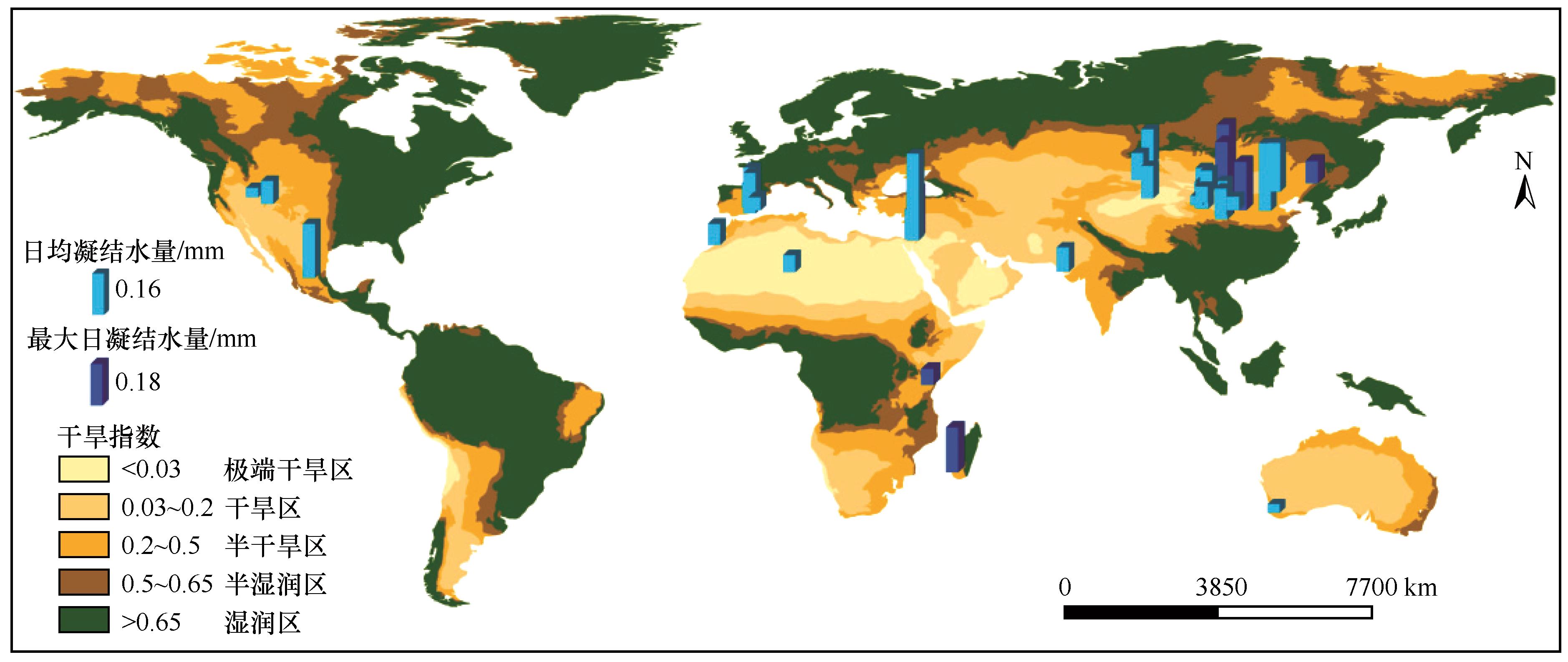
图1 全球凝结水量的观测示意图
Fig.1 Observation of global dew amount
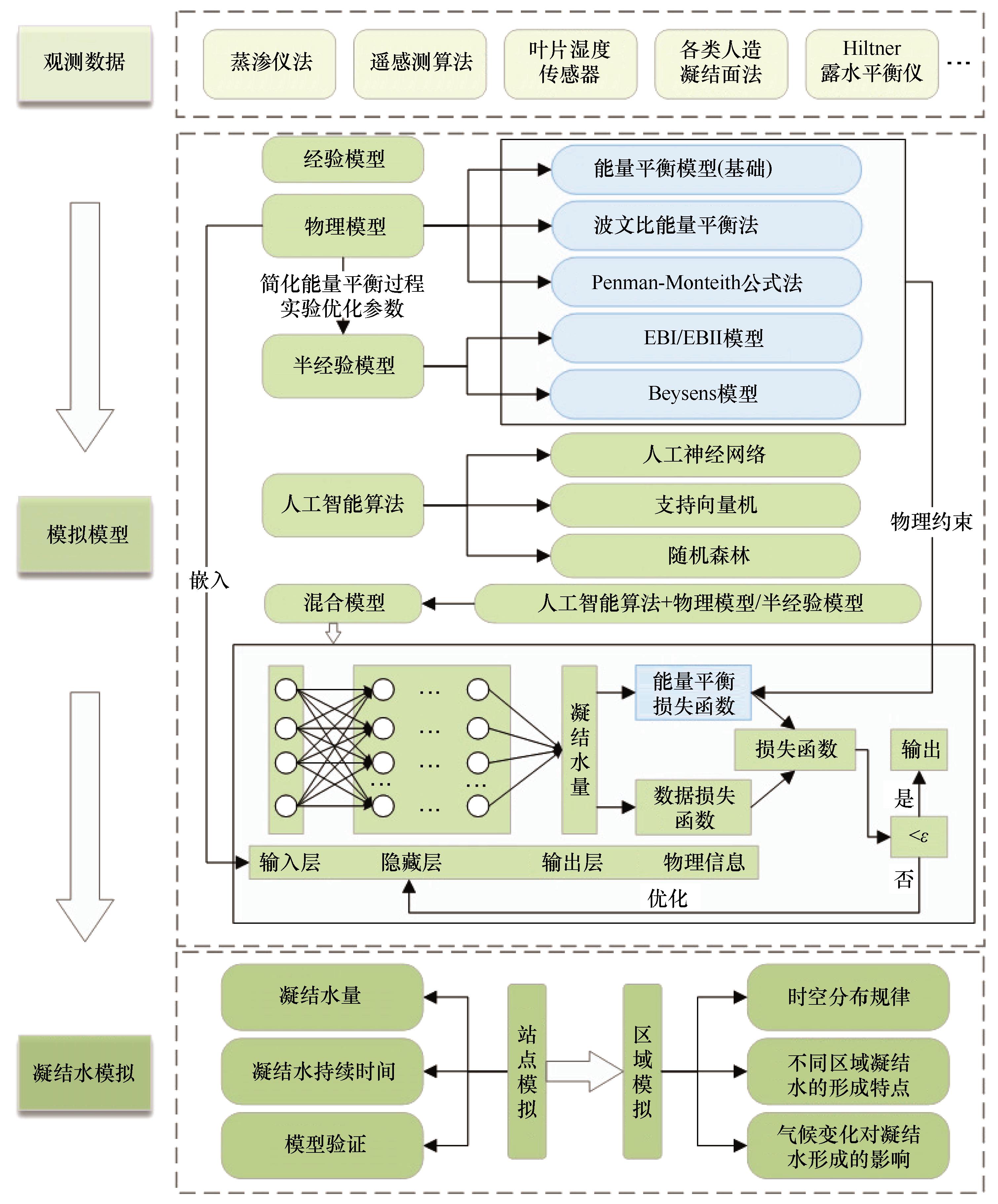
图2 凝结水模拟分析框架
Fig.2 Dew simulation analysis framework
| 模型类型 | 模型名称 | 模型公式 | 输入参数 | 优点 | 缺点 |
|---|---|---|---|---|---|
| 经验模型 | 统计回归模型 | — | 无固定参数输入,选择当地对凝结水形成影响最大的气象因子。通常为常规气象数据(气温、露点温度、风速风向、相对湿度和云量等) | 构建简单,参数易获取,站点模拟精度高 | 气象因子对模型模拟结果影响很大,不适用于区域模拟 |
| 阈值模型 | |||||
| 物理模型 | 能量平衡模型 | Rn=LE+H(叶片表面) Rn=LE+H+G(土壤表面) Rn=Ri+Rhe+Rcond(人造凝结面) | Rn:净辐射;LE:潜热通量;H:显热通量;G:土壤热通量;Ri:凝结面吸收与释放的长波辐射之差;Rhe:凝结面失去的显热;Rcond:凝结水释放的潜热 | 能反映凝结过程中的能量平衡关系 | 模型构建较复杂,计算需要众多参数,且不易获取 |
| Penman-Monteith公式法 | Rn:净辐射;G:土壤热通量;γ:湿度计常数;Δ:饱和蒸汽压随温度的增加;Cn和Cd:随参考作物类型和计算时间步长而变化的常数;U2:2 m高处风速;es:饱和蒸汽压;ea:实际蒸汽压 | 不需要表面温度变量。既考虑了空气动力学和辐射项的作用,又涉及作物的生理特征。可用于区域潜热通量的计算 | 把植物冠层当成整体,不适用于稀疏植被或多种植被覆盖的区域 | ||
| 波文比能量平衡法 | LE:潜热通量;γ:湿度计常数;ΔT和Δea为不同高度冠层的温度差和蒸汽压差 | 计算简单,可模拟植物冠层中凝结水的形成。对大气层没有特别要求和限制,避免了热和蒸汽传导率给模型带来的误差 | 水平衡计算过程中,由于多种因素的影响,易产生误差。只有在开阔均一下垫面才能保证较高精度 | ||
| 涡动相关法 | LE=LE/L | LE:潜热通量;L:汽化潜热(2 450 J·kg-1);D:凝结水量(mm) | 可以直接获取长期的水通量观测数据 | 存在能量不闭合问题,会造成凝结水量的低估 | |
| 半经验模型 | Beysens模型 | H:海拔;Td:露点温度;N:云量;u:10 m处风速;u0:凝结水形成的风速阈值4.4 m·s-1;Ta:气温;b:Td-Ta与露水量的斜率 | 只需要基础的观测数据,适用范围广,可用于区域模拟 | 模型假设的下垫面为发射率为1的凝结面,经验系数不具有普遍适用性 | |
| 人工智能模型 | 人工神经网络模型 | — | 选择对凝结水形成影响较大的影响因子,经过筛选确定输入参数 | 可处理复杂环境下凝结水量与影响因素之间的非线性关系 | 需要大量的训练数据集,对数据质量要求较高 |
| 支持向量机模型 |
表1 主要模拟模型及其优缺点
Table 1 The main simulation models and their advantages and disadvantages
| 模型类型 | 模型名称 | 模型公式 | 输入参数 | 优点 | 缺点 |
|---|---|---|---|---|---|
| 经验模型 | 统计回归模型 | — | 无固定参数输入,选择当地对凝结水形成影响最大的气象因子。通常为常规气象数据(气温、露点温度、风速风向、相对湿度和云量等) | 构建简单,参数易获取,站点模拟精度高 | 气象因子对模型模拟结果影响很大,不适用于区域模拟 |
| 阈值模型 | |||||
| 物理模型 | 能量平衡模型 | Rn=LE+H(叶片表面) Rn=LE+H+G(土壤表面) Rn=Ri+Rhe+Rcond(人造凝结面) | Rn:净辐射;LE:潜热通量;H:显热通量;G:土壤热通量;Ri:凝结面吸收与释放的长波辐射之差;Rhe:凝结面失去的显热;Rcond:凝结水释放的潜热 | 能反映凝结过程中的能量平衡关系 | 模型构建较复杂,计算需要众多参数,且不易获取 |
| Penman-Monteith公式法 | Rn:净辐射;G:土壤热通量;γ:湿度计常数;Δ:饱和蒸汽压随温度的增加;Cn和Cd:随参考作物类型和计算时间步长而变化的常数;U2:2 m高处风速;es:饱和蒸汽压;ea:实际蒸汽压 | 不需要表面温度变量。既考虑了空气动力学和辐射项的作用,又涉及作物的生理特征。可用于区域潜热通量的计算 | 把植物冠层当成整体,不适用于稀疏植被或多种植被覆盖的区域 | ||
| 波文比能量平衡法 | LE:潜热通量;γ:湿度计常数;ΔT和Δea为不同高度冠层的温度差和蒸汽压差 | 计算简单,可模拟植物冠层中凝结水的形成。对大气层没有特别要求和限制,避免了热和蒸汽传导率给模型带来的误差 | 水平衡计算过程中,由于多种因素的影响,易产生误差。只有在开阔均一下垫面才能保证较高精度 | ||
| 涡动相关法 | LE=LE/L | LE:潜热通量;L:汽化潜热(2 450 J·kg-1);D:凝结水量(mm) | 可以直接获取长期的水通量观测数据 | 存在能量不闭合问题,会造成凝结水量的低估 | |
| 半经验模型 | Beysens模型 | H:海拔;Td:露点温度;N:云量;u:10 m处风速;u0:凝结水形成的风速阈值4.4 m·s-1;Ta:气温;b:Td-Ta与露水量的斜率 | 只需要基础的观测数据,适用范围广,可用于区域模拟 | 模型假设的下垫面为发射率为1的凝结面,经验系数不具有普遍适用性 | |
| 人工智能模型 | 人工神经网络模型 | — | 选择对凝结水形成影响较大的影响因子,经过筛选确定输入参数 | 可处理复杂环境下凝结水量与影响因素之间的非线性关系 | 需要大量的训练数据集,对数据质量要求较高 |
| 支持向量机模型 |
| [1] | 程姗岭,于海鹏,任钰,等.中国干旱半干旱区气候异常影响机理研究进展[J].中国沙漠,2023,43(3):21-35. |
| [2] | Huang J P, Yu H P, Guan X D,et al.Accelerated dryland expansion under climate change[J].Nature Climate Change,2016,6(2):166-171. |
| [3] | Tomaszkiewicz M, Abou Najm M, Zurayk R,et al.Dew as an adaptation measure to meet water demand in agriculture and reforestation[J].Agricultural and Forest Meteorology,2017,232:411-421. |
| [4] | 庄艳丽,赵文智.干旱区凝结水研究进展[J].地球科学进展,2008(1):31-38. |
| [5] | Zhuang Y L, Zhao W Z.The ecological role of dew in assisting seed germination of the annual desert plant species in a desert environment,northwestern China[J].Journal of Arid Land,2016,8(2):264-271. |
| [6] | Jacobs A F G, Heusinkveld B G, Berkowicz S M.Dew deposition and drying in a desert system:a simple simulation model[J].Journal of Arid Environments,1999,42(3):211-222. |
| [7] | Dawson T E, Goldsmith G R.The value of wet leaves[J].New Phytologist,2018,219(4):1156-1169. |
| [8] | Wang L X, Kaseke K F, Seely M K.Effects of non-rainfall water inputs on ecosystem functions[J].WIREs Water,2017,4(1):e1179. |
| [9] | Lange O L, Belnap J, Reichenberger H.Photosynthesis of the cyanobacterial soil-crust lichen collema tenax from arid lands in southern utah,USA:role of water content on light and temperature responses of CO2 exchange[J].Functional Ecology,1998,12(2):195-202. |
| [10] | 潘颜霞,张亚峰,虎瑞.吸湿凝结水对荒漠地区生物土壤结皮生态功能的影响综述[J].地球科学进展,2022,37(1):99-109. |
| [11] | Makek E, McCurdy G, Giles B.Dew contribution to the annual water balances in semi-arid desert valleys[J].Journal of Arid Environments.,1999,42(2):71-80. |
| [12] | 郝兴明,美尔汗·黑扎特,朱成刚.塔里木河下游典型胡杨群落大气凝结水的形成规律与数量评估[J].干旱区地理,39(4):785-792. |
| [13] | Pan Y X, Wang X P, Zhang Y F,et al.Dew formation characteristics at annual and daily scale in xerophyte shrub plantations at southeast margin of Tengger Desert,northern China[J].Ecohydrology,2018,11(5):e1968. |
| [14] | Groh J, Slawitsch V, Herndl M,et al.Determining dew and hoar frost formation for a low mountain range and alpine grassland site by weighable lysimeter[J].Journal of Hydrology,2018,563:372-381. |
| [15] | Uclés O, Villagarcía L, Moro M J,et al.Role of dewfall in the water balance of a semiarid coastal steppe ecosystem[J].Hydrological Processes,2014,28(4):2271-2280. |
| [16] | Whitfield J.Water wings aid desert survival[J].Nature,2001.DOI:10.1038/news011101-14 . |
| [17] | Zangvil A.Six years of dew observations in the Negev Desert,Israel[J].Journal of Arid Environments,1996,32(4):361-371. |
| [18] | Lekouch I, Muselli M, Kabbachi B,et al.Dew,fog,and rain as supplementary sources of water in south-western Morocco[J].Energy,2011,36(4):2257-2265. |
| [19] | Hao X M, Li C, Guo B,et al.Dew formation and its long-term trend in a desert riparian forest ecosystem on the eastern edge of the Taklimakan Desert in China[J].Journal of Hydrology,2012,472/473:90-98. |
| [20] | Jia R L, Li X R, Liu L C,et al.Effects of sand burial on dew deposition on moss soil crust in a revegetated area of the Tennger Desert,northern China[J].Journal of Hydrology,2014,519:2341-2349. |
| [21] | Tomaszkiewicz M, Abou Najm M, Beysens D,et al.Dew as a sustainable non-conventional water resource:a critical review[J].Environmental Reviews,2015,23(4):425-442. |
| [22] | 冯天骄,张智起,张立旭,等.干旱半干旱区生态系统凝结水的影响因素及其作用研究进展[J].生态学报,2021,41(2):456-468. |
| [23] | 张强,王胜,问晓梅,等.黄土高原陆面水分的凝结现象及收支特征试验研究[J].气象学报,2012(1):128-135. |
| [24] | 刘文杰,李红梅,段文平.西双版纳地区露水资源分析[J].自然资源学报,1998(1):40-45. |
| [25] | 肖辉杰,张锋,贾瑞燕.凝结水研究进展[J].中国水土保持科学,13(2):126-130. |
| [26] | 王兴,张强,王胜,等.陆面露水凝结预估模型研究进展及面临的主要科学问题与展望[J].干旱气象,2021,39(1):159-167. |
| [27] | Jackson T J, Moy L.Dew effects on passive microwave observations of land surfaces[J].Remote Sensing of Environment,1999,70(2):129-137. |
| [28] | 王胜,张强.黄土高原半干旱区露水形成的大气物理特征研究[J].物理学报,2011,60(5):840-847. |
| [29] | Monteith J L.Dew[J].Quarterly Journal of the Royal Meteorological Society,1957,83(357):322-341. |
| [30] | Kidron G J, Starinsky A.Measurements and ecological implications of non-rainfall water in desert ecosystems:a review[J].Ecohydrology,2019,12(6):e2121. |
| [31] | Beysens D.Estimating dew yield worldwide from a few meteo data[J].Atmospheric Research,2016,167:146-155. |
| [32] | Muselli M, Beysens D, Marcillat J,et al.Dew water collector for potable water in Ajaccio (Corsica Island,France)[J].Atmospheric Research,2002,64(1):297-312. |
| [33] | Kidron G J.Altitude dependent dew and fog in the Negev Desert,Israel[J].Agricultural and Forest Meteorology,1999,96(1):1-8. |
| [34] | Kidron G J.Analysis of dew precipitation in three habitats within a small arid drainage basin,Negev Highlands,Israel[J].Atmospheric Research,2000,55(3):257-270. |
| [35] | 潘颜霞,王新平,张亚峰,等.沙坡头地区地形对凝结水形成特征的影响[J].中国沙漠,2014,34(1):118-124. |
| [36] | 庄艳丽,赵文智.荒漠植物雾冰藜和沙米叶片对凝结水响应的模拟实验[J].中国沙漠,2010,30(5):1068-1074. |
| [37] | 阿拉依·哈那提,刘艳霞,兰海燕.荒漠植物表皮毛的凝结水形成及吸收机制研究进展[J].干旱区研究,2024,41(1):114-123. |
| [38] | 王忠静,张子雄,索滢.干旱区凝结水评估及对水量平衡方程影响[J].水利学报,2019,50(6):710-720. |
| [39] | Sharan G, Beysens D, Milimouk-Melnytchouk I.A study of dew water yields on galvanized iron roofs in Kothara(North-west India)[J].Journal of Arid Environments,2007,69(2):259-269. |
| [40] | Guo X N, Zhang Y, Zha T S,et al.Biophysical controls of dew formation in a typical cropland and its relationship to drought in the North China Plain[J].Journal of Hydrology,2023,617:128945. |
| [41] | Kidron G J, Temina M.The effect of dew and fog on lithic lichens along an altitudinal gradient in the Negev Desert[J].Geomicrobiology Journal,2013,30(4):281-290. |
| [42] | Uclés O, Villagarcía L, Cantón Y,et al.Partitioning of non rainfall water input regulated by soil cover type[J].Catena,2016,139:265-270. |
| [43] | Zhuang Y L, Zhao W Z.Dew formation and its variation in haloxylon ammodendron plantations at the edge of a desert oasis,northwestern China[J].Agricultural and Forest Meteorology,2017,247:541-550. |
| [44] | Moro M J, Were A, Villagarcía L,et al.Dew measurement by eddy covariance and wetness sensor in a semiarid ecosystem of SE Spain[J].Journal of Hydrology,2007,335(3):295-302. |
| [45] | Sharan G, Roy A K, Royon L,et al.Dew plant for bottling water[J].Journal of Cleaner Production,2017,155:83-92. |
| [46] | Maestre-Valero J F, Ragab R, Martínez-Alvarez V,et al.Estimation of dew yield from radiative condensers by means of an energy balance model[J].Journal of Hydrology,2012,460:103-109. |
| [47] | Li H, Han C T, Yang Y,et al.Formation and variations of dew and hoarfrost in the hulu catchment on northeast Qinghai-Tibet Plateau,China[J].Journal of Hydrology:Regional Studies,2022,42:101179. |
| [48] | Lekouch I, Lekouch K, Muselli M,et al.Rooftop dew,fog and rain collection in southwest morocco and predictive dew modeling using neural networks[J].Journal of Hydrology,2012,448:60-72. |
| [49] | Zhang Q, Wang S, Yue P,et al.Variation characteristics of non-rainfall water and its contribution to crop water requirements in China's summer monsoon transition zone[J].Journal of Hydrology,2019,578:124039. |
| [50] | Clus O, Ortega P, Muselli M,et al.Study of dew water collection in humid tropical islands[J].Journal of Hydrology,2008,361(1):159-171. |
| [51] | Aguirre-Gutiérrez C A, Holwerda F, Goldsmith G R,et al.The importance of dew in the water balance of a continental semiarid grassland[J].Journal of Arid Environments,2019,168:26-35. |
| [52] | Yokoyama G, Yasutake D, Wang W,et al.Limiting factor of dew formation changes seasonally in a semiarid crop field of Northwest China[J].Agricultural and Forest Meteorology,2021,311:108705. |
| [53] | Zhuang Y L, Zhao W Z, Luo L H,et al.Dew formation characteristics in the gravel desert ecosystem and its ecological roles on Reaumuria soongorica [J].Journal of Hydrology,2021,603:126932. |
| [54] | Jia Z F, Zhao Z, Zhang Q,et al.Dew yield and its influencing factors at the western edge of Gurbantunggut Desert,China[J].Water,2019,11(4):733. |
| [55] | Maestre-Valero J F, Martin-Gorriz B, Martínez-Alvarez V.Dew condensation on different natural and artificial passive surfaces in a semiarid climate[J].Journal of Arid Environments,2015,116:63-70. |
| [56] | Guo X N, Zha T S, Jia X,et al.Dynamics of dew in a cold desert-shrub ecosystem and its abiotic controls[J].Atmosphere,2016,7(3):32-41. |
| [57] | Wang C, Cen Y, Liu M,et al.Formation and influencing factors of dew in sparse elm woods and grassland in a semi-arid area[J].Acta Ecologica Sinica,2017,37(3):125-132. |
| [58] | Pan Y X, Wang X P, Zhang Y F.Dew formation characteristics in a revegetation-stabilized desert ecosystem in Shapotou area,northern China[J].Journal of Hydrology,2010,387(3):265-272. |
| [59] | Tuure J, Korpela A, Hautala M,et al.Comparison of surface foil materials and dew collectors location in an arid area:a one-year field experiment in Kenya[J].Agricultural and Forest Meteorology,2019,276/277:107613. |
| [60] | Hanisch S, Lohrey C, Buerkert A.Dewfall and its ecological significance in semi-arid coastal south-western Madagascar[J].Journal of Arid Environments,2015,121:24-31. |
| [61] | 张静,张元明,周晓兵,等.生物结皮影响下沙漠土壤表面凝结水的形成与变化特征[J].生态学报,29(12):6600-6608. |
| [62] | 张晓影,李小雁,王卫,等.毛乌素沙地南缘凝结水观测实验分析[J].干旱气象,2008(3):8-13. |
| [63] | 徐莹莹,汤洁,祝惠,等.东北城市露水凝结观测及其与常规气象要素的关系[J].生态学报,2016,37(7):2382-2391. |
| [64] | 郭晓楠,查天山,贾昕,等.典型沙生灌木生态系统凝结水量估算[J].北京林业大学学报,2016,38(10):80-87. |
| [65] | Ninari N, Berliner P R.The role of dew in the water and heat balance of bare loess soil in the Negev Desert:quantifying the actual dew deposition on the soil surface[J].Atmospheric Research,2002,64(1):323-334. |
| [66] | Kidron G J, Kronenfeld R.Microlysimeters overestimate the amount of non-rainfall water:an experimental approach[J].CATENA,2020,194:104691. |
| [67] | Kidron G J, Yair A, Danin A.Dew variability within a small arid drainage basin in the Negev Highlands,Israel[J].Quarterly Journal of the Royal Meteorological Society,2000,126(562):63-80. |
| [68] | Kidron G J, Herrnstadt I, Barzilay E.The role of dew as a moisture source for sand microbiotic crusts in the Negev Desert,Israel[J].Journal of Arid Environments,2002,52(4):517-533. |
| [69] | Zhuang Y L, Zhao W Z.Dew variability in three habitats of a sand dune transect in a desert oasis ecotone,northwestern China[J].Hydrological Processes,2014,28(3):1399-1408. |
| [70] | Wigneron J P, Calvet J C, Kerr Y.Monitoring water interception by crop fields from passive microwave observations[J].Agricultural and Forest Meteorology,1996,80(2):177-194. |
| [71] | Ridley J, Strawbridge F, Card R,et al.Radar backscatter characteristics of a desert surface[J].Remote Sensing of Environment,1996,57(2):63-78. |
| [72] | 马策,蒋小伟,闫宏彬,等.基于红外热成像技术的石窟壁面凝结水形成规律研究[J].水文地质工程地质,2022,49(4):30-36. |
| [73] | 张亚峰,潘颜霞,霍建强,等.人工固沙植被系统生态水文研究进展[J].中国沙漠,2025,45(3):50-59.. |
| [74] | Crowe M J, Coakley S M, Emge R G.Forecasting dew duration at Pendleton,Oregon,using simple weather observations[Z].National Weather Service in Pendleton,1978. |
| [75] | Sentelhas P C, Dalla Marta A, Orlandini S,et al.Suitability of relative humidity as an estimator of leaf wetness duration[J].Agricultural and Forest Meteorology,2008,148(3):392-400. |
| [76] | Pedro M J, Gillespie T J.Estimating dew duration.II.utilizing standard weather station data[J].Agricultural Meteorology,1981,25:297-310. |
| [77] | Pedro M J, Gillespie T J.Estimating dew duration.I.utilizing micrometeorological data[J].Agricultural Meteorology,1981,25:283-296. |
| [78] | Qin Z, Berliner P, Karnieli A.Numerical solution of a complete surface energy balance model for simulation of heat fluxes and surface temperature under bare soil environment[J].Applied Mathematics and Computation,2002,130(1):171-200. |
| [79] | Beysens D, Muselli M, Nikolayev V,et al.Measurement and modelling of dew in island,coastal and alpine areas[J].Atmospheric Research,2005,73(1):1-22. |
| [80] | Nikolayev V S, Beysens D, Gioda A,et al.Water recovery from dew[J].Journal of Hydrology,1996,182(1):19-35. |
| [81] | Jacobs A F G, Heusinkveld B G, Wichink Kruit R J,et al.Contribution of dew to the water budget of a grassland area in the Netherlands[J].Water Resources Research,2006,42(3):1-16. |
| [82] | Madeira A C, Kim K S, Taylor S E,et al.A simple cloud-based energy balance model to estimate dew[J].Agricultural and Forest Meteorology,2002,111(1):55-63. |
| [83] | Jia Z F, Chang Y, Liu H,et al.Characteristics and estimation of dew in the loess hilly region of northern Shaanxi Province,China[J].Sustainability,2024,16(6):2482-2493. |
| [84] | Breiman L.Random forests[J].Machine Learning,2001,45(1):5-32. |
| [85] | 孟德惠,孙适,吴远翔,等.机器学习在生态安全领域中的应用综述[J].生态学报,2024,45(3):1503-1517. |
| [86] | 汪成刚,王波,王琪智,等.城市活力与建成环境的非线性关系和阈值效应研究:以广州市中心城区为例[J].地理科学进展,42(1):79-88. |
| [87] | Karniadakis G E, Kevrekidis I G, Lu L,et al.Physics-informed machine learning[J].Nature Reviews Physics,2021,3(6):422-440. |
| [88] | Meng C, Seo S, Cao D,et al.When physics meets machine learning:a survey of physics-informed machine learning[J].Machine Learning for Computational Science and Engineering,2025,1(1):1-23. |
| [89] | 刘肖廷,闵建,于相楠,等.物理信息神经网络的应用与研究进展[J].河南科学,2024,42(7):945-959. |
| [90] | Liu X, Peng W, Gong Z,et al.Temperature field inversion of heat-source systems via physics-informed neural networks[J].Engineering Applications of Artificial Intelligence,2022,113:104902. |
| [91] | Glenn D M, Feldhake C, Takeda F,et al.The dew component of strawberry evapotranspiration[J].HortScience,1996,31(6):947-950. |
| [92] | Li H Y, Chen R S, Han C T,et al.Evaluation of the spatial and temporal variations of condensation and desublimation over the Qinghai-Tibet Plateau based on penman model using hourly ERA5-land and ERA5 reanalysis datasets[J].Remote Sensing,2022,14(22):5815-5824. |
| [93] | Guo X N, Liu X Y, Shang G F,et al.Spatio-temporal variations in dew and its relevance to drought in the Beijing-Tianjin-Hebei Region of China[J].International Journal of Remote Sensing,2024,45(190):6934-6953. |
| [94] | Suo Y, Wang Z J, Zhang Z,et al.Accessible remote sensing data mining based dew estimation[J].Remote Sensing,2022,14(22):5653-5661. |
| [95] | Zhang S Y, Li J Z, Zhang T,et al.How does dewfall affect drought assessment in different climate regions in China[J].Journal of Hydrology,2023,616:128601. |
| [96] | Xu Y Y, Yan B, Tang J.The effect of climate change on variations in dew amount in a paddy ecosystem of the Sanjiang Plain,China[J].Advances in Meteorology,2015,2015(1):793107. |
| [97] | Jia Z F, Wang Z, Wang H.Characteristics of dew formation in the semi-arid Loess Plateau of central Shaanxi Province,China[J].Water,2019,11(1):126-135. |
| [98] | Atashi N, Rahimi D, Al Kuisi M,et al.Modeling long-term temporal variation of dew formation in Jordan and its link to climate change[J].Water,2020,12(8):2186-2198. |
| [99] | Yang Y T, Roderick M L, Guo H,et al.Evapotranspiration on a greening earth[J].Nature Reviews Earth and Environment,2023,4(9):626-641. |
| [100] | Dou Y, Quan J, Jia X,et al.Near-surface warming reduces dew frequency in China[J].Geophysical Research Letters,2021,48(7):e2020GL091923. |
| [101] | Muselli M, Lekouch I, Beysens D.Physical and chemical characteristics of dew and rain in North-west Africa with focus on morocco:mapping past and future evolution (2005–2100)[J].Atmosphere,2022,13(12):1974-1983. |
| [102] | Tomaszkiewicz M, Abou Najm M, Beysens D,et al.Projected climate change impacts upon dew yield in the Mediterranean Basin[J].Science of the Total Environment,2016:566-567:1339-1348. |
| [103] | Rasoafaniry A, Muselli M, Beysens D.Dew and rain evolution from climate change in semi-arid south-western Madagascar between 1991 and 2033 (extrapolated)[J].Atmosphere,2024,15(7):784-796. |
| [104] | Budhbhatti R, Roy A K, Muselli M,et al.Evolution of dew and rain water resources in Gujarat (India) between 2005 and 2021[J].Atmosphere,2024,15(8):989-996. |
| [105] | Valjarević A, Milanović M, Valjarević D,et al.Geographical information systems and remote sensing methods in the estimation of potential dew volume and its utilization in the United Arab Emirates[J].Arabian Journal of Geosciences,2021,14(15):1430-1442. |
| [106] | Vuollekoski H, Vogt M, Sinclair V A,et al.Estimates of global dew collection potential on artificial surfaces[J].Hydrology and Earth System Sciences,2015,19(1):601-613. |
| [107] | Qiao N, Wang L, Marais E,et al.Fog detection and estimation using CALIPSO Lidar observations[J].Geophysical Research Letters,2022,49(24):e2022GL101375. |
| [108] | 张桔云.运用机器学习整合卫星资料量化亚热带日间山地云雾森林之云雾时空分布[D].台北:台湾大学,2023. |
| [109] | 陈丽晶,张镭,梁捷宁,等.半干旱区不同下垫面大气湍流通量比较分析[J].高原气象,2017,36(5):1325-1335. |
| [1] | 庄艳丽, 赵文智, 刘楷愈. 荒漠凝结水形成过程及其生态水文效应研究进展[J]. 中国沙漠, 2026, 46(1): 162-174. |
| [2] | 马登科, 赵文智, 何志斌. 人工防风固沙生态系统中的植被结构研究进展[J]. 中国沙漠, 2026, 46(1): 199-208. |
| [3] | 杨荣, 苏永中, 张勇勇, 陈龙飞. 干旱区土壤过程与绿洲农业可持续研究进展[J]. 中国沙漠, 2026, 46(1): 20-29. |
| [4] | 邓心茹, 别强, 黄春林, 石莹, 李欣璋. 干旱区典型绿洲景观格局的冷岛效应[J]. 中国沙漠, 2025, 45(6): 12-25. |
| [5] | 王海仙, 张勇勇, 康文蓉, 肖建华, 王淑敏, 魏淑娥, 吴绍雄. 干旱半干旱区典型植被类型蒸散比及土壤水分阈值[J]. 中国沙漠, 2025, 45(6): 289-299. |
| [6] | 牟晓明, 黑婷, 贾荣亮, 王旭洋, 陈国鹏, 李玉强. 治沙模式对科尔沁沙地植被和生物土壤结皮的短期影响[J]. 中国沙漠, 2025, 45(4): 118-129. |
| [7] | 南益聪, 霍建强, 韩高玲, 周元贞, 赵自强, 张志山. 干旱区植物水力传导与抗旱性研究进展[J]. 中国沙漠, 2025, 45(3): 113-120. |
| [8] | 牧仁, 乔俊, 徐光甫, 韩进夫, 俞潇, 孔垂玖, 李新乐. 石墨烯添加对干旱区牧草生长及土壤养分的影响[J]. 中国沙漠, 2025, 45(2): 155-165. |
| [9] | 马登科, 何志斌, 赵文智, 杜军, 孙玮皓, 王帅, 李睿, 刘冰. 干旱区沙生药用植物生态效益综述[J]. 中国沙漠, 2025, 45(1): 55-62. |
| [10] | 方进, 刘任涛, 赵璇, 杨敏. 绿洲农田中小型土壤动物多样性与功能群结构对土壤质地的响应[J]. 中国沙漠, 2024, 44(6): 155-166. |
| [11] | 段瑞兵, 张瑞, 王乐乐, 张亚鑫, 杨战, 董雪, 马迎宾. 乌兰布和沙漠10种植物叶片PV曲线水分参数与解剖特征关系[J]. 中国沙漠, 2024, 44(5): 205-216. |
| [12] | 卢建男, 李玉强, 赵学勇, 李宝成, 王旭洋, 张蕊. 半干旱区典型沙地生态环境演变特征及沙漠化防治建议[J]. 中国沙漠, 2024, 44(4): 284-292. |
| [13] | 张腾, 苗运法, 邹亚国, 张孜越, 冯国平. 极端干旱区苏干湖湿地植被分类与变化分析[J]. 中国沙漠, 2024, 44(4): 81-90. |
| [14] | 卫雨西, 陈丽娟, 冯起, 席海洋, 郭瑞, 张成琦. 干旱区盐碱土微生物特征及其影响因素研究进展[J]. 中国沙漠, 2024, 44(3): 18-30. |
| [15] | 万雨晨, 刘彦平, 吴永胜, 贾鸿飞, 张甜, 高艳红, 杨昊天, 尤万学, 杜军, 贾荣亮. 腾格里沙漠人工固沙植被区藓类植物形态演变特征[J]. 中国沙漠, 2024, 44(3): 298-307. |
| 阅读次数 | ||||||
|
全文 |
|
|||||
|
摘要 |
|
|||||
©2018中国沙漠 编辑部
地址: 兰州市天水中路8号 (730000)
电话:0931-8267545
Email:caiedit@lzb.ac.cn;desert@lzb.ac.cn


 甘公网安备 62010202000688号