
- CN 62-1070/P
- ISSN 1000-694X
- Bimonthly 1981
Journal of Desert Research ›› 2026, Vol. 46 ›› Issue (1): 151-161.DOI: 10.7522/j.issn.1000-694X.2025.00324
Weicheng Luo1( ), Wenzhi Zhao1(), Bing Liu1, Hai Zhou1, Jiliang Liu1, Jiayi Liu1,2
Received:2025-11-23
Revised:2025-12-23
Online:2026-01-20
Published:2026-03-09
Contact:
Wenzhi Zhao
CLC Number:
Weicheng Luo, Wenzhi Zhao, Bing Liu, Hai Zhou, Jiliang Liu, Jiayi Liu. The progress on the development process and driving mechanisms of nebkhas in arid regions[J]. Journal of Desert Research, 2026, 46(1): 151-161.
Add to citation manager EndNote|Ris|BibTeX
URL: http://www.desert.ac.cn/EN/10.7522/j.issn.1000-694X.2025.00324
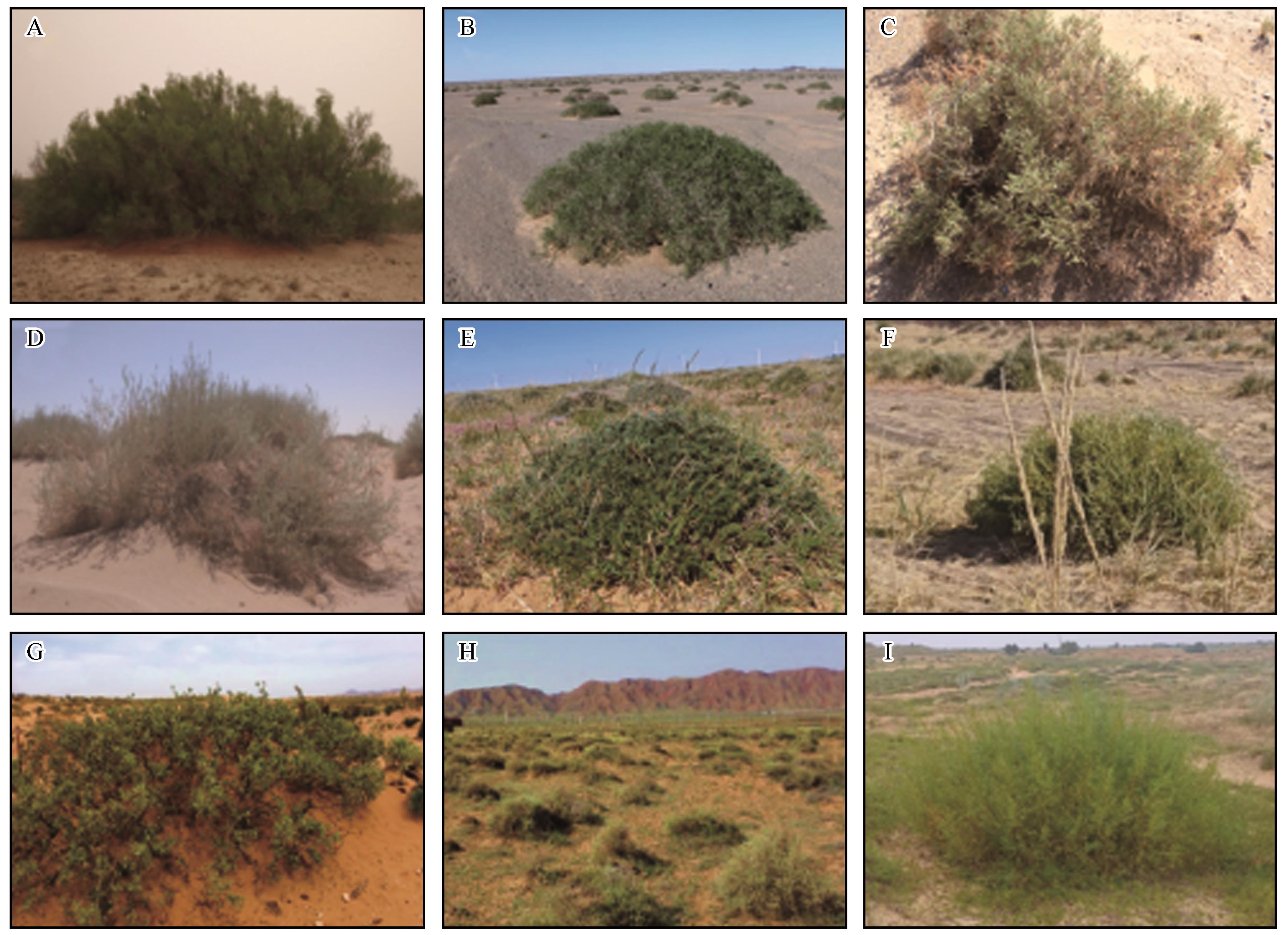
Fig.1 The common types of nebkhas in the arid and semi-arid regions of Northern China
| 灌丛类型 | 调查区域 | 形态参数 |
|---|---|---|
| 白刺(泡泡刺) | 河西走廊中部荒漠区 | 戈壁生境高度均值0.46 m,沙漠生境高度均值1.43 m[ |
| 腾格里沙漠南缘 | 高0.13~4.5 m[ | |
| 艾比湖 | 高0.5~1.0 m,长4.5~7 m,宽3~5.5 m[ | |
| 毛乌素沙地 | 高0.8~1.0 m,长6~8 m,宽5~7 m[ | |
| 巴丹吉林沙漠 | 高0.37~1.3 m,长0.64~5.67 m,宽0.57~5.0 m[ | |
| 柽柳 | 罗布泊干湖盆 | 高3.0~15.0 m[ |
| 和田河 | 高度均值3.34 m,长9.0 m,宽8.5 m[ | |
| 柴达木盆地 | 高15 m,长30 m,宽25 m | |
| 塔克拉玛干沙漠 | 高3~15 m[ | |
| 小叶锦鸡儿 | 腾格里沙漠边缘 | 高0.4~1.8 m[ |
| 鄂尔多斯高原 | 高<2.0 m,宽0.5~14 m[ | |
| 河北坝上 | 高0.1~1 m,长0.1~4.5 m,宽0.1~4.1 m[ | |
| 油蒿 | 毛乌素沙地 | 高0.2~1.1 m,长0.9~3.3 m,宽0.8~2.4 m[ |
| 沙冬青 | 库布齐沙漠 | 高0.5~1.5 m,长0.8~4.5 m |
| 霸王 | 浑善达克沙地 | 高0.5~1.3 m,长0.8~3.0 m |
| 猫头刺 | 库布齐沙漠 | 高0.2~1.0 m,长0.5~2.3 m,宽0.3~2.0 m |
Table 1 Common types and their morphological parameters of nebkhas in the arid and semi-arid regions of Northern China
| 灌丛类型 | 调查区域 | 形态参数 |
|---|---|---|
| 白刺(泡泡刺) | 河西走廊中部荒漠区 | 戈壁生境高度均值0.46 m,沙漠生境高度均值1.43 m[ |
| 腾格里沙漠南缘 | 高0.13~4.5 m[ | |
| 艾比湖 | 高0.5~1.0 m,长4.5~7 m,宽3~5.5 m[ | |
| 毛乌素沙地 | 高0.8~1.0 m,长6~8 m,宽5~7 m[ | |
| 巴丹吉林沙漠 | 高0.37~1.3 m,长0.64~5.67 m,宽0.57~5.0 m[ | |
| 柽柳 | 罗布泊干湖盆 | 高3.0~15.0 m[ |
| 和田河 | 高度均值3.34 m,长9.0 m,宽8.5 m[ | |
| 柴达木盆地 | 高15 m,长30 m,宽25 m | |
| 塔克拉玛干沙漠 | 高3~15 m[ | |
| 小叶锦鸡儿 | 腾格里沙漠边缘 | 高0.4~1.8 m[ |
| 鄂尔多斯高原 | 高<2.0 m,宽0.5~14 m[ | |
| 河北坝上 | 高0.1~1 m,长0.1~4.5 m,宽0.1~4.1 m[ | |
| 油蒿 | 毛乌素沙地 | 高0.2~1.1 m,长0.9~3.3 m,宽0.8~2.4 m[ |
| 沙冬青 | 库布齐沙漠 | 高0.5~1.5 m,长0.8~4.5 m |
| 霸王 | 浑善达克沙地 | 高0.5~1.3 m,长0.8~3.0 m |
| 猫头刺 | 库布齐沙漠 | 高0.2~1.0 m,长0.5~2.3 m,宽0.3~2.0 m |
| [1] | Tengberg A.Nebkha dunes as indicators of wind erosion and land degradation in the Sahel zone of Burkina Faso[J].Journal of Arid Environments,1995,30:265-282. |
| [2] | El-Bana M I, Nijs I, Kockelbergh F.Microenvironmental and vegetational heterogeneity induced by phytogenic nebkhas in an arid coastal ecosystem[J].Plant and Soil,2002,247:283-293. |
| [3] | Dougill A J, Thomas A D.Nebkha dune in the Molopo Basin,South Africa and Botswana:formation controls and their validity as indicators of soil degradation[J].Journal of Arid Environments,2002,50:413-428. |
| [4] | Luo W C, Zhao W Z, Liu B,et al.Nebkhas play important roles in desertification control and biodiversity protection in arid and semi-arid regions of China[J].Ecosystem Health and Sustainability,2020,6(1):1844550. |
| [5] | Barrows C W, Allen M F, Rotenberry J T.Boundary Processes between a Desert Sand Dune Community and an Encroaching Suburban Landscape[M].California,USA:UC Riverside Previously Published Works,2006:1-37. |
| [6] | El-Bana M I, Nijs I, Khedr A H A.The importance of phytogenic mounds (nebkhas) for restoration of arid degraded rangelands in northern Sinai[J].Restoration Ecology,2003,11:317-324. |
| [7] | Field J P, Breshears D D, Whicker J J,et al.Sediment capture by vegetation patches:implications for desertification and increased resource redistribution[J].Journal of Geophysical Research-Biogeosciences,2012,117:1-9. |
| [8] | King J, Nickling W G, Gillies J A.Aeolian shear stress ratio measurements within mesquite-dominated landscapes of the Chihuahuan Desert,New Mexico,USA[J].Geomorphology,2006,82:229-244. |
| [9] | Parsons A J, Wainwright J, Schlesinger W H,et al.The role of overland flow in sediment and nitrogen budgets of mesquite dune fields,southern New Mexico[J].Journal of Arid Environments,2003,53:61-71. |
| [10] | Quets J J, El-Bana M I, Al-Rowaily S L,et al.A mechanism of self-organization in a desert with phytogenic mounds[J].Ecosphere,2016,7(11):e01494. |
| [11] | Zou X Y, Li J F, Liu B,et al.The protective effects of nebkhas on an oasis[J].Aeolian Research,2016,20:71-79. |
| [12] | Zhang Z C, Han L Y, Pan K J,et al.Nebkha dune morphology in the gobi deserts of northern China and potential implications for dust emission[J].Sedimentology,2020,67:3769-3782. |
| [13] | 魏亚娟,汪季,党晓宏,等.不同生境白刺(Nitraria tangutorum)灌丛沙堆形态特征[J].干旱区研究,2019,36(1):253-261. |
| [14] | Zhang Z C, Dong Z B, Qian G Q.Implications of surface properties for dust emission from gravel deserts (gobis) in the Hexi Corridor[J].Geoderma,2016,268:69-77. |
| [15] | 丁延龙,汪季,胡生荣,等.吉兰泰盐湖风沙防护林体系建立35 a以来防沙效益评估[J].中国沙漠,2019,39(5):111-119. |
| [16] | Wang X M, Wang T, Dong Z B,et al.Nebkha development and its significance to wind erosion and land degradation in semi-arid northern China[J].Journal of Arid Environments,2006,65:129-141. |
| [17] | 丁婧祎,尹彩春,韩逸,等.草原灌丛化对生态系统多功能性的影响[J].生态学报,2023,43(20):8257-8267. |
| [18] | El-Bana M I, Zhen Q L, Nijs I.Role of host identity in effects of phytogenic mounds on plant assemblages and species richness on coastal arid dunes[J].Journal of Vegetation Science,2007,18(5):635-644. |
| [19] | Wang X M, Xiao H L, Li J C,et al.Nebkha development and its relationship to environmental change in the Alaxa Plateau,China[J].Environmental Geology,2008,56:359-365. |
| [20] | 谭凤翥,王雪芹,王海峰,等.柽柳灌丛沙堆三维流场随背景植被变化的风洞实验[J].中国沙漠,2018,38(1):48-47. |
| [21] | 罗维成,赵文智,任珩,等.不同气候区灌丛沙堆形态及土壤养分积累特征[J].中国沙漠,2021,41(2):191-199. |
| [22] | Luo W C, Zhao W Z, Liu B,et al.Changes in morphology and soil nutrient patterns of nebkhas in arid regions along a precipitation gradient[J].Sciences in Cold and Arid Regions,2021,13(3):256-267. |
| [23] | 谢国勋,罗维成,赵文智.荒漠草原带沙源及灌丛对灌丛沙堆形态的影响[J].中国沙漠,2015,35(3):573-581. |
| [24] | Cabrera-vega L L, Cruz-avero N, Hernández-Calvento L,et al.Morphological changes in dunes as an indicator of anthropogenic interferences in arid dune fields[J].Journal of Coastal Research Sience,2013,65(3):1271-1276. |
| [25] | 王文帆,刘任涛,郭志霞,等.腾格里沙漠东南缘固沙灌丛林土壤理化性质及分形维数[J].中国沙漠,2021,41(1):209-218. |
| [26] | Quets J J, Temmerman S, El-Bana M I,et al.Unravelling landscapes with phytogenic mounds (nebkhas):an exploration of spatial pattern[J].Acta Oecologica,2013,49:53-63. |
| [27] | Luo W C.Zhao W Z.Adventitious roots are key to the development of nebkhas in extremely arid regions[J].Plant and Soil,2019,442:471-482. |
| [28] | 杜建会,严平,董玉祥.干旱地区灌丛沙堆研究现状与展望[J].地理学报,2010,65(3):339-350. |
| [29] | 刘冰,赵文智.荒漠绿洲过渡带泡泡刺灌丛沙堆形态特征及其空间异质性[J].应用生态学报,2007,18(12):2814-2820. |
| [30] | 贾晓红,李新荣.腾格里沙漠东南缘不同生境白刺(Nitraria)灌丛沙堆的空间分布格局[J].环境科学,2008,29(7):2046-2053. |
| [31] | 刘金伟,李志忠,武胜利,等.新疆艾比湖周边白刺沙堆形态特征空间异质性研究[J].中国沙漠,2009,29(4):628-635. |
| [32] | 夏训诚,赵元杰,王富葆,等.红柳沙包的层状特征及其可能的年代学意义[J].科学通报,2004,49(13):1337-1338. |
| [33] | Li C, Yang F, Zheng X,et al.Changes in distribution and morphology of Tamarix ramosissima nebkhas in an oasis-desert ecotone[J].Geosciences Journal,2021,25:661-673. |
| [34] | Qong M, Takamura H, Hudaberdi M.Formation and internal structure of Tamarix cones in the Taklimakan Desert[J].Journal of Arid Environments,2002,50:81-97. |
| [35] | 杨帆,王雪芹,何清,等.绿洲-沙漠过渡带柽柳灌丛沙堆形态特征及空间分布格局[J].干旱区研究,2014,31(3):556-563. |
| [36] | Zhang P, Yang J, Zhao L,et al.Effect of Caragana tibetica nebkhas on sand entrapment and fertile islands in steppe-desert ecotones on the Inner Mongolia Plateau,China[J].Plant Soil,2011,347(1/2):79-90. |
| [37] | Lang L, Wang X, Hasi E,et al.Nebkha (coppice dune) formation and significance to environmental change reconstructions in arid and semiarid areas[J].Journal of Geographical Sciences,2013,23(2):344-358. |
| [38] | 胡国云,郭中领,王仁德,等.河北坝上低山区坡地灌丛沙堆形态与沉积特征[J].水土保持研究,2016,23(4):251-256. |
| [39] | 陈东,张宇清,吴斌,等.毛乌素沙地南缘油蒿(Artemisia ordosica)灌丛沙堆形态特征[J].中国沙漠,2015,35(3):565-572. |
| [40] | 刘冰,赵文智,杨荣.荒漠绿洲过渡带柽柳灌丛沙堆特征及其空间异质性[J].生态学报,2008,28(4):1446-1455. |
| [41] | 何志斌,赵文智.黑河流域荒漠绿洲过渡带两种优势植物种群空间格局特征[J].应用生态学报,2004,15(6):947-952. |
| [42] | Rango A, Chopping M, Ritchie J,et al.Morphological characteristics of shrub coppice dunes in desert grasslands of southern New Mexico derived from scanning LIDAR[J].Remote Sensing of Environment,2000,74:26-44. |
| [43] | Nield J M, Baas A C W.Investigating parabolic and nebkha dune formation using a cellular automaton modelling approach[J].Earth Surface Process and Landforms,2008,33:724-740. |
| [44] | Ruz M H, Hequette A, Marin D.Development of large nebkhas along an accreting macrotidal coastline,Northern France[J].Aeolian Research,2017,24:1-14. |
| [45] | Hesp P, McLachlan A.Morphology,dynamics,ecology and fauna of Arctotheca populifolia and Gazania rigens nebkha dunes[J].Journal of Arid Environments,2000,44:155-172. |
| [46] | Luo W C, Zhao W Z, Zhou H.Growth stages affect species richness and vegetation patterns of nebkhas in the desert steppes of China[J].Catena,2016,137:126-133. |
| [47] | Zhou H, Zhao W Z, Luo W C,et al.Species diversity and vegetation distribution in nebkhas of Nitraria tangutorum,in the desert steppes of China[J].Ecological Research,2015,30(4):1-10. |
| [48] | Abd El-Wahab R H, Al-Rashed A R.Vegetation and soil conditions of phytogenic mounds in Subiya area Northeast of Kuwait[J].Catrina,2010,5(1):87-95. |
| [49] | Goudie A S.Nebkhas:an essay in Aeolian biogeomorphology[J].Aeolian Research,2022,54:100772. |
| [50] | Madani I, Pokorný P, Tahir Y F,et al.Vegetation mounds in El-Gáab Depression (Sudan):their significance in archaeology and archaeobotany[J].Poznan Archaeological Museum,Studies in Archaeol,2018,15:473-483. |
| [51] | Dech J, Maun M.Adventitious root production and plastic resource allocation to biomass determine burial tolerance in woody plants from Central Canadian coastal dunes[J].Annals of Botany,2006,98(5):1095-1105. |
| [52] | Mitchell D, Henschel J R, Hetem R S,et al.Fog and fauna of the Namib Desert:past and future[J].Ecosphere,2020,11(1):e02996. |
| [53] | Prescott C E, Maynard D G, Laiho R.Humus in northern forests:friend or foe?[J].Forest Ecological Management,2000,133:23-36. |
| [54] | Pernot C, Thiffault N, Desrochers A.Contribution of adventitious vs initial roots to growth and physiology of black spruce seedlings[J].Physiologia Plantarum,2019,165:29-38. |
| [55] | Poorter H, Niklas K J, Reich P B,et al.Biomass allocation to leaves,stems and roots:meta-analyses of interspecific variation and environmental control[J].New Phytologist,2011,193(1):30-50. |
| [56] | Luo W C, Zhao W Z.Effects of wind erosion and sand burial on growth and reproduction of a clonal shrub[J].Flora,2015,217:164-169. |
| [57] | Gilbert M E, Ripley B S.Biomass reallocation and the mobilization of leaf resources support dune plant growth after sand burial[J].Physiologia Plantarum,2008,134(3):464-472. |
| [58] | Pregitzer K S, Laskowski M J, Burton A J,et al.Variation in sugar maple root respiration with root diameter and soil depth[J].Tree Physiology,1998,18(10):665-670. |
| [59] | Egilla J N, Davies F T, Drew M C.Effect of potassium on drought resistance of hibiscus rosa-sinensis cv.leprechaun:plant growth,leaf macro- and micronutrient content and root longevity[J].Plant and Soil,2001,229(2):213-224. |
| [60] | Li J C, Zhao Y F, Han L Y,et al.Moisture variation inferred from a nebkha profile correlates with vegetation changes in the southwestern Mu Us Desert of China over one century[J].Science of Total Environment,2017,598:797-804. |
| [61] | Kidron G J, Zohar M.Factors controlling the formation of coppice dunes (nebkhas) in the Negev Desert[J].Earth Surface Processes and Landforms,2016,41(7):918-927. |
| [62] | Li F, Zhao W, Liu H.The response of aboveground net primary productivity of desert vegetation to rainfall pulse in the temperate desert region of Northwest China[J].PLoS One,2013,8(9):e73003. |
| [63] | Austin T A, Yahdjian M L, Stark J M,et al.Water pulses and biogeochemical cycles in arid and semiarid ecosystems[J].Oecologia,2004,141(2):221-235. |
| [64] | Belnap J, Phillips S L, Miller M E,et al.Response of desert biological soil crusts to alterations in precipitation frequency[J].Oecologia,2004,141:306-316. |
| [65] | Reynolds J F, Kemp P R, Ogle K,et al.Modifying the ‘pulse-reserve’ paradigm for deserts of North America:precipitation pulses,soil water,and plant responses[J].Oecologia,2004,141:194-210. |
| [66] | Yan J L, Zhao W Z.Characteristics of preferential flow during simulated rainfall events in an arid region of China[J].Environment Earth Science,2016,75(7):1-12. |
| [67] | Luo W C, Zhao W Z, An N,et al.Preferential flow in soils is key to the development of nebkhas in water limited regions[J].Geoderma,2025,454:117205. |
| [68] | Okin G S, Murray B, Schlesinger W H.Degradation of sandy arid shrubland environments:observations,process modelling,and management implications[J].Journal of Arid Environments,2001,47:123-144. |
| [69] | 中国科学院西北生态环境资源研究院.一种荒漠绿洲过渡带退化泡泡刺沙堆人工修复方法:201810703502.9[P].2021-09-21. |
| [70] | Qu W J, Chen L, Wang L,et al.Local soil hydrological effects of nebkha creation in a degraded artificial Caragana shrubland[J].Ecological Engineering,2019,131:27-33. |
| [71] | 闫德仁,季蒙,薛英英.沙漠生物结皮土壤发育特征的研究[J].土壤通报,2006,37(5):990-993. |
| [72] | Chamizo S, Cantón Y, Rodrìguez-Caballero E,et al.BSCs positively affect the soil water balance in semiarid ecosystems[J].Ecohydrology,2016,9:1208-1221. |
| [73] | Eldridge D J, Reed S, Travers S K,et al.The pervasive and multifaceted influence of BSCs on water in the world's drylands[J].Global Chang Biology,2020,26:6003-6014. |
| [74] | Román J R, Roncero-Ramos B, Rodríguez-Caballero E,et al.Effect of water availability on induced cyanobacterial BSCs development[J].Catena,2021,197:104988. |
| [75] | Khalaf F I, Al-Hurban A E, Al-Awadhi J.Morphology of protected and non-protected Nitraria retusacoastal nabkha in Kuwait,Arabian Gulf:a comparative study[J].Catena,2014,115:115-122. |
| [1] | Min Han, Yong Gao, Minghui He, Ru Yan, Fang Bai, Wenyuan Yang, Xiaole Li, Xiaoman Yuan, Juan Yang. Morphology and sediment characterization of a scrub sandpile in Caragana tibetica [J]. Journal of Desert Research, 2024, 44(2): 185-195. |
| [2] | Xiangjie Li, Zhiwen Li, Dingding Du, Li Sun, Chu Hou, Shiqian Li, Wen Zhang. Sediments and spatial pattern characteristics of Vitex trifolia nebkhas in the Houtian sandy land of Nanchang, China [J]. Journal of Desert Research, 2022, 42(6): 211-220. |
| [3] | Jie Yin, Hasi Eerdun, Jing An, Yanguang Zhou, Rina Hu, Zifeng Wu. Geomorphologic significance of airflow and sand transport around an Artemisia ordosica nebkha in the Ordos Plateau, China [J]. Journal of Desert Research, 2022, 42(1): 184-195. |
| [4] | Qinni Huang, Zhibao Dong, Nan Xiao, Miaoyan Feng, Huanyu Shi, Guoxiang Chen, Ziyi Bai, Xin Zhang, Chong Gao, Xiaozhi Wang. Sediments and morphology of coastal Spinifex littoreus nebkhas on Jingxinjiao beach of Hainan Island, China [J]. Journal of Desert Research, 2021, 41(6): 157-168. |
| [5] | Weicheng Luo, Wenzhi Zhao, Heng Ren, Bing Liu. Nebkha morphological characteristics and soil nutrition content in three regions with different climates in North China [J]. Journal of Desert Research, 2021, 41(2): 191-199. |
| [6] | Pan Kaijia, Zhang Zhengcai, Liang Aimin, Dong Zhibao, Li Xingcai. Nebkhas geomorphology in the gobi desert using the unmanned aerial vehicle and tilt camera [J]. Journal of Desert Research, 2020, 40(2): 24-32. |
| [7] | Feng Miaoyan, Dong Zhibao, Huang Rihui, Liu Zhengyao, Xiao Nan, Yang Junhuai, Chen Guoxiang, Zhu Chunming. Morphology and Sediments of Coastal Spinifex littoreus Nebkhas on Donghai Island of Guangdong Province, China [J]. Journal of Desert Research, 2019, 39(6): 167-176. |
| [8] | Ling Zhiyong, Wang Jianping, Chen Liang, Lu Baoliang. Rare Earth Elements' Geochemical Characteristics of Nebkhas in the Qaidam Basin and the Provenance [J]. Journal of Desert Research, 2018, 38(5): 963-971. |
| [9] | Tan Fengzhu, Wang Xueqin, Wang Haifeng, Xu Junrong, Yuan Xinxin. Wind Tunnel Simulation of the Three-Dimensional Airflow Patterns around Tamarix ramosissima Nebkhas under the Change of Background Vegetation Coverage [J]. JOURNAL OF DESERT RESEARCH, 2018, 38(1): 48-57. |
| [10] | Lang Lili, Wang Xunming, Zhu Bingqi, Wang Xiangdong, Hua Ting, Wang Guangtao, Li Hui, Zhang Caixia. Nebkha Formation and Variations in Sediment Availability and Wind-energy Regime of the Western Hexi Corridor over the Past Several Decades [J]. JOURNAL OF DESERT RESEARCH, 2017, 37(4): 611-620. |
| [11] | You Nanshan, Meng Jijun. Ecological Functions Regionalization and Ecosystem Management Based on the Ecological Sensitivity and Ecosystem Service in the Middle Reaches of the Heihe River [J]. JOURNAL OF DESERT RESEARCH, 2017, 37(1): 186-197. |
| [12] | Ma Jian, He Yuanqing, Feng Qi, Li Panpan, He Ze. Climatic and Environmental Records in the Tamarix ramosissima Nebkha of Heihe River Downstream [J]. JOURNAL OF DESERT RESEARCH, 2016, 36(2): 319-326. |
| [13] | Liu Jinhui, Wang Xueqin, Ma Yang, Tan Fengzhu. Spatial Variation of Soil Salinity on Tamarix ramosissima Nebkhas and Interdune in Oasis-desert Ecotone [J]. JOURNAL OF DESERT RESEARCH, 2016, 36(1): 181-189. |
| [14] | Zhang Ping, Hasi Eerdun, Yang Yi, Wu Xia. Responses of Nebkhas Morphology to the Mode and Richness of Sand Supply [J]. JOURNAL OF DESERT RESEARCH, 2015, 35(6): 1453-1460. |
| [15] | Zhang Jinhu, Tang Jinnian, Li Delu, Wei Linyuan, Man Duoqing, Chai Chengwu. Morphological Characteristics and Distribution Patterns of Nebkhas in Desert-oasis Ecotone [J]. JOURNAL OF DESERT RESEARCH, 2015, 35(5): 1141-1149. |
| Viewed | ||||||
|
Full text |
|
|||||
|
Abstract |
|
|||||
©2018Journal of Desert Research
Tel:0931-8267545
Email:caiedit@lzb.ac.cn;desert@lzb.ac.cn
Support:Magtech
