
- CN 62-1070/P
- ISSN 1000-694X
- Bimonthly 1981
Journal of Desert Research ›› 2026, Vol. 46 ›› Issue (3): 120-130.DOI: 10.7522/j.issn.1000-694X.2025.00111
Previous Articles Next Articles
Weicheng Luo1( ), Wenzhi Zhao1(), Heng Ren1, Bin Guo2, Ning An1,3, Bing Liu1, Jiayi Liu1,3
Received:2025-04-08
Revised:2025-05-06
Online:2026-05-20
Published:2026-06-11
Contact:
Wenzhi Zhao
CLC Number:
Weicheng Luo, Wenzhi Zhao, Heng Ren, Bin Guo, Ning An, Bing Liu, Jiayi Liu. Responses of typical C3 and C4 desert shrubs to simulated warming in Hexi Corridor[J]. Journal of Desert Research, 2026, 46(3): 120-130.
Add to citation manager EndNote|Ris|BibTeX
URL: http://www.desert.ac.cn/EN/10.7522/j.issn.1000-694X.2025.00111
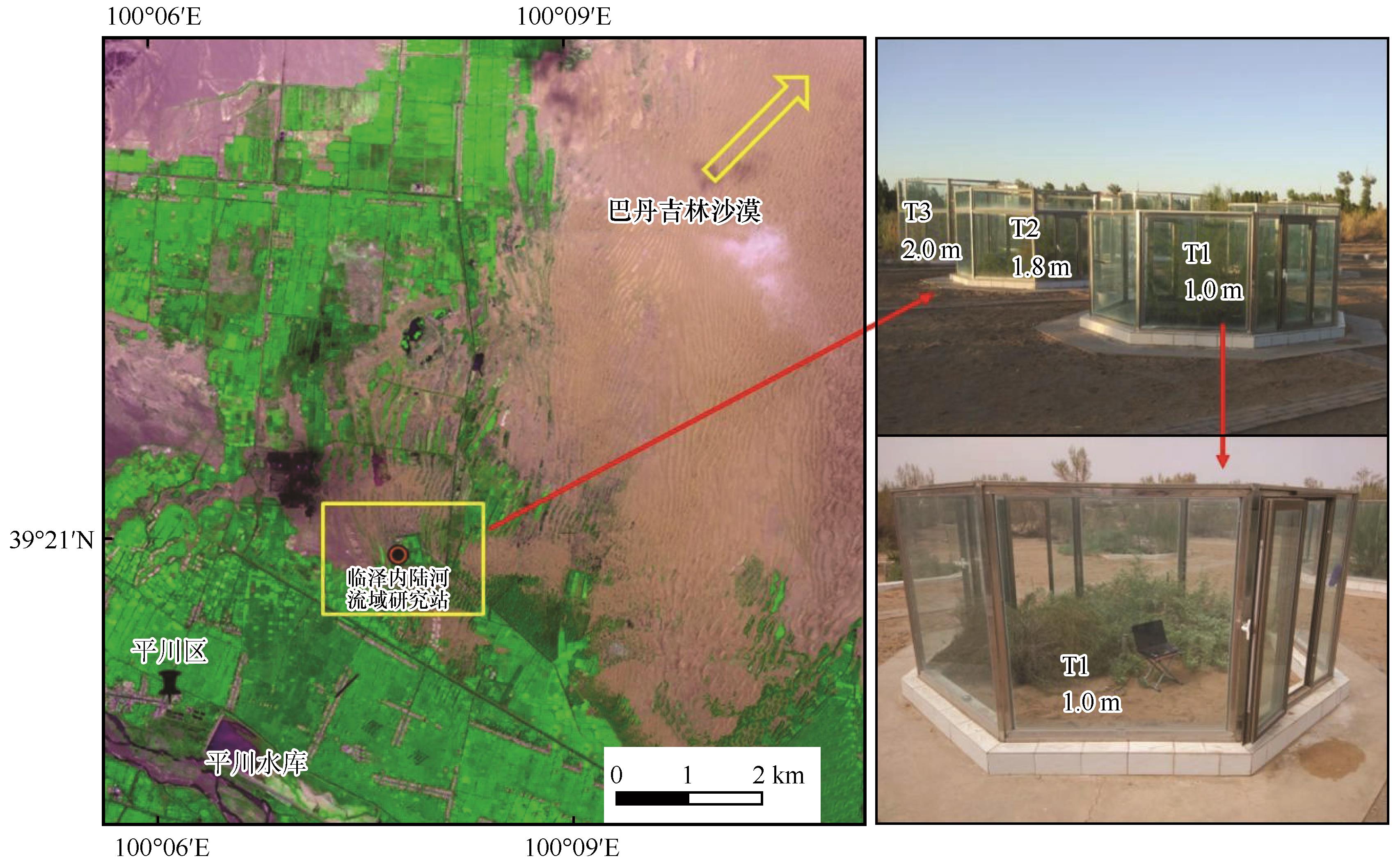
Fig.1 Location of study area and Open-top chambers
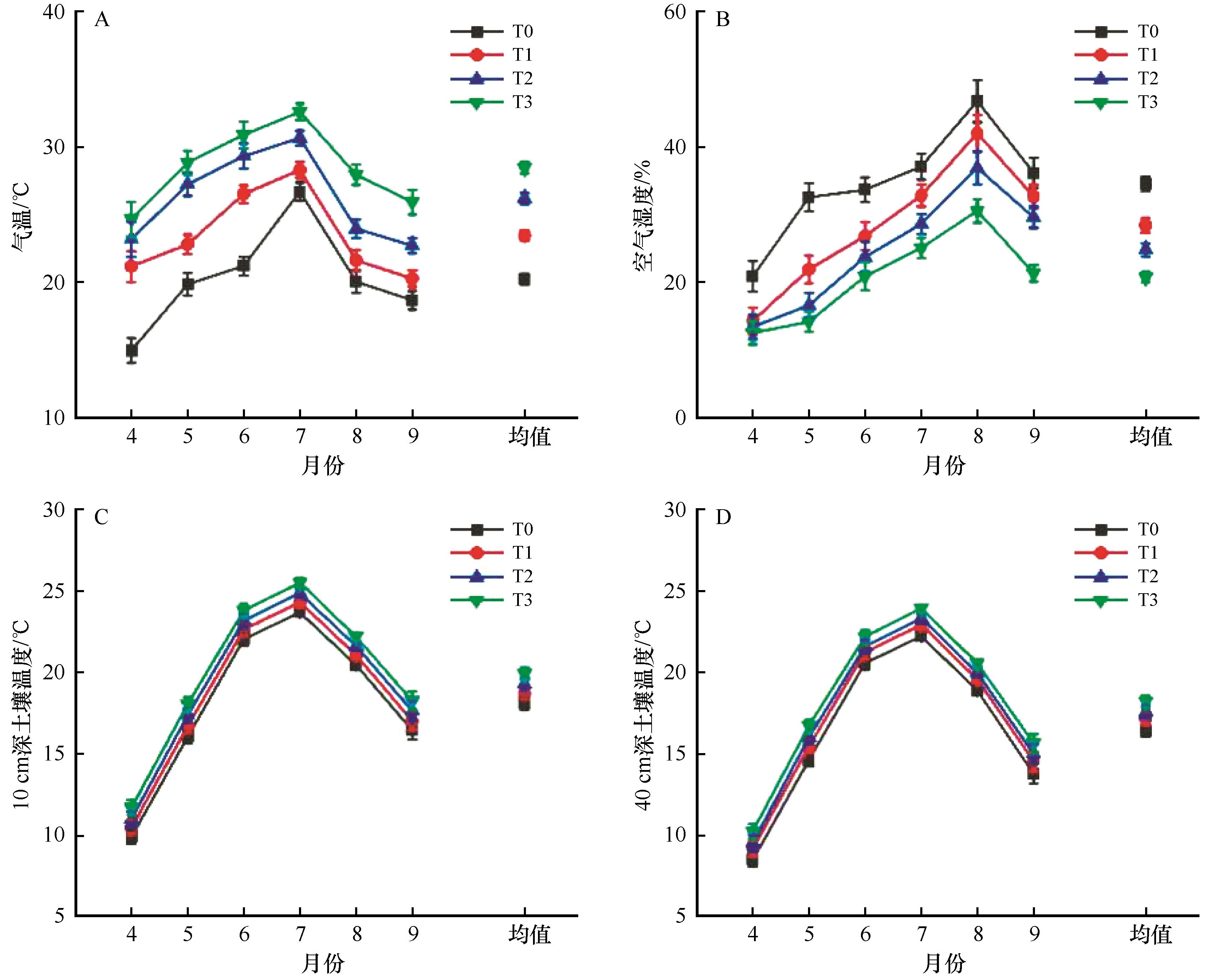
Fig.2 Changes of air temperature, humidity and soil temperature under different warming treatments during growth seasons (April to September)
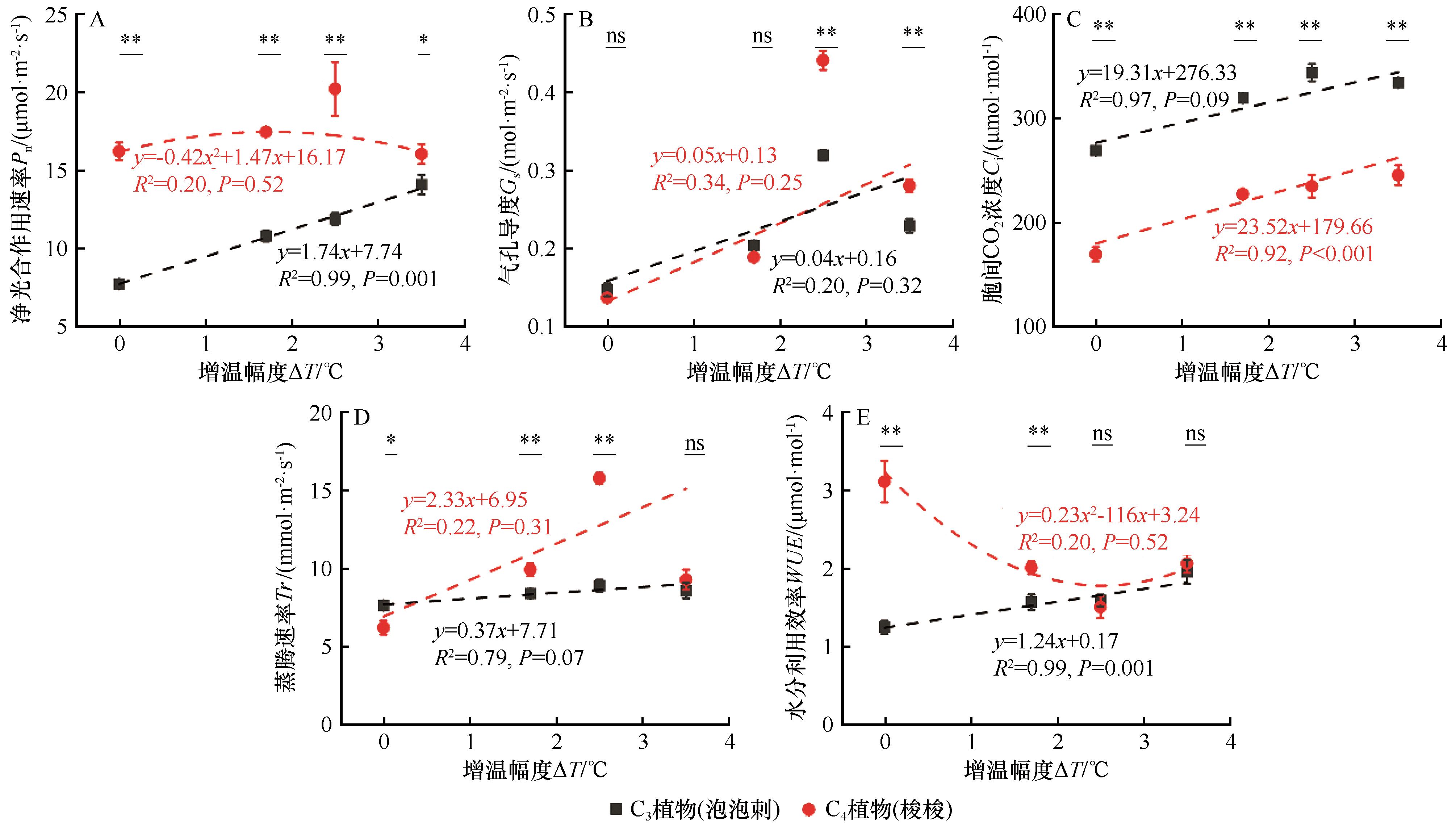
Fig.3 Changes of photosynthetic indices of C3 plant N. sphaerocarpa and C4 plant H. ammodendron under different warming ranges (*, ** and ns indicated that the indices of C3 plant and C4 plant were significantly different (P<0.05), extremely significant (P<0.01) and had no difference (P≥0.05) under the same warming range, respectively)
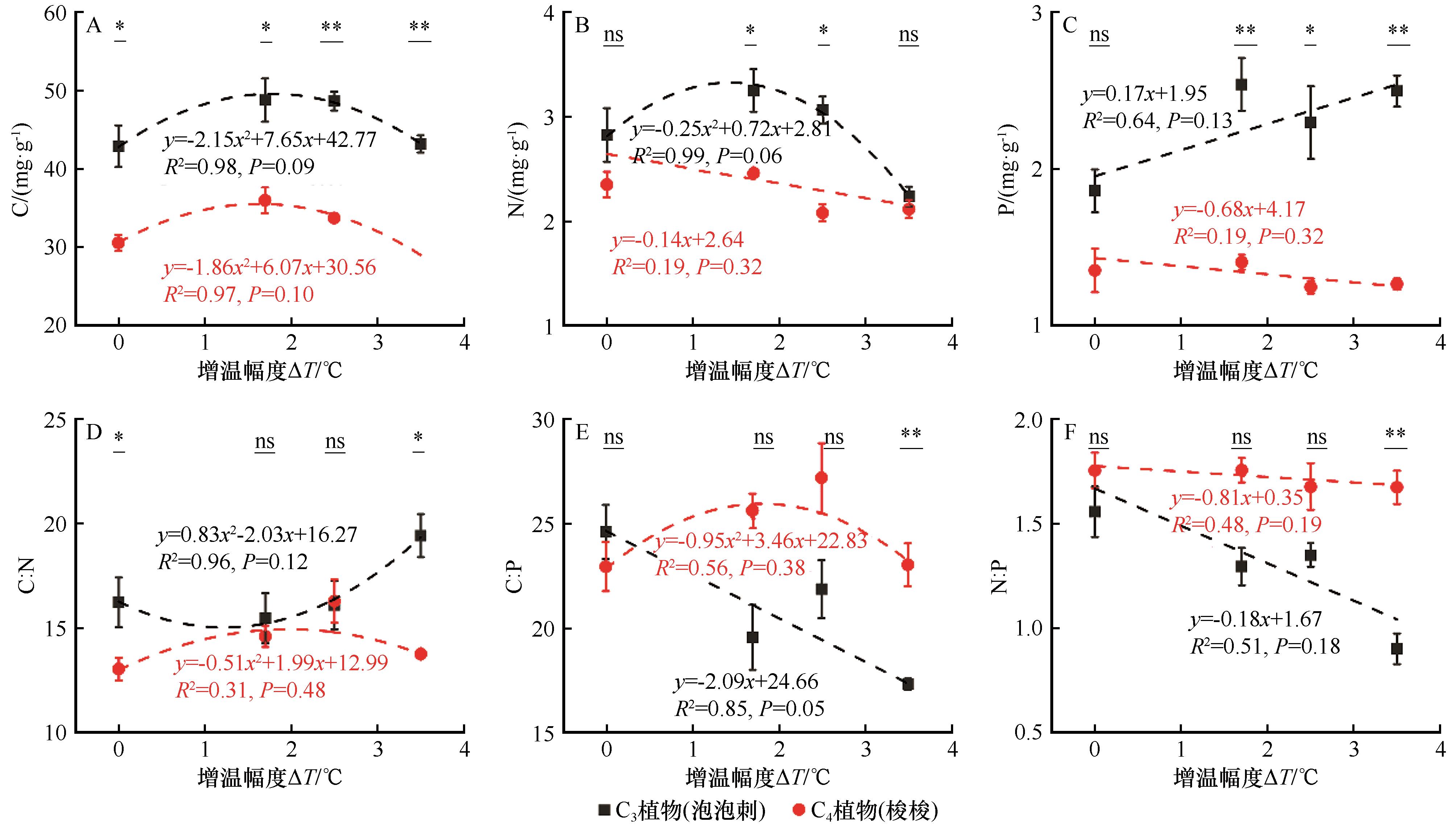
Fig.4 Changes of leaf stoichiometric element contents of C3 plant N. sphaerocarpa and C4 plant H. ammodendron under different warming ranges
| Pn | Gs | Ci | Tr | WUE | ||||||||||
|---|---|---|---|---|---|---|---|---|---|---|---|---|---|---|
| F | P | F | P | F | P | F | P | F | P | |||||
| 物种S | 991.66 | <0.01 | 19.32 | <0.01 | 691.15 | <0.01 | 97.12 | <0.01 | 50.65 | <0.01 | ||||
| 增温幅度ΔT | 74.28 | <0.01 | 148.92 | <0.01 | 81.09 | <0.01 | 132.00 | <0.01 | 11.18 | <0.01 | ||||
| S×ΔT | 56.83 | <0.01 | 14.64 | <0.01 | 1.47 | 0.26 | 82.49 | <0.01 | 29.21 | <0.01 | ||||
Table 1 Two-way ANOVA analysis of the effects of species and warming range on plant photosynthetic indexes
| Pn | Gs | Ci | Tr | WUE | ||||||||||
|---|---|---|---|---|---|---|---|---|---|---|---|---|---|---|
| F | P | F | P | F | P | F | P | F | P | |||||
| 物种S | 991.66 | <0.01 | 19.32 | <0.01 | 691.15 | <0.01 | 97.12 | <0.01 | 50.65 | <0.01 | ||||
| 增温幅度ΔT | 74.28 | <0.01 | 148.92 | <0.01 | 81.09 | <0.01 | 132.00 | <0.01 | 11.18 | <0.01 | ||||
| S×ΔT | 56.83 | <0.01 | 14.64 | <0.01 | 1.47 | 0.26 | 82.49 | <0.01 | 29.21 | <0.01 | ||||
| C | N | P | C∶N | C∶P | N∶P | ||||||||||||
|---|---|---|---|---|---|---|---|---|---|---|---|---|---|---|---|---|---|
| F | P | F | P | F | P | F | P | F | P | F | P | ||||||
| 物种S | 121.00 | <0.01 | 9.31 | <0.01 | 51.20 | <0.01 | 5.33 | 0.04 | 6.70 | 0.20 | 26.03 | <0.01 | |||||
| 增温幅度ΔT | 6.49 | <0.01 | 2.08 | 0.14 | 1.31 | 0.30 | 0.80 | 0.51 | 1.63 | 0.22 | 3.16 | 0.05 | |||||
| S×ΔT | 0.23 | 0.87 | 0.94 | 0.44 | 1.40 | 0.28 | 1.59 | 0.23 | 1.54 | 0.24 | 2.06 | 0.15 | |||||
Table 2 Two-way ANOVA analysis of the effects of species and warming range on leaf stoichiometric element contents
| C | N | P | C∶N | C∶P | N∶P | ||||||||||||
|---|---|---|---|---|---|---|---|---|---|---|---|---|---|---|---|---|---|
| F | P | F | P | F | P | F | P | F | P | F | P | ||||||
| 物种S | 121.00 | <0.01 | 9.31 | <0.01 | 51.20 | <0.01 | 5.33 | 0.04 | 6.70 | 0.20 | 26.03 | <0.01 | |||||
| 增温幅度ΔT | 6.49 | <0.01 | 2.08 | 0.14 | 1.31 | 0.30 | 0.80 | 0.51 | 1.63 | 0.22 | 3.16 | 0.05 | |||||
| S×ΔT | 0.23 | 0.87 | 0.94 | 0.44 | 1.40 | 0.28 | 1.59 | 0.23 | 1.54 | 0.24 | 2.06 | 0.15 | |||||
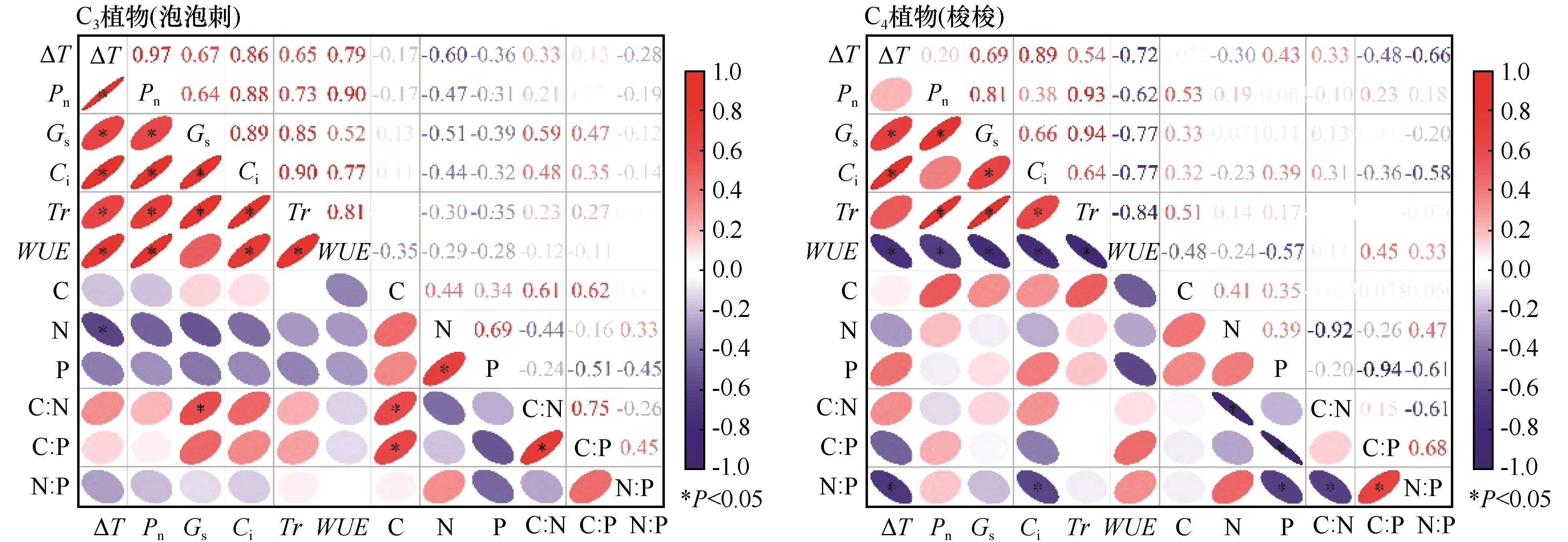
Fig.5 Correlation between photosynthetic indexes, leaf stoichiometric elements content and warming ranges of C3 plant Nitraria sphaerocarpa and C4 plant Haloxylon ammodendron
| [1] | IPCC.Climate Change 2007:The Physical Science Basis[M].London,UK:Cambridge University Press,2007. |
| [2] | Arias P, Bellouin N, Coppola E,et al.Climate Change 2021:the Physical Science Basis[R].2021. |
| [3] | 江志红,张霞,王冀.IPCC-AR4模式对中国21世纪气候变化的情景预估[J].地理研究,2008(4):787-799. |
| [4] | Edenhofer O.Climate Change 2014:Mitigation of Climate Change[M].Cambridge,UK:Cambridge University Press,2015. |
| [5] | Cunningham S J, Martin R O, Hojem C L.Temperatures in excess of critical thresholds threaten nestling growth and survival in a rapidly-warming arid savanna:a study of common fiscals[J].PLoS One,2013,8(9):e74613. |
| [6] | Zhou D, Xiao J, Frolking S,et al.Urbanization contributes little to global warming but substantially intensifies local and regional land surface warming[J].Earths Future,2022,10(5):e2021EF002401. |
| [7] | Piao S L, Liu Q, Chen A P,et al.Plant phenology and global climate change:current progresses and challenges[J].Global Change Biology,2019,25(6):1922-1940. |
| [8] | Grossiord C, Buckley T N, Cernusak L A,et al.Plant responses to rising vapor pressure deficit[J].New Phytologist,2020,226(6):1550-1566. |
| [9] | 徐振锋,胡庭兴,张力,等.模拟增温对川西亚高山林线交错带绵穗柳生长、叶物候和叶性状的影响[J].应用生态学报,2009,20(1):7-12. |
| [10] | 冯秋红,史作民,董莉莉,等.南北样带温带区栎属树种功能性状间的关系及其对气象因子的响应[J].植物生态学报,2010,30(6):619-627. |
| [11] | Pecl G T, Araújo M B, Bell J D,et al.Biodiversity redistribution under climate change:impacts on ecosystems and human well-being[J].Science,2017,355(6332):eaai9214. |
| [12] | Urban M C, Bocedi G, Hendry A P,et al.Improving the forecast for biodiversity under climate change[J].Science,2016,353(6304):aad8466. |
| [13] | Walker M D, Wahren C H, Hollister R D,et al.Plant community responses to experimental warming across the tundra biome[J].Proceedings of the National Academy of Sciences,2006,103(5):1342-1346. |
| [14] | Klein J A, Harte J, Zhao X Q.Experimental warming causes large and rapid species loss,dampened by simulated grazing on the Tibetan Plateau[J].Ecology Letters,2004,7(12):1170-1179. |
| [15] | Garcia R A, Cabeza M, Rahbek C,et al.Multiple dimensions of climate change and their implications for biodiversity[J].Science,2018,344(6183):1247579. |
| [16] | Hadi A, Naz N, Rehman F,et al.Impact of climate change drivers on C4 plants:a review[J].Current Research in Agriculture and Farming,2020,1(4):13-18. |
| [17] | 吕广一.荒漠草原植物群落特征和生态系统碳交换对增温增雨的响应机制[D].呼和浩特:内蒙古农业大学,2024. |
| [18] | Taylor S H, Piao S L.C4 photosynthesis and climate change[J].Journal of Experimental Botany,2019,70(10):2589-2601. |
| [19] | Jia F M, Shi X Y, Thornton P E,et al.Global latitudinal-asymmetric vegetation growth trends and their driving mechanisms:1982-2009[J].Remote Sensing,2013:53(3):1484-1497. |
| [20] | 李晓丽,徐满厚,孟万忠,等.模拟增温对云顶山亚高山草甸水热因子及群落结构的影响[J].生态学报,2020:40(19):6885-6896. |
| [21] | 王婧,刘雄洲,金冠芳,等.季节性不对称模拟增温对青藏高原高寒草甸群落特征的影响[J].草地学报,2022,30(11):3056-3062. |
| [22] | 张中华,马丽,周秉荣,等.高寒草甸优势种功能多样性对增温和模拟放牧的响应[J].草地学报,2021:29(S1):225-232. |
| [23] | 王冰莹,韩国栋,武倩,等.长期增温和氮素添加对荒漠草原不同植物功能群特征的影响[J].草原与草坪,2022,42(2):42-49. |
| [24] | 赵文智,任珩,杜军,等.河西走廊绿洲生态建设和农业发展的若干思考与建议[J].中国科学院院刊,2023,38(3):424-434. |
| [25] | 赵文智,郑颖,张格非.绿洲边缘人工固沙植被自组织过程[J].中国沙漠,2018,38(1):1-7. |
| [26] | 杨淇越,赵文智.梭梭(Haloxylon ammodendron)叶片气孔导度与气体交换对典型降水事件的响应[J].中国沙漠,2014,34(2):419-425. |
| [27] | 杨杰,薛浩,杨淇越,等.巴丹吉林沙漠不同林龄梭梭(Haloxylon ammodendron)气体交换对增温的适应策略[J].中国沙漠,2025,45(1):195-203. |
| [28] | 刘深思,徐贵青,陈图强,等.地下水埋深对幼龄梭梭功能性状的影响[J].应用生态学报,2022,33(3):733-741. |
| [29] | 罗维成.河西走廊荒漠绿洲边缘风沙生境沙拐枣的适应策略[D].北京:中国科学院大学,2016. |
| [30] | Li B, Chen Y, Shi X.Why does the temperature rise faster in the arid region of northwest China?[J].Journal of Geophysical Research:Atmospheres,2012,117(D16115):1-7. |
| [31] | Yang Q, Zhao W, Liu B,et al.Physiological responses of Haloxylon ammodendron to rainfall pulses in temperate desert regions,Northwestern China[J].Trees-Structure and Function,2014,28(3):709-722. |
| [32] | 董姣姣,龚吉蕊,翟占伟,等.内蒙古温带草原大针茅叶片光合生理特性对氮添加的响应[J].生态学报,2023,43(14):5994-6004. |
| [33] | 朱彪,陈迎.陆地生态系统野外增温控制实验的技术与方法[J].植物生态学报,2020,44(4):330-339. |
| [34] | 包天玲,刘继亮,苑峰,等.科尔沁沙质草地植物群落对增温的响应[J].中国沙漠,2024,44(1):151-160. |
| [35] | 朱军涛.实验增温对藏北高寒草甸植物繁殖物候的影响[J].植物生态学报,2016,40(10):1028-1036. |
| [36] | Shi G X, Yao B Q, Liu Y J,et al.The phylogenetic structure of AMF communities shifts in response to gradient warming with and without winter grazing on the Qinghai-Tibet Plateau[J].Applied Soil Ecology,2017,121:31-40. |
| [37] | Niu S L, Xia J, Han Y,et al.Climatic warming changes plant photosynthesis and its temperature dependence in a temperate steppe of Northern China[J].Environmental and Experimental Botany,2008,63(1/3):91-101. |
| [38] | Sage R F, Kubien D S.The temperature responses of C3 and C4 photosynthesis[J].Plant,Cell & Environment,2007,30(9):1086-1106. |
| [39] | 张海娜,苏培玺,李善家,等.荒漠区植物光合器官解剖结构对水分利用效率的指示作用[J].生态学报,2013,33(16):10-18. |
| [40] | 严巧娣,苏培玺,高松.干旱程度对C3植物红砂和C4植物珍珠光合生理参数的影响[J].中国沙漠,2012,32(2):364-371. |
| [41] | 张维,贺亚玲,吴泽昂,等.模拟增温对梭梭光合生理生态特征的影响[J].草地学报,2017,25(2):296-302. |
| [42] | Lattanzi F A.C3/C4 grasslands and climate change[C]//Proceedings of the Grassland Science in Europe,2010(1):3-13. |
| [43] | Zargar S M, Gupta N, Nazir M,et al.Impact of drought on photosynthesis:molecular perspective[J].Plant Gene,2017,11:154 -159. |
| [44] | 高松,苏培玺,严巧娣,等.C4荒漠植物猪毛菜与木本猪毛菜的叶片解剖结构及光合生理特征[J].植物生态学报,2009,33(2):347-354. |
| [45] | Xu Z Z, Zhou G S, Shimizu H.Plant responses to drought and rewatering[J].Plant Signaling & Behavior,2010,5(6):649-654. |
| [46] | Ainsworth E A, Rogers A.The response of photosynthesis and stomatal conductance to rising CO2:mechanisms and environmental interactions[J].Plant,Cell & Environment,2007,30(3):258-270. |
| [47] | Ainsworth E A, Piao S L.What have we learned from 15 years of free-air CO2 enrichment (FACE)?:a meta-analytic review of the responses of photosynthesis,canopy properties and plant production to rising CO2 [J].New Phytologist,2005,165(2):351-372. |
| [48] | Poorter H, Niklas K J, Reich P B,et al.Biomass allocation to leaves,stems and roots:meta-analyses of interspecific variation and environmental control[J].New Phytologist,2012,193(1):1-15. |
| [49] | Freschet G T, Cornelissen J H C, van Logtestijn R S P,et al.Substantial nutrient resorption from leaves,stems and roots in a subarctic flora:What is the link with other resource economics traits?[J].New Phytologist,2010,186(4):879-889. |
| [50] | 谭钠丹,吴婷,程严,等.增温对南亚热带常绿阔叶林4种幼树生长和碳氮磷化学计量特征的影响[J].生态学报,2021,41(15):6146-6158. |
| [51] | 袁书禹,谢柳娟,叶思源,等.黄渤海湿地芦苇光合特征对增温的响应[J].应用生态学报,2023,34(7):1825-1833. |
| [52] | Yan C, Liu Z C, Yuan Z Y,et al.Aridity modifies the responses of plant stoichiometry to global warming and nitrogen deposition in semi-arid steppes[J].Science of the Total Environment,2022,831:154807. |
| [53] | 黄路路,周慧玲,王启帆,等.陆地生态系统植物碳、氮和磷含量对增温的响应:Meta分析[J].应用生态学报,2024,35(9):2527-2534. |
| [1] | Guanglu Hu, Nana He, Yeye Zhang, Kun Chen, Taoyang Jin, Jiaqi Wang, Kaifu Tian. Numerical simulation of the effect of sand-fixing plant Haloxylon ammodendron on the wind-sand flow field [J]. Journal of Desert Research, 2026, 46(3): 304-317. |
| [2] | Xue Zhang, Haibing Wang, Chengxian Liao, Haoqin Yang, Yunfei Bai. Wind tunnel simulation test of gobi Haloxylon ammodendron windproof efficiency [J]. Journal of Desert Research, 2026, 46(1): 242-251. |
| [3] | Ziting Wang, Jiliang Liu, Yongzhong Luo, Quanlin Ma, Xiaogan Zhou, Xin Luo, Wenzhen Zong. Long-term effects of Haloxylon ammodendron plantations on topsoil carbon, nitrogen, phosphorus stoichiometry and stocks in the desert-oasis ecotone [J]. Journal of Desert Research, 2025, 45(5): 241-252. |
| [4] | Xiaogan Zhou, Yongzhong Luo, Quanlin Ma, Jiliang Liu, Jialong Ren, Ziting Wang, Qihan Yan, Chang Qin, Jiaqi Zhai. Long-term effects of the introduction of Haloxylon ammodendron on desert soil characteristics [J]. Journal of Desert Research, 2025, 45(5): 68-77. |
| [5] | Jie Yang, Hao Xue, Qiyue Yang, Xiangyan Feng, Yuzhe Wang. Adaptation strategies of gas exchange to temperature increase of different ages of Haloxylon ammodendron in Badain Jaran Desert [J]. Journal of Desert Research, 2025, 45(1): 195-203. |
| [6] | Jiliang Liu, Yilin Feng, Yongzhen Wang, Chengchen Pan, Tianling Bao, Jialong Ren, Wenzhi Zhao. Effects of restoration of artificial sand-fixing vegetation on the diversity of reptiles and mammals in the middle reaches of the Heihe River Basin [J]. Journal of Desert Research, 2024, 44(6): 167-177. |
| [7] | Lili Bao, Jinrong Li, Zhaoen Han, Yue Liu, Haodong Shan. Estimation of aboveground biomass of Haloxylon ammodendron based on UAV multi-source data [J]. Journal of Desert Research, 2024, 44(5): 50-59. |
| [8] | Fangjiao An, Yongzhong Su, Ziru Niu, Tingna Liu. Evolution of soil nematode community after establishment of Haloxylon ammodendron plantations in an arid desert-oasis ecotone [J]. Journal of Desert Research, 2024, 44(2): 133-142. |
| [9] | Jin Wang, Zhao Liu, Yujie Zhang, Chao Pu, Yao Wu, Lifeng E, Quangang Xie. Phenotype differences and dormancy breaking of Nitraria sphaerocarpa seeds in Hexi Corridor [J]. Journal of Desert Research, 2024, 44(1): 86-95. |
| [10] | Xingchi Jiang, Wensuyalatu, Junyao Li, Feng Chen, Jinyu Hu, Guolin Wang, Sujuan Qing, Jiannan Lu, Shaokun Wang. Study on storage of soil surface carbon and nitrogen and its influencing factors in UradNational Nature Reserve of Haloxylon ammodendron based on SHAP values [J]. Journal of Desert Research, 2023, 43(2): 170-183. |
| [11] | Xiaohui He, Jianhua Si, Dongmeng Zhou, Chunlin Wang, Chunyan Zhao. Photosynthetic properties and leaf-scale water use efficiency of Haloxylon ammodendron in different stand ages [J]. Journal of Desert Research, 2023, 43(1): 20-26. |
| [12] | Feng Chen, Jing Zhang, Erniu Han, Wensuyalatu, Shenglin Li, Guolin Wang, Lei Wang, Shaokun Wang. Soil microbial diversity and its relationship with soil physicochemical properties in Urat natural Haloxylon ammodendron forest [J]. Journal of Desert Research, 2022, 42(2): 207-214. |
| [13] | Peixi Su. Review and prospect of the researches on C4 woody plants and soil inorganic carbon sequestration in deserts of China [J]. Journal of Desert Research, 2022, 42(1): 23-33. |
| [14] | Quanlin Ma, Wen Shang, Xinyou Wang, Jing Ma, Kejie Zhan, Duoze Wang. Influence of sand blown activity on soil organic carbon and total nitrogen in artificial Haloxylon ammodendron plantations in arid desert regions [J]. Journal of Desert Research, 2022, 42(1): 71-78. |
| [15] | Ning Li, Hai Zhou, Heng Ren, Peifang Chong, Guopeng Chen. Water sources of Haloxylon ammodendron under different groundwater depths [J]. Journal of Desert Research, 2021, 41(4): 79-86. |
| Viewed | ||||||
|
Full text |
|
|||||
|
Abstract |
|
|||||
©2018Journal of Desert Research
Tel:0931-8267545
Email:caiedit@lzb.ac.cn;desert@lzb.ac.cn
Support:Magtech
