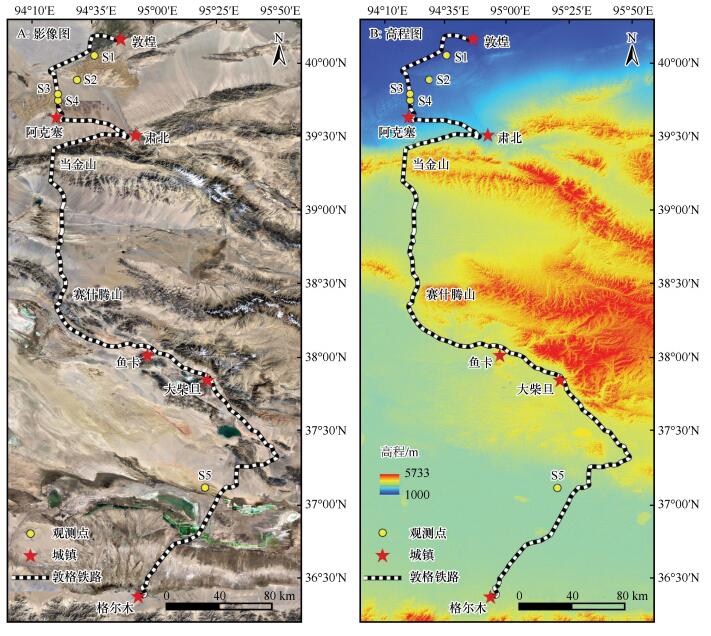
敦煌-格尔木铁路沿线地形复杂、起沙因素多变、沙源丰富,沙害问题日益严重。目前对其风沙活动规律还未有研究,不利于防沙工作的开展。为此,通过对自北向南的5个观测点(S1、S2、S3、S4、S5)风速和风向的观测、计算和分析,利用平均风速、起沙风况及输沙势对敦格铁路沿线的风动力环境特征进行研究。结果表明:S5、S4和S3的风况对铁路风沙灾害防治意义较大。S5年平均风速、起沙风频率和输沙势最大,春季风沙活动最为强烈,且风向单一、风力强劲,风沙运动方向基本与铁路垂直,沙粒易在铁路附近堆积。S4夏季风沙活动最为强烈;S3春季风沙活动最为强烈,且风向单一,S4和S3的风沙运动方向与铁路夹角小于90°,附近沙源广阔,铁路易受风沙侵蚀,阻碍交通运营。
Due to the complex terrain, the variable sand-moving factors and the abundant sand sources along the Dunhuang-Golmud Railway, the problem of sand damage is becoming more and more serious, but the regularity of blown sand activity has not been studied yet, which is not conducive to targeted sand prevention and control work. To this end, the characteristics of wind dynamic environment are studied by analyzing the average wind speed, sand-moving wind condition and sand drift potential, which is based on the observation, calculation and analysis of wind speed and wind direction at various sites in the field. The results show that the wind conditions at S5, S4 and S3 are of great significance to the prevention and control of railway wind-sand disasters. In S5, the annual average wind speed, sand-moving wind frequency and drift potential are the largest, and the wind-sand activity is the strongest in spring. The sand accumulate easily near the railway because of the single wind direction, the strong wind, and the movement of wind direction is basically perpendicular to the railway. In S4, The summer blown sand activity is the strongest; In S3, the main wind season is spring and the wind direction is single. The wind direction of S4 and S3 is less than 90° with the railway, and in addition, the nearby sand source is wide, which causes the railway to be vulnerable to wind and sand damage and affects the railway operation.
[1] 许钱通.集二铁路沙漠区防风固沙措施防护效果研究[D].北京:北京交通大学,2015.
[2] 王涛.中国风沙防治工程[M].北京:科学出版社,2011:5-11.
[3] 肖建华.青藏铁路(格拉段)风沙危害及其防治研究[D].兰州:中国科学院寒区旱区环境与工程研究所,2014.
[4] 罗劲文.浅谈敦煌至格尔木铁路风沙地区选线[J].科技资讯,2013(3):31-32.
[5] 梁晓磊,牛清河,安志山,等.甘肃瓜州锁阳城南雅丹地貌区起沙风况与输沙势特征[J].中国沙漠,2019,39(3):1-8.
[6] 谢胜波,喻文波,屈建军,等.青藏高原红梁河风沙动力环境特征[J].中国沙漠,2018,38(2):219-224.
[7] 蔡迪文,张克存,安志山,等.青藏铁路格拉段风动力环境及其对铁路沙害的影响[J].中国沙漠,2017,37(1):40-47.
[8] 张龙飞.敦格铁路小柴旦至饮马峡段风沙病害分析[J].四川建筑,2009,29(6):81-82.
[9] 王旭.敦格铁路塞什腾山区的地质构造特征[J].科技资讯,2012(36):30-31.
[10] 杨兴华,李红军,何清,等.塔克拉玛干沙漠荒漠过渡带春季风沙活动特征——以肖塘为例[J].中国沙漠,2012,32(4):915-920.
[11] R sner U.Aeolian geomorphology:an introduction[J].Journal of Quaternary Science,2015,14(1):97.
[12] Wasson R J,Hyde R.Factors determining desert dune type[J].Nature,1983,304(5924):337-339.
[13] 殷代英,屈建军,韩庆杰,等.青藏铁路错那湖段风沙活动强度特征分析[J].中国沙漠,2013,33(1):9-15.
[14] 杨兴华,李红军,何清,等.塔克拉玛干沙漠荒漠过渡带春季风沙活动特征——以肖塘为例[J].中国沙漠,2012,32(4):915-920.
[15] 吴正.风沙地貌与治沙工程学[M].北京:科学出版社,2003:385-390.
[16] Fryberger S G.Dune forms and wind regine[M]//McKee E D.A Study of Global Sand Seas.Washington,USA:US Geological Survey,1979:137-169.
[17] Bagnold R A.The Physics of Blown Sand and Desert Dunes[M].London,UK:Methuen,1941:167-187.
[18] 张克存,奥银焕,屈建军,等.巴丹吉林沙漠湖泊-沙山近地表风沙动力环境[J].干旱区地理,2013,36(5):790-794.
[19] 郑伟,郑新倩,刘娅楠,等.塔里木盆地南缘风动力环境研究[J].新疆师范大学学报(自然科学版),2018,37(2):44-49.
[20] Zhang Z C,Dong Z B,Qian G Q,et al.Formation and development of dunes in the northern Qarhan Desert,central Qaidam Basin,China[J].Geological Journal,2018,53(3):1123-1134.
[21] 陈国祥,董治宝,李超,等.察尔汗盐湖北侧沙丘沉积物颗粒微结构特征[J].中国沙漠,2018,38(5):954-962.
[22] 李继彦,赵二丹,柳文龙,等.察尔汗盐湖线形沙丘沙物质来源及输移路径[J].中国沙漠,2018,38(5):909-918.
[23] 李超,董治宝,陈国祥,等.柴达木盆地察尔汗盐湖北侧沙丘黏性沉积物特征[J].中国沙漠,2018,38(1):68-75.
[24] 谢胜波,屈建军.青藏铁路主要沙害路段治理技术及成效[J].干旱区资源与环境,2014,28(7):105-110.
[25] 姚宏乐.敦煌-格尔木铁路高大沙丘区的风沙环境特征及风沙危害综合防护体系[J].中国沙漠,2015,35(3):555-564.
[26] 田禾,屈建军,杨根生,等.敦-格铁路途经库姆塔格沙漠东缘高大沙山区可行性研究[J].中国沙漠,2012,32(1):1-8.


 甘公网安备 62010202000688号