
- CN 62-1070/P
- ISSN 1000-694X
- Bimonthly 1981
Journal of Desert Research ›› 2026, Vol. 46 ›› Issue (1): 219-228.DOI: 10.7522/j.issn.1000-694X.2025.00354
Jiayi Liu1,2( ), Weicheng Luo1(), Wenzhi Zhao1, Bin Guo3, Hai Zhou1, Heng Ren1
Received:2025-11-23
Revised:2025-12-25
Online:2026-01-20
Published:2026-03-09
Contact:
Weicheng Luo
CLC Number:
Jiayi Liu, Weicheng Luo, Wenzhi Zhao, Bin Guo, Hai Zhou, Heng Ren. Research progress on adventitious roots of sand-fixing shrubs in arid desert regions[J]. Journal of Desert Research, 2026, 46(1): 219-228.
Add to citation manager EndNote|Ris|BibTeX
URL: http://www.desert.ac.cn/EN/10.7522/j.issn.1000-694X.2025.00354
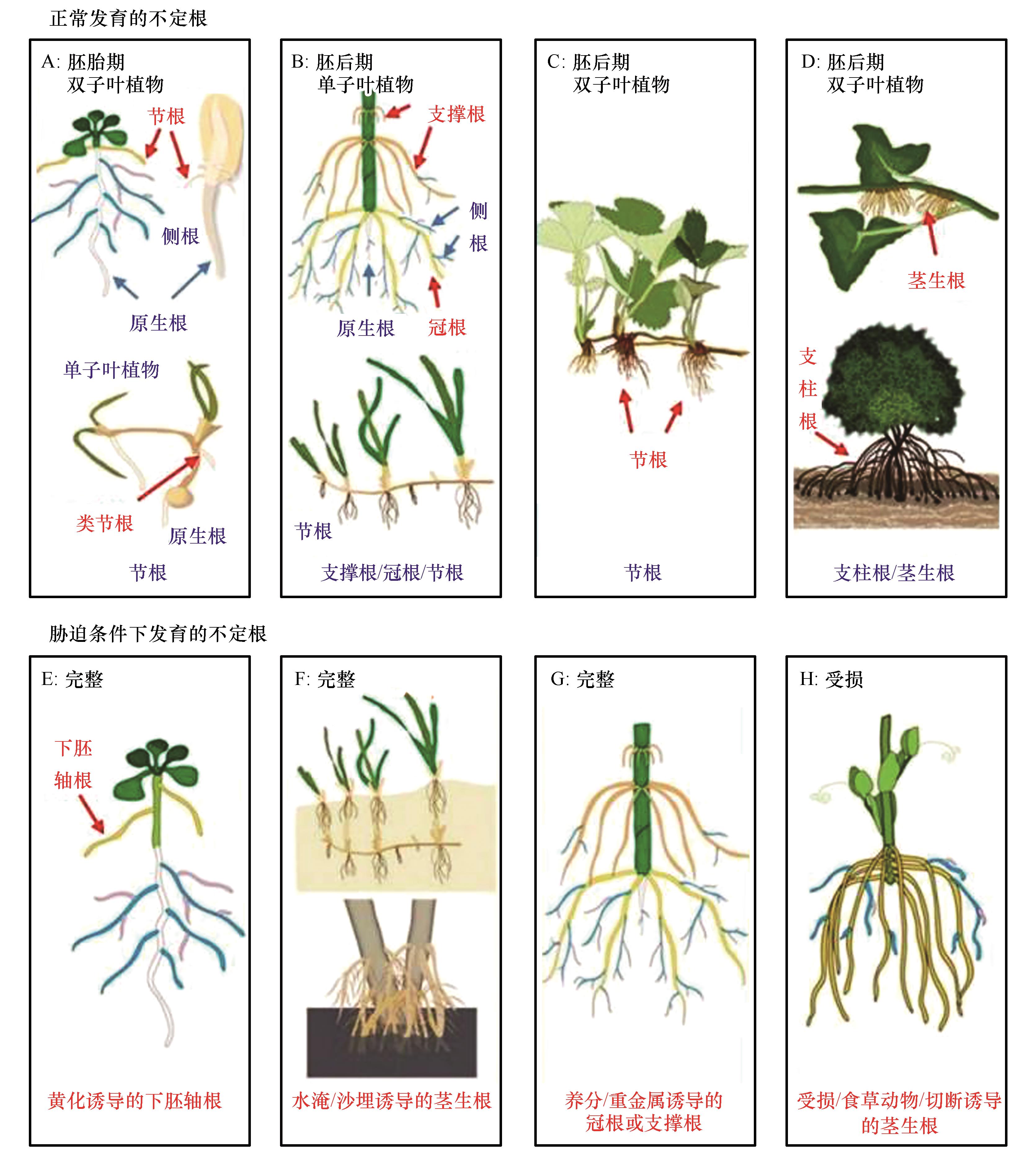
Fig.1 Schematic diagram illustrating adventitious roots formation[5]
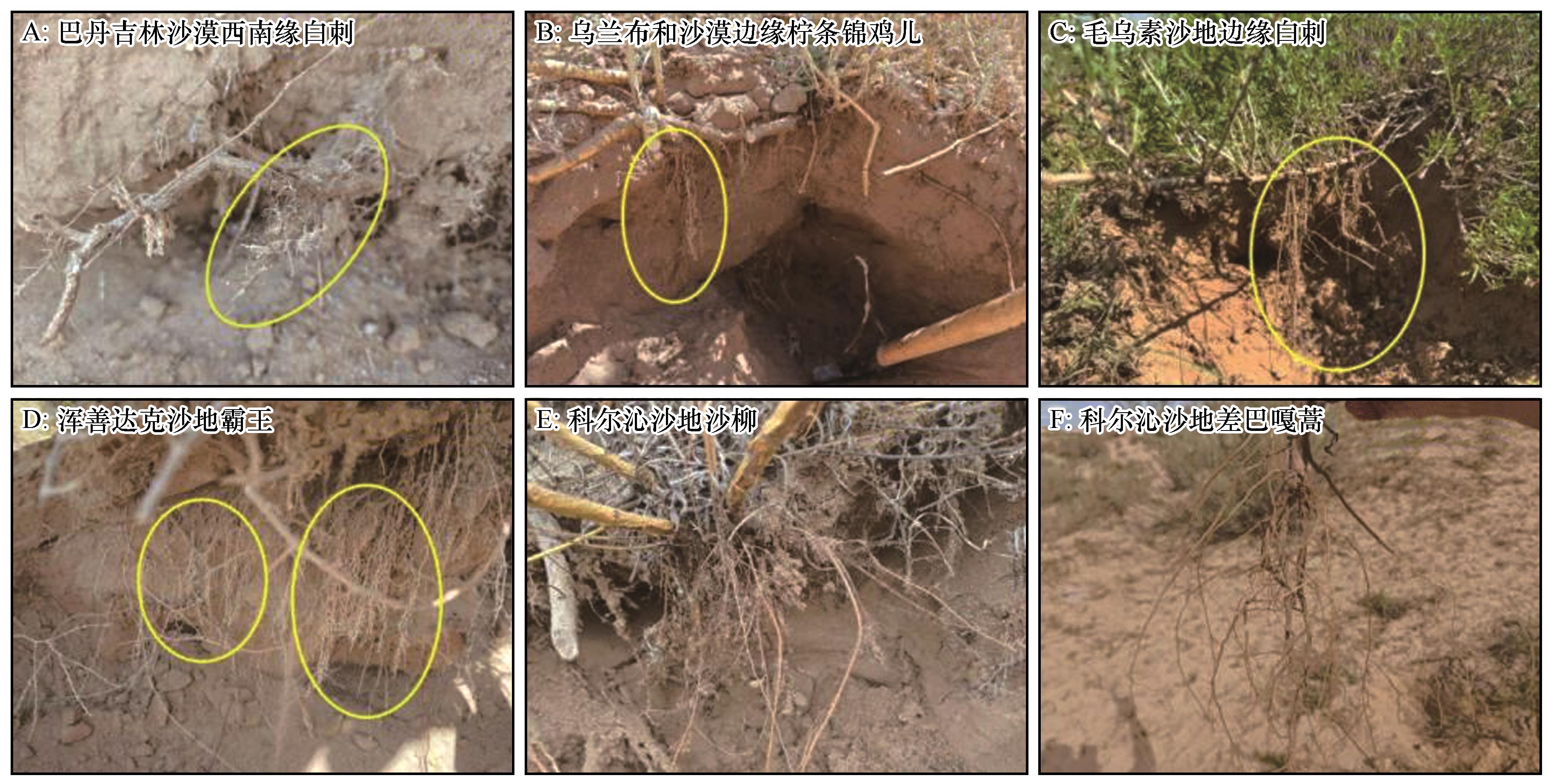
Fig.2 Adventitious roots developed on buried stems of common sand-fixing shrubs in major sandy regions of Northern China
| 调控机制 | 调控因子 | 功能及作用机制 | 参考文献 |
|---|---|---|---|
| 植物激素 | 生长素(IAA) | 调控基因表达,促进细胞分裂分化,诱导根原基形成,促使不定根产生 | [ |
| 细胞分裂素(CK) | 与生长素拮抗,高浓度抑制根原基形成 | [ | |
| 乙烯(ET) | 诱导皮层细胞死亡,形成通气组织,帮助根原基细胞产生,但可能在不定根诱导后期负向调控 | [ | |
| 独脚金内酯(SL) | 促进单子叶植物不定根伸长,植物受养分胁迫或机械损伤时,调控根系发育 | [ | |
| 茉莉酸(JA) | 负向调控,过表达茉莉酸的负向调节因子可以促进植物产生更长、更多的不定根 | [ | |
| 脱落酸(ABA) | 对水稻冠根生长有抑制作用 | [ | |
| 赤霉素(GA) | 通常抑制不定根发育,但其和乙烯一起可促进皮层细胞死亡,促进不定根出现 | [ | |
| 转录因子 | WOX家族(WOX10/WOX11) | 受生长素调控,建立根原基细胞 | [ |
| LBD家族(AtLBD18) | 调控不定根的发生 | [ | |
| ARF家族(AtARF4/AtARF6) | 参与木质部中柱鞘细胞的启动 | [ | |
| OsPLT家族(OsPLT1/OsPLT2) | OsPLT1正向调控不定根和侧根的起始和生长,OsPLT2控制侧根的形成但不影响不定根的发育 | [ | |
| miR156 | 维持植物的高可塑性,使植物保持较强的根系再生能力,以应对不确定的环境资源 | [ | |
| 蛋白质 | 过氧化物酶 | 诱导不定根形成,参与植物的各种生理过程,如抗氧化防御和木质素的形成等 | [ |
| 多酚氧化酶 | 主要集中在根原基形成区,影响细胞分裂分化和根原基的启动 | [ | |
| 吲哚乙酸氧化酶 | 氧化和降解IAA,调节内源激素的含量,帮助触发和启动植物根原基 | [ |
Table 1 Regulation factors related to adventitious roots
| 调控机制 | 调控因子 | 功能及作用机制 | 参考文献 |
|---|---|---|---|
| 植物激素 | 生长素(IAA) | 调控基因表达,促进细胞分裂分化,诱导根原基形成,促使不定根产生 | [ |
| 细胞分裂素(CK) | 与生长素拮抗,高浓度抑制根原基形成 | [ | |
| 乙烯(ET) | 诱导皮层细胞死亡,形成通气组织,帮助根原基细胞产生,但可能在不定根诱导后期负向调控 | [ | |
| 独脚金内酯(SL) | 促进单子叶植物不定根伸长,植物受养分胁迫或机械损伤时,调控根系发育 | [ | |
| 茉莉酸(JA) | 负向调控,过表达茉莉酸的负向调节因子可以促进植物产生更长、更多的不定根 | [ | |
| 脱落酸(ABA) | 对水稻冠根生长有抑制作用 | [ | |
| 赤霉素(GA) | 通常抑制不定根发育,但其和乙烯一起可促进皮层细胞死亡,促进不定根出现 | [ | |
| 转录因子 | WOX家族(WOX10/WOX11) | 受生长素调控,建立根原基细胞 | [ |
| LBD家族(AtLBD18) | 调控不定根的发生 | [ | |
| ARF家族(AtARF4/AtARF6) | 参与木质部中柱鞘细胞的启动 | [ | |
| OsPLT家族(OsPLT1/OsPLT2) | OsPLT1正向调控不定根和侧根的起始和生长,OsPLT2控制侧根的形成但不影响不定根的发育 | [ | |
| miR156 | 维持植物的高可塑性,使植物保持较强的根系再生能力,以应对不确定的环境资源 | [ | |
| 蛋白质 | 过氧化物酶 | 诱导不定根形成,参与植物的各种生理过程,如抗氧化防御和木质素的形成等 | [ |
| 多酚氧化酶 | 主要集中在根原基形成区,影响细胞分裂分化和根原基的启动 | [ | |
| 吲哚乙酸氧化酶 | 氧化和降解IAA,调节内源激素的含量,帮助触发和启动植物根原基 | [ |
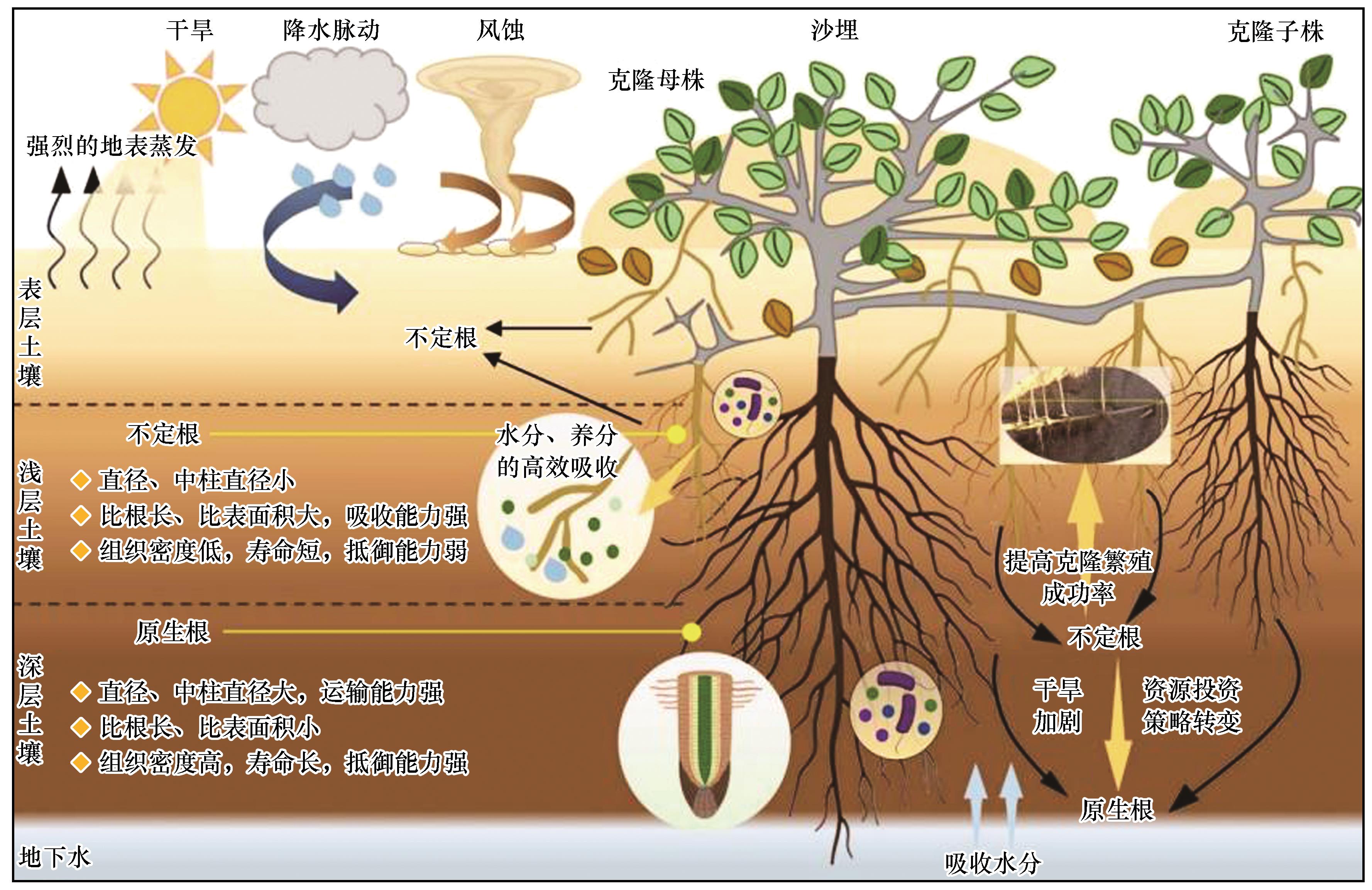
Fig.3 Schematic diagram of adventitious roots architectural characteristics and environmental function
| [1] | Luo W C, Zhao W Z, Liu B,et al.Nebkhas play important roles in desertification control and biodiversity protection in arid and semi-arid regions of China[J].Ecosystem Health and Sustainability,2020,6(1):1844550. |
| [2] | Zang Y X, Xu W X, Wu K,et al.Effect of nitrogen application on the sensitivity of desert shrub community productivity to precipitation in Central Asia[J].Frontiers in Plant Science,2022,13:916706. |
| [3] | Lynch J P.Harnessing root architecture to address global challenges[J].The Plant Journal,2022,109(2):415-431. |
| [4] | Liu B, Zeng F J, Arndt S K,et al.Patterns of root architecture adaptation of a phreatophytic perennial desert plant in a hyperarid desert[J].South African Journal of Botany,2013,86:56-62. |
| [5] | Steffens B, Rasmussen A.The physiology of adventitious roots[J].Plant Physiology,2016,170(2):603-617. |
| [6] | Bellini C, Pacurar D I, Perrone I.Adventitious roots and lateral roots:similarities and differences[J].Annual Review of Plant Biology,2014,65:639-666. |
| [7] | Luo W C, Zhao W Z.Adventitious roots are key to the development of nebkhas in extremely arid regions[J].Plant and Soil,2019,442(1/2):471-482. |
| [8] | Dech J P, Maun M A.Adventitious root production and plastic resource allocation to biomass determine burial tolerance in woody plants from central Canadian coastal dunes[J].Annals of Botany,2006,98(5):1095-1105. |
| [9] | Luo W C, Zhao W Z.Burial depth and diameter of the rhizome fragments affect the regenerative capacity of a clonal shrub[J].Ecological Complexity,2015,23:34-40. |
| [10] | Pernot C, Thiffault N, DesRochers A.Root system origin and structure influence planting shock of black spruce seedlings in boreal microsites[J].Forest Ecology and Management,2019,433:594-605. |
| [11] | Zhong L F, Feng X Y, Zhao W Z.Fixing active sand dune by native grasses in the desert of Northwest China[J].Ecological Processes,2024,13(4):1-13. |
| [12] | Freschet G T, Roumet C, Comas L H,et al.Root traits as drivers of plant and ecosystem functioning: current understanding,pitfalls and future research needs[J].New Phytologist,2021,232(3):1123-1158. |
| [13] | 单立山,李毅,任伟,等.河西走廊中部两种荒漠植物根系构型特征[J].应用生态学报,2013,24(1):25-31. |
| [14] | Tariq A, Graciano C, Sardans J,et al.Plant root mechanisms and their effects on carbon and nutrient accumulation in desert ecosystems under changes in land use and climate[J].New Phytologist,2024,242(3):916-934. |
| [15] | Xu H, Li Y.Water-use strategy of three central Asian desert shrubs and their responses to rain pulse events[J].Plant and Soil,2006,285(1):5-17. |
| [16] | Dai Y, Zheng X J, Tang L S,et al.Stable oxygen isotopes reveal distinct water use patterns of two Haloxylon species in the Gurbantonggut Desert[J].Plant and Soil,2015,389(1):73-87. |
| [17] | 杨小林,张希明,李义玲,等.塔克拉玛干沙漠腹地3种植物根系构型及其生境适应策略[J].植物生态学报,2008,32(6):1268-1276. |
| [18] | 单立山,李毅,董秋莲,等.红砂根系构型对干旱的生态适应[J].中国沙漠,2012,32(5):1283-1290. |
| [19] | 高天.额济纳荒漠植物红砂(Reaumuria songarica)根系构型、叶片生理指标变化的研究[D].呼和浩特:内蒙古农业大学,2022. |
| [20] | 单立山.西北典型荒漠植物根系形态结构和功能及抗旱生理研究[D].兰州:甘肃农业大学,2013. |
| [21] | Zhou H, Zhao W Z, Zheng X J,et al.Root distribution of Nitraria sibirica with seasonally varying water sources in a desert habitat[J].Journal of Plant Research,2015,128(4):613-622. |
| [22] | Fan M Y, Zhou H, Tian L H,et al.Hydrological niche separation between two coexisting shrubs in an extremely arid region[J].Journal of Hydrology:Regional Studies,2025,57:102170. |
| [23] | Lynch J P.Steep,cheap and deep: an ideotype to optimize water and N acquisition by maize root systems[J].Annals of Botany,2013,112(2):347-357. |
| [24] | Li X L, Dang X H, Gao Y,et al.Response mechanisms of adventitious root architectural characteristics of Nitraria tangutorum shrubs to soil nutrients in nabkha[J].Plants-Basel,2022,11(23):3218. |
| [25] | Liao T, Wang Y, Guo L Q,et al.Uncovering protein regulation during adventitious root formation in Platycladus orientalis cuttings[J].Tree Physiology,2024,44(12):tpae148. |
| [26] | 扈嘉鑫,陈宇熙,余敏芬,等.植物不定根生成的生理及分子调控机制研究进展[J].分子植物育种,2024,22(18):6151-6159. |
| [27] | 苗大鹏,贾瑞瑞,李胜皓,等.木本植物不定根发生机制研究进展[J].浙江农林大学学报,2022,39(4):902-912. |
| [28] | Pacurar D I, Perrone I, Bellini C.Auxin is a central player in the hormone cross-talks that control adventitious rooting[J].Physiologia Plantarum,2014,151(1):83-96. |
| [29] | Damodaran S, Strader L C.Factors governing cellular reprogramming competence in Arabidopsis adventitious root formation[J].Developmental Cell,2024,59(20):2745-2758. |
| [30] | Da Costa C T, De Almeida M R, Ruedell C M,et al.When stress and development go hand in hand:main hormonal controls of adventitious rooting in cuttings[J].Frontiers in Plant Science,2013,4:e00133. |
| [31] | Singh Z, Singh H, Garg T,et al.Genetic and hormonal blueprint of shoot-borne adventitious root development in rice and maize[J].Plant Cell Physiology,2022,63(12):1806-1813. |
| [32] | Liu J C, Sheng L H, Xu Y Q,et al. WOX11 and 12 are involved in the first-step cell fate transition during de novo root organogenesis in Arabidopsis [J].The Plant Cell,2014,26(3):1081-1093. |
| [33] | Zhao Y, Cheng S F, Song Y L,et al.The interaction between rice ERF3 and WOX11 promotes crown root development by regulating gene expression involved in cytokinin signaling[J].The Plant Cell,2015,27(9):2469-2483. |
| [34] | Muthulakshmi V, Vijayam C V, Bachpai V K W,et al.Genetic control of adventitious rooting traits in bi-parental pedigree of Eucalyptus tereticornis × E. camaldulensis [J].New Forests,2021,52(4):585-603. |
| [35] | Liu H J, Wang S F, Yu X B,et al.ARL1,a LOB-domain protein required for adventitious root formation in rice[J].The Plant Journal,2005,43(1):47-56. |
| [36] | Garg T, Singh Z, Chennakesavulu K,et al.Species-specific function of conserved regulators in orchestrating rice root architecture[J].Development,2022,149(9):dev200381. |
| [37] | Mhimdi M, Pérez-Pérez J M.Understanding of adventitious root formation: What can we learn from comparative genetics[J]?Frontiers in Plant Science,2020,11:582020. |
| [38] | Gaspar T, Kevers C, Hausman J,et al.Practical uses of peroxidase activity as a predictive marker of rooting performance of micropropagated shoots[J].Agronomie,1992,12(10):757-765. |
| [39] | Timm C R F, Schuch M W, Tomaz Z F,et al.Rooting of herbaceous minicuttings of peach rootstock under effect of indolebutyric acid (IBA)[J].Semina-Ciencias Agrarias,2015,36(1):135-140. |
| [40] | Sunita Kochhar S K, Kochhar V, Singh S,et al.Differential rooting and sprouting behaviour of two Jatropha species and associated physiological and biochemical changes[J].Current Science,2005,89(6):936-939. |
| [41] | Proctor C, He Y H.Quantifying root extracts and exudates of sedge and shrub in relation to root morphology[J].Soil Biology and Biochemistry,2017,114:168-180. |
| [42] | Centenaro G, Hudek C, Zanella A,et al.Root-soil physical and biotic interactions with a focus on tree root systems:a review[J].Applied Soil Ecology,2018,123:318-327. |
| [43] | Zhou M, Guo Y, Sheng J,et al.Using anatomical traits to understand root functions across root orders of herbaceous species in a temperate steppe[J].New Phytologist,2022,234(2):422-434. |
| [44] | 安宁,罗维成,郭彬,等.不定根发育对典型荒漠灌木白刺光合作用的影响[J].生态学报,2025,45(14):7026-7037. |
| [45] | Pernot C, Thiffault N, DesRochers A.Contribution of adventitious vs initial roots to growth and physiology of black spruce seedlings[J].Physiologia Plantarum,2019,165(1):29-38. |
| [46] | Padilla F M, Miranda J D, Pugnaire F I.Early root growth plasticity in seedlings of three Mediterranean woody species[J].Plant and Soil,2007,296(1/2):103-113. |
| [47] | Pernot C, Thiffault N, DesRochers A.Influence of root system characteristics on black spruce seedling responses to limiting conditions[J].Plants,2019,8(3):70. |
| [48] | Hafner B D, Hesse B D, Grams T E E.Friendly neighbours: hydraulic redistribution accounts for one quarter of water used by neighbouring drought stressed tree saplings[J].Plant Cell and Environment,2021,44(4):1243-1256. |
| [49] | Schwinning S, Ehleringer J R.Water use trade-offs and optimal adaptations to pulse-driven arid ecosystems[J].Journal of Ecology,2001,89(3):464-480. |
| [50] | Poorter H, Niklas K J, Reich P B,et al.Biomass allocation to leaves,stems and roots:meta-analyses of interspecific variation and environmental control[J].New Phytologist,2012,193(1):30-50. |
| [51] | Padilla F M, Miranda J D, Jorquera M J,et al.Variability in amount and frequency of water supply affects roots but not growth of arid shrubs[J].Plant Ecology,2009,204(2):261-270. |
| [52] | 李小乐,党晓宏,翟波,等.白刺(Nitraria tangutorum)灌丛不定根构型特征及生物量分配模式[J].中国沙漠,2022,42(4):172-180. |
| [53] | 周瑞莲,杨淑琴,黄清荣,等.小叶锦鸡儿抗沙埋生长与抗氧化酶及同工酶变化的关系[J].生态学报,2015,35(9):3014-3022. |
| [54] | 赵国靖,徐伟洲,郭亚力,等.达乌里胡枝子根系形态特征对土壤水分变化的响应[J].应用与环境生物学报,2014,20(3):484-490. |
| [55] | 李帅,赵国靖,徐伟洲,等.白羊草根系形态特征对土壤水分阶段变化的响应[J].草业学报,2016,25(2):169-177. |
| [56] | Quets J J, El-Bana M I, Al-Rowaily S L,et al.A mechanism of self-organization in a desert with phytogenic mounds[J].Ecosphere,2016,7(11):e01494. |
| [57] | 杜建会,严平,董玉祥.干旱地区灌丛沙堆研究现状与展望[J].地理学报,2010,65(3):339-350. |
| [58] | 苗纯萍,李雪华,蒋德明.半干旱风沙区黄柳幼苗生长发育对沙埋的响应[J].干旱区研究,2012,29(2):208-212. |
| [59] | Knipfer T, Besse M, Verdeil J-L,et al.Aquaporin-facilitated water uptake in barley (Hordeum vulgare L.) roots[J].Journal of Experimental Botany,2011,62(12):4115-4126. |
| [60] | Luo W C, Zhao W Z, An N,et al.Preferential flow in soils is key to the development of nebkhas in water limited regions[J].Geoderma,2025,454:117205. |
| [61] | 耿东梅,单立山,李毅.土壤水分胁迫对红砂幼苗细根形态和功能特征的影响[J].水土保持通报,2014,34(6):36-42. |
| [62] | 侯晓娟,李志,崔诚,等.武功山芒根系垂直分布及其与土壤养分的关系[J].草业科学,2017,34(12):2428-2436. |
| [63] | Rellán-Alvarez R, Lobet G, Dinneny J R.Environmental control of root system biology[J].Annual Review of Plant Biology,2016,67:619-642. |
| [64] | Bayuelo-Jiménez J S, Gallardo-Valdéz M, Pérez-Decelis V A,et al.Genotypic variation for root traits of maize (Zea mays L.) from the Purhepecha Plateau under contrasting phosphorus availability[J].Field Crops Research,2011,121(3):350-362. |
| [65] | 苏洁琼,李新荣,李小军,等.草原化荒漠植被草本层片植物对人工施加氮素的响应[J].中国沙漠,2010,30(6):1336-1340. |
| [66] | Rosas U, Lara-González J A, De-la-Rosa-Tilapa A,et al.Persistent adventitious and basal root development during salt stress tolerance in Echinocactus platyacanthus (Cactaceae) seedlings[J].Journal of Arid Environments,2021,187:104431. |
| [67] | Yu P, White P J, Hochholdinger F,et al.Phenotypic plasticity of the maize root system in response to heterogeneous nitrogen availability[J].Planta,2014,240(4):667-678. |
| [68] | Cheng L, Wu B, Pang Y J,et al.Shrub growth improves morphological features of nebkhas:a case study of Nitraria tangutorum in the Tengger Desert[J].Plants-Basel,2024,13(5):624. |
| [69] | Klimešová J, Martínková J, Ottaviani G.Belowground plant functional ecology: towards an integrated perspective[J].Functional Ecology,2018,32(9):2115-2126. |
| [1] | Weicheng Luo, Wenzhi Zhao, Bing Liu, Hai Zhou, Jiliang Liu, Jiayi Liu. The progress on the development process and driving mechanisms of nebkhas in arid regions [J]. Journal of Desert Research, 2026, 46(1): 151-161. |
| [2] | Weiqi Yao, Yafeng Zhang, Chuan Yuan, Jingliang Chen, Jianqiang Huo, Yanxia Pan, Miaomiao Wang. The influence of morphological characteristics of Caragana korshinskii on stemflow production [J]. Journal of Desert Research, 2025, 45(3): 346-356. |
| [3] | Yixue Zhao, Yang Zhao, Yuchao Lian, Yanqiao Zhao, Wenwen Xu. The influence of sand-sixing shrubs species and densities on the litter and biological soil crusts [J]. Journal of Desert Research, 2025, 45(3): 262-270. |
| [4] | Jiale Li, Beibei Chen, Dinghai Zhang. Research progress on spatial point pattern of sand-fixing shrubs in sandy regions of Northern China [J]. Journal of Desert Research, 2025, 45(3): 102-112. |
| [5] | Dengke Ma, Zhibin He, Wenzhi Zhao, Jun Du, Weihao Sun, Shuai Wang, Rui Li, Bing Liu. Review on the ecological benefits of sandy medicinal plants in arid areas [J]. Journal of Desert Research, 2025, 45(1): 55-62. |
| [6] | Dandan Li, Jiawen Li, Guanglei Gao, Ying Zhang, Yue Ren, Ye Liu, Peishan Zhao. Soil fungal community structure and functional characteristics associated with Pinussylvestris var. mongolica plantations in the Horqin Sandy Land [J]. Journal of Desert Research, 2023, 43(4): 241-251. |
| [7] | Xiaohan Chen, Yongsheng Wu, Chunxing Hai. Effects of surface dew under different types of sand-fixing shrubs in the southern margin of Mu Us Sandy Land, Northern China [J]. Journal of Desert Research, 2023, 43(1): 83-95. |
| [8] | Wenwen Xu, Yanqiao Zhao, Nan Wang, Yang Zhao. Effects of artificial biological soil crusts on the composition and diversity of herbaceous plant communities [J]. Journal of Desert Research, 2022, 42(5): 204-211. |
| [9] | Xiaole Li, Xiaohong Dang, Bo Zhai, Yajuan Wei, Xu Chi, Huimin Wu. Adventitious root architecture and growth characteristics of Nitraria tangutorum shrub [J]. Journal of Desert Research, 2022, 42(4): 172-180. |
| [10] | Hei Weigao, Zhan Jin, Han Dan, Yang Hongling, Li Yulin. Compatible Biomass Models for Two Dominant Sand-fixing Shrubs in Horqin Sandy Land [J]. Journal of Desert Research, 2019, 39(5): 193-199. |
| [11] | You Nanshan, Meng Jijun. Ecological Functions Regionalization and Ecosystem Management Based on the Ecological Sensitivity and Ecosystem Service in the Middle Reaches of the Heihe River [J]. JOURNAL OF DESERT RESEARCH, 2017, 37(1): 186-197. |
| [12] | Du Jianhui, Dong Yuxiang, Hu Mianyou. The Research Progress and Prospects of Ecosystem Services in Coastal Dunes [J]. JOURNAL OF DESERT RESEARCH, 2015, 35(2): 479-486. |
| [13] | XU Xian-ying1,2,3, YAN Ping1, GUO Shu-jiang2,3, CHAI Cheng-wu2,3. The Interception Loss of Rainfall by Three Sand-fixing Shrubs at the Fringe of Minqin Oasis [J]. JOURNAL OF DESERT RESEARCH, 2013, 33(1): 141-145. |
| [14] | WU Yu-huan, CHENG Guo-dong, GAO Qian. Bryophyte's Ecology Functions and Its Significances in Revegetation [J]. JOURNAL OF DESERT RESEARCH, 2003, 23(3): 215-220. |
| [15] | ZHANG Ai guo, ZHANG Shu li, QIN Zuo dong. The Land Ecology Designing Method and Its Use to Desertification Control in Northwestern Region of Shanxi [J]. JOURNAL OF DESERT RESEARCH, 1999, 19(1): 46-50. |
| Viewed | ||||||
|
Full text |
|
|||||
|
Abstract |
|
|||||
©2018Journal of Desert Research
Tel:0931-8267545
Email:caiedit@lzb.ac.cn;desert@lzb.ac.cn
Support:Magtech
