中国沙漠 ›› 2026, Vol. 46 ›› Issue (1): 262-272.DOI: 10.7522/j.issn.1000-694X.2025.00107
• • 上一篇
王二军1( ), 张亚龙1, 刘阳3,4, 张怡洋4, 晋玲1,2, 章高森1,3,4()
收稿日期:2025-03-06
修回日期:2025-05-06
出版日期:2026-01-20
发布日期:2026-03-09
通讯作者:
章高森
作者简介:王二军(2001—),男,甘肃陇南人,硕士研究生,研究方向为资源保护、评价及可持续利用。E-mail: wej2024@163.com
基金资助:
Erjun Wang1(), Yalong Zhang1, Yang Liu3,4, Yiyang Zhang4, Ling Jin1,2, Gaosen Zhang1,3,4()
Received:2025-03-06
Revised:2025-05-06
Online:2026-01-20
Published:2026-03-09
Contact:
Gaosen Zhang
摘要:
新疆罗布泊极端干旱区生态系统中蕴藏着丰富的微生物资源。为揭示该地区微生物资源的多样性和分布特征,采用6种培养基对样品中的细菌进行分离纯化,结合16S rRNA基因扩增、测序及系统发育分析,对分离获得的细菌进行鉴定和群落结构分析。结果表明:分离的细菌主要归属于放线菌门(Actinobacteria)、拟杆菌门(Bacteroidetes)、厚壁菌门(Firmicutes)和变形菌门(Proteobacteria),其中放线菌门和厚壁菌门为优势菌门。在属水平上,考克氏菌属(Kocuria)、诺卡氏菌属(Nocardiopsis)和盐水球菌属(Salinicoccus)是优势菌属。不同生境中可培养细菌的数量、群落结构和多样性存在显著差异,细菌丰富度沙土>珠芽蓼>芦苇>柽柳。4种生境中共分离出54个菌属,可培养菌落数为1.280×10⁵~2.168×10⁶ CFU·g-1,并鉴定出41株潜在新种。本研究揭示了罗布泊地区可培养细菌的多样性特征,阐明了该地区珠芽蓼、柽柳和芦苇3种药用植物根际可培养细菌的菌属差异。
中图分类号:
王二军, 张亚龙, 刘阳, 张怡洋, 晋玲, 章高森. 罗布泊荒漠药用植物根际可培养细菌多样性[J]. 中国沙漠, 2026, 46(1): 262-272.
Erjun Wang, Yalong Zhang, Yang Liu, Yiyang Zhang, Ling Jin, Gaosen Zhang. Cultivatable bacterial diversity in the rhizosphere of Lop Nur desert sandy soil and medicinal plants[J]. Journal of Desert Research, 2026, 46(1): 262-272.
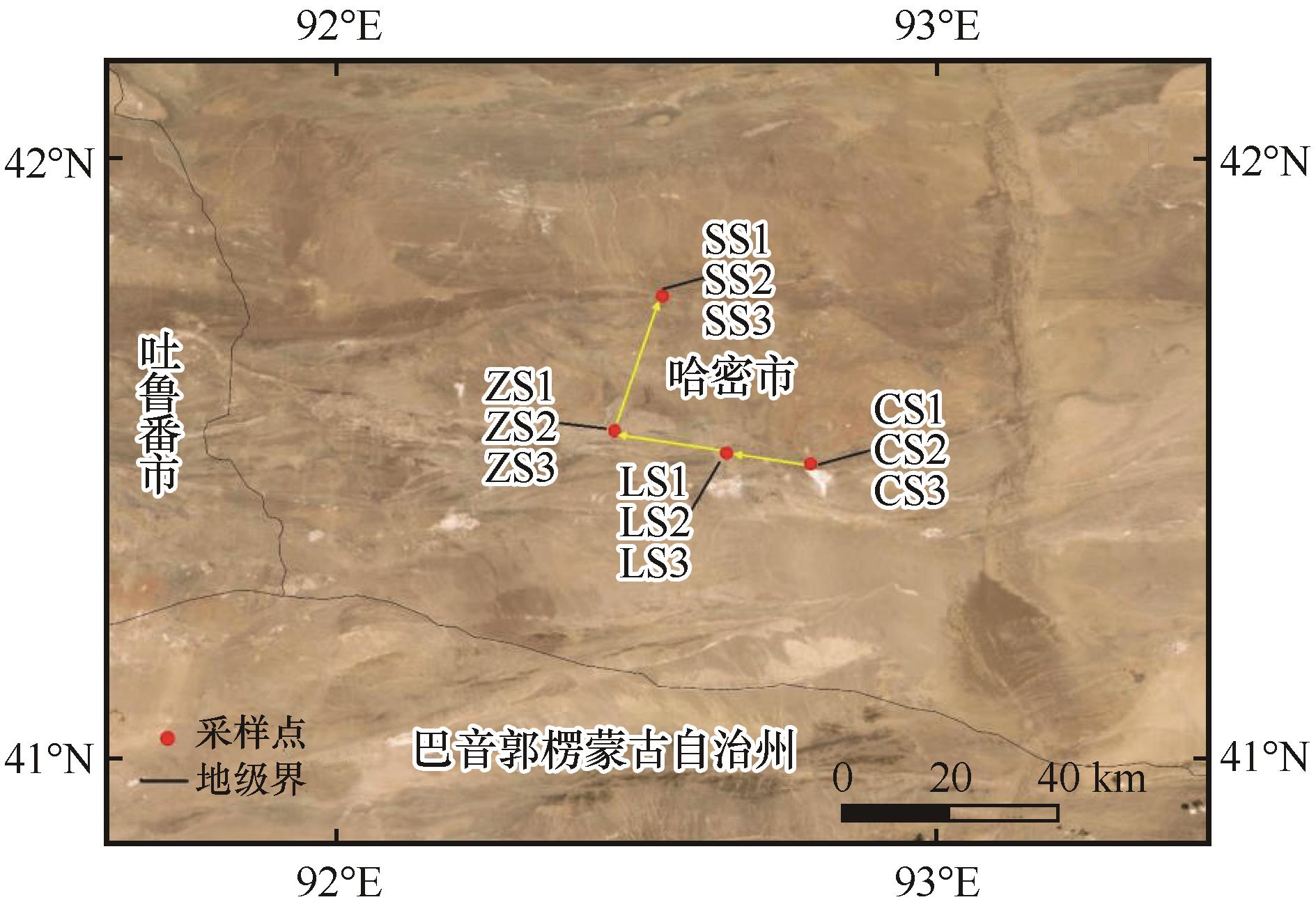
图1 采样点位置
Fig.1 Locations of the sampling points
| 培养基 | 成分及浓度/(g·L-1) |
|---|---|
| NFM | KH₂PO₄: 1.0, K₂HPO₄: 1.54, NaCl: 0.05, CaCl₂: 0.04, FeCl₃: 0.004, MgSO₄: 0.1, 酵母浸粉: 0.8, 琼脂: 15.0, pH: 6.9±0.1 |
| YMA | K₂HPO₄: 0.5, MgSO₄: 0.2, NaCl: 0.1, 甘露醇: 10.0, 酵母浸粉: 1.0, 刚果红: 0.025, 琼脂: 15.0, pH: 7.0±0.2 |
| ISP2 | 麦芽浸粉: 10.0, 酵母浸粉: 4.0, 葡萄糖: 4.0, 琼脂: 20.0, pH: 7.3±0.2 |
| ISP7 | L-天冬酰胺: 1.0, L-酪氨酸: 0.5, K₂HPO₄: 0.5, MgSO₄·7H₂O: 0.5, NaCl: 0.5, FeSO₄·7H₂O: 0.01, MnCl₂·4H₂O: 0.001, ZnSO₄·7H₂O: 0.001, 丙三醇: 18.9, 琼脂: 20.0, pH: 7.0±0.2 |
| R2A | 胰蛋白胨: 0.25, 酸水解酪蛋白: 0.5, 酵母浸粉: 0.5, 可溶性淀粉: 0.5, K₂HPO₄: 0.3, MgSO₄: 0.1, 丙酮酸钠: 0.3, 蛋白胨: 0.25, 葡萄糖: 0.5, 琼脂: 20.0, pH: 7.2±0.2 |
| TSB | 胰酪胨: 17.0, 大豆粉木瓜蛋白酶消化物: 3.0, 葡萄糖: 2.5, NaCl: 5.0, K₂HPO₄: 2.5, 琼脂: 20.0, pH: 7.3±0.2 |
表1 培养基组成
Table 1 Medium composition
| 培养基 | 成分及浓度/(g·L-1) |
|---|---|
| NFM | KH₂PO₄: 1.0, K₂HPO₄: 1.54, NaCl: 0.05, CaCl₂: 0.04, FeCl₃: 0.004, MgSO₄: 0.1, 酵母浸粉: 0.8, 琼脂: 15.0, pH: 6.9±0.1 |
| YMA | K₂HPO₄: 0.5, MgSO₄: 0.2, NaCl: 0.1, 甘露醇: 10.0, 酵母浸粉: 1.0, 刚果红: 0.025, 琼脂: 15.0, pH: 7.0±0.2 |
| ISP2 | 麦芽浸粉: 10.0, 酵母浸粉: 4.0, 葡萄糖: 4.0, 琼脂: 20.0, pH: 7.3±0.2 |
| ISP7 | L-天冬酰胺: 1.0, L-酪氨酸: 0.5, K₂HPO₄: 0.5, MgSO₄·7H₂O: 0.5, NaCl: 0.5, FeSO₄·7H₂O: 0.01, MnCl₂·4H₂O: 0.001, ZnSO₄·7H₂O: 0.001, 丙三醇: 18.9, 琼脂: 20.0, pH: 7.0±0.2 |
| R2A | 胰蛋白胨: 0.25, 酸水解酪蛋白: 0.5, 酵母浸粉: 0.5, 可溶性淀粉: 0.5, K₂HPO₄: 0.3, MgSO₄: 0.1, 丙酮酸钠: 0.3, 蛋白胨: 0.25, 葡萄糖: 0.5, 琼脂: 20.0, pH: 7.2±0.2 |
| TSB | 胰酪胨: 17.0, 大豆粉木瓜蛋白酶消化物: 3.0, 葡萄糖: 2.5, NaCl: 5.0, K₂HPO₄: 2.5, 琼脂: 20.0, pH: 7.3±0.2 |
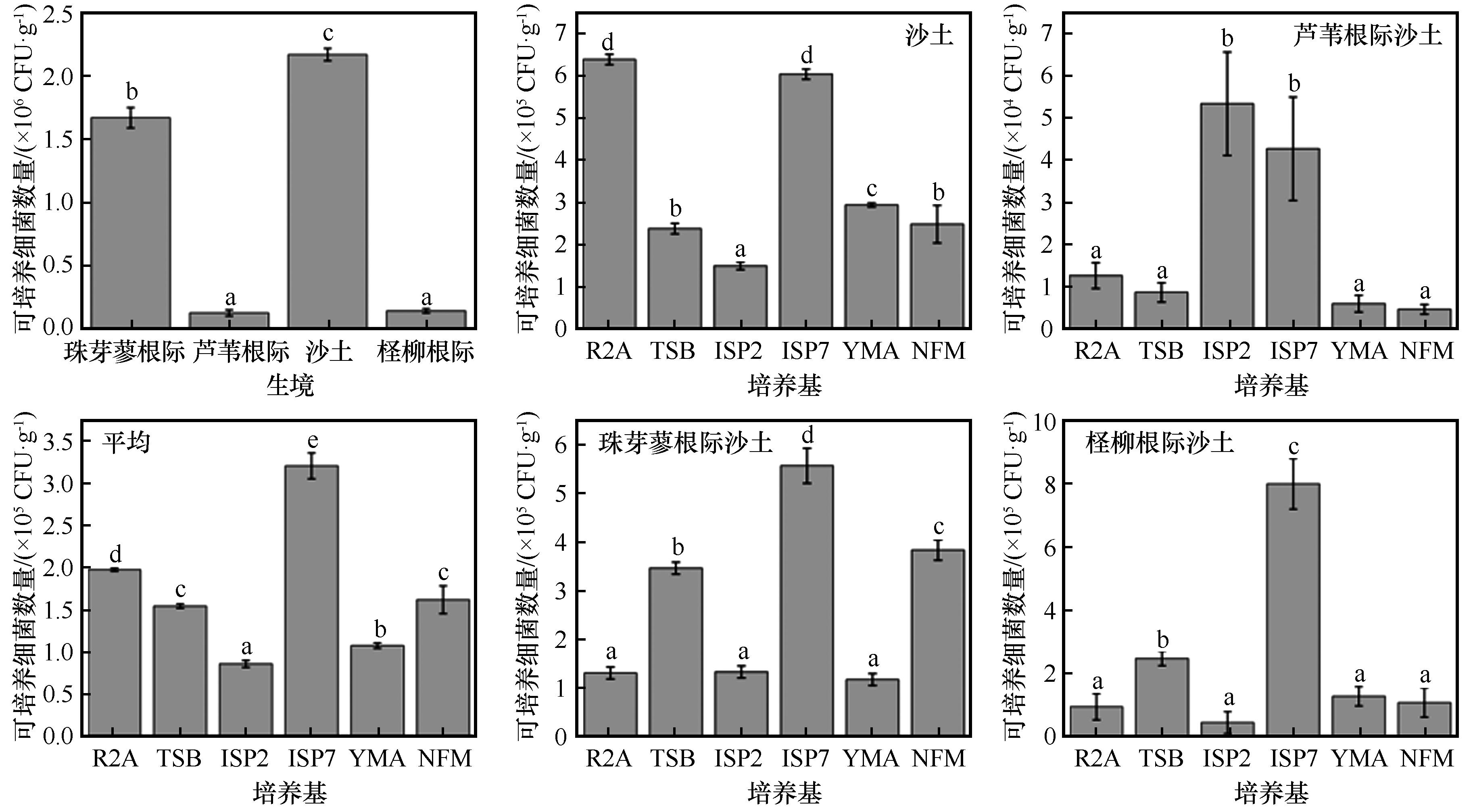
图2 不同生境与培养基可培养细菌数量注:不同小写字母代表不同处理之间采用“Duncan test”检验,具有显著性差异(P<0.05),相同字母代表不同处理之间,不具有显著差异(P>0.05)
Fig.2 The number of bacteria that can be cultured in different habitats and media
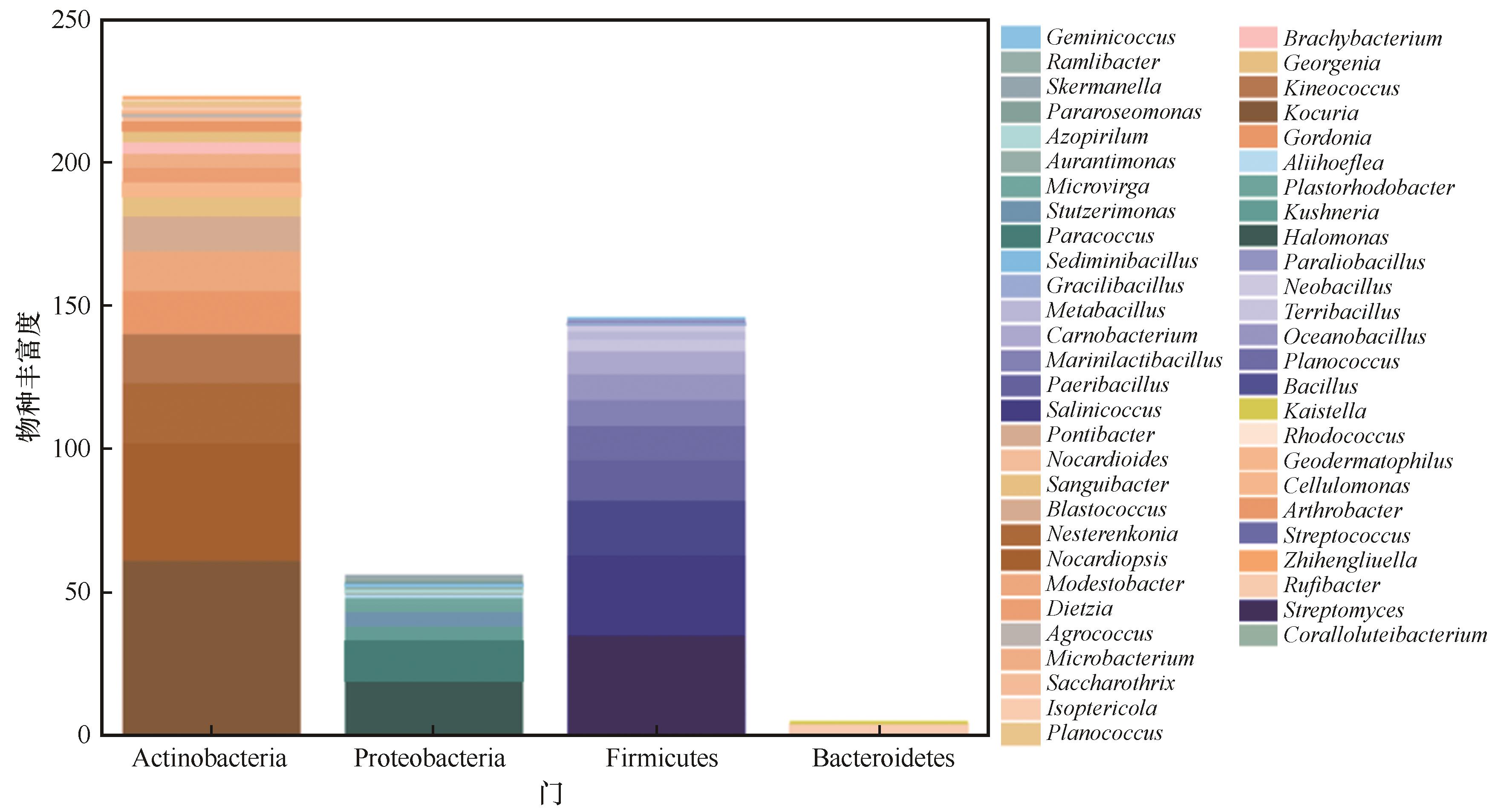
图3 罗布泊可培养细菌群落组成
Fig.3 Composition of the cultureable bacterial community in Lop Nur
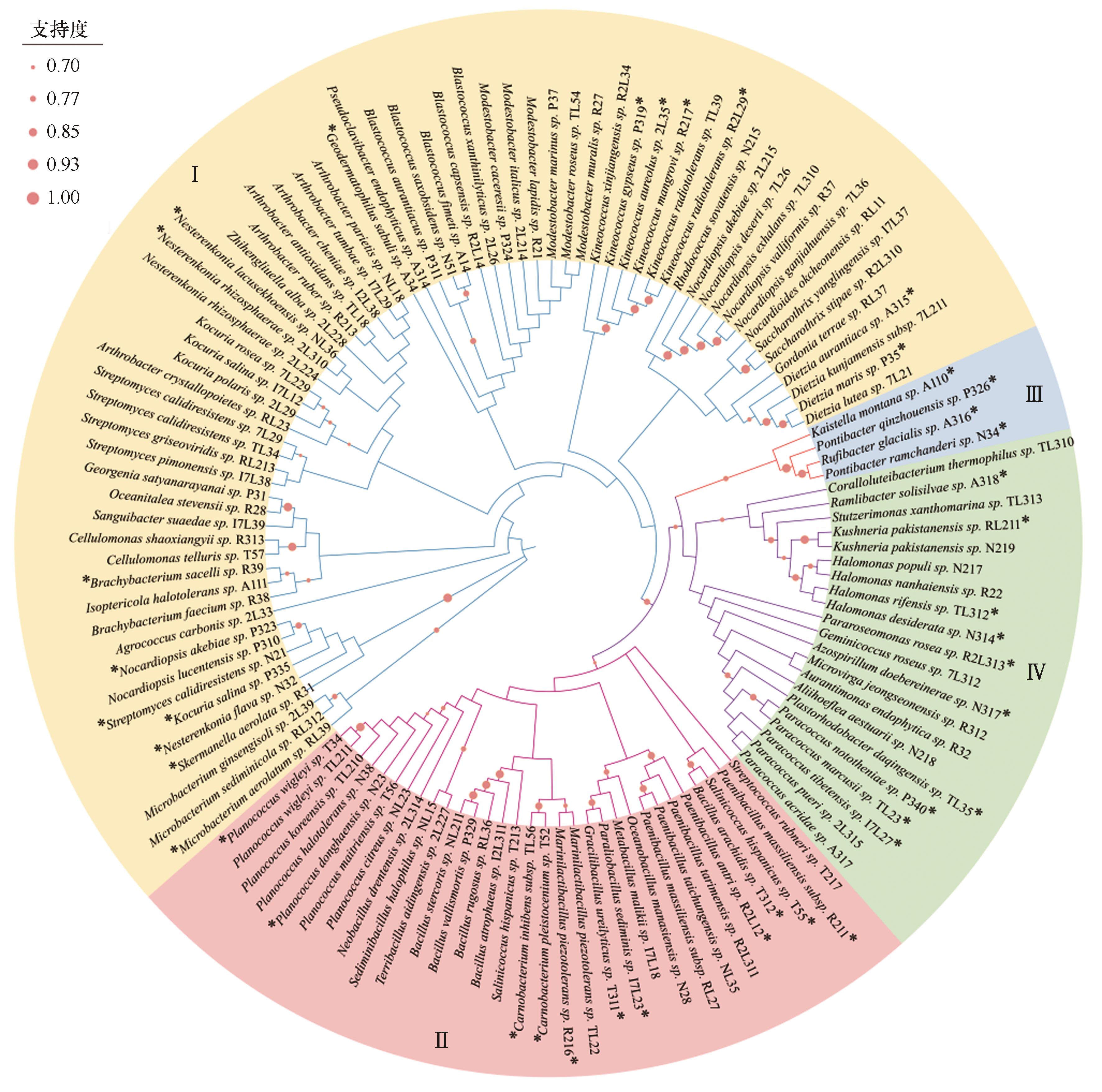
图4 可培养细菌基于16S rRNA基因序列构建的系统发育树注:系统发育树采用近邻相接法构建;*表示与最相似模式菌株比对后16S rRNA基因序列相似度低于98.65%的疑似新种;Ⅰ,Ⅱ,Ⅲ,Ⅳ分别表示Actinobacteria、Firmicutes、Bacteroidetes、Proteobacteria
Fig.4 Phylogenetic tree of culturable bacteria based on 16S rRNA gene sequences
| 属名 | 编号 | 模式菌株 | 相似度 | 登录号 |
|---|---|---|---|---|
| Dietzia | P35 | Dietzia maris DSM 43672T | 98.60 | X79290 |
| Nocardiopsis | P323 | Nocardiopsis akebiae HDS12T | 98.35 | OM368592 |
| Nesterenkonia | 2L310 | Nesterenkonia rhizosphaerae EGI 80099T | 98.34 | KF040423 |
| Nesterenkonia | NL36 | Nesterenkonia lacusekhoensis IFAM EL-30T | 98.41 | AJ290397 |
| Nesterenkonia | N32 | Nesterenkonia flava CAAS 251T | 96.79 | EF680886 |
| Microbacterium | RL39 | Microbacterium aerolatum NBRC 103071T | 98.20 | BJUW01000027 |
| Kocuria | P335 | Kocuria salina Hv14bT | 97.97 | LT674162 |
| Kineococcus | R2L29 | Kineococcus radiotolerans SRS30216T | 97.39 | CP000750 |
| Kineococcus | R217 | Kineococcus mangrovi L2-1-L1T | 98.48 | LC056925 |
| Kineococcus | P319 | Kineococcus gypseus YIM 121300T | 97.84 | KP205400 |
| Kineococcus | 2L35 | Kineococcus aureolus YIM 121940T | 98.26 | KX943589 |
| Geodermatophilus | A34 | Geodermatophilus sabuli BMG8133T | 98.38 | LN626269 |
| Dietzia | A315 | Dietzia aurantiaca CCUG 35676T | 97.23 | FR821260 |
| Brachybacterium | R39 | Brachybacterium sacelli LMG 20345T | 98.37 | AJ415384 |
| Rufibacter | A316 | Rufibacter glacialis MDT1-10-3T | 97.89 | JX949546 |
| Pontibacter | N34 | Pontibacter ramchanderi LP43T | 94.44 | jgi.1102448 |
| Pontibacter | P326 | Pontibacter qinzhouensis GY10130T | 96.98 | MZ318048 |
| Kaistella | A110 | Kaistella montana WG4T | 98.47 | KX082815 |
| Streptomyces | N21 | Streptomyces calidiresistens YIM 78087T | 97.15 | KJ361473 |
| Salinicoccus | T55 | Salinicoccus hispanicus DSM 5352T | 96.91 | AY028927 |
| Planococcus | T34 | Planococcus wigleyi Sa1BUA13T | 98.45 | JACSPU010000017 |
| Planococcus | N23 | Planococcus donghaensis DSM 22276T | 98.57 | CP016544 |
| Paraliobacillus | I7L23 | Paraliobacillus sediminis 126C4T | 95.73 | KU870235 |
| Paenibacillus | R211 | Paenibacillus massiliensis subsp panacisoli Gsoil 1411T | 97.55 | AB245384 |
| Paenibacillus | R2L12 | Paenibacillus antri SYSU K30003T | 96.50 | MK943674 |
| Marinilactibacillus | R216 | Marinilactibacillus piezotolerans DSM 16108T | 98.57 | jgi.1067996 |
| Gracilibacillus | T311 | Gracilibacillus ureilyticus MF38T | 97.83 | EU709020 |
| Carnobacterium | T52 | Carnobacterium pleistocenium FTR1T | 96.40 | JQLQ01000002 |
| Carnobacterium | TL56 | Carnobacterium inhibens subsp Inhibens DSM 13024T | 95.93 | JQIV01000006 |
| Bacillus | T312 | Bacillus arachidis SY8T | 97.94 | OM062591 |
| Skermanella | R31 | Skermanella aerolata 5416T-32T | 98.31 | DQ672568 |
| Ramlibacter | A318 | Ramlibacter solisilvae 5-10T | 97.71 | CP010951 |
| Plastorhodobacter | TL35 | Plastorhodobacter daqingensis DQW12E81-30T | 97.08 | KF312713 |
| Pararoseomonas | R2L313 | Pararoseomonas rosea 173-96T | 98.22 | AJ488505 |
| Paracoccus | I7L27 | Paracoccus tibetensis Tibet-S9a3T | 98.04 | DQ108402 |
| Paracoccus | P340 | Paracoccus nototheniae I-41R45T | 98.28 | MH065728 |
| Paracoccus | TL23 | Paracoccus marcusii DSM 11574T | 98.34 | Y12703 |
| Kushneria | RL211 | Kushneria pakistanensis NCCP-934T | 98.15 | AB970675 |
| Halomonas | TL312 | Halomonas rifensis HK31T | 97.43 | HM026177 |
| Halomonas | N314 | Halomonas desiderata FB2T | 97.86 | X92417 |
| Azospirillum | N317 | Azospirillum doebereinerae GSF71T | 98.48 | AJ238567 |
表2 罗布泊地区可培养细菌的潜在新种
Table 2 Potential new species of bacteria that can be cultured in the Lop Nur area
| 属名 | 编号 | 模式菌株 | 相似度 | 登录号 |
|---|---|---|---|---|
| Dietzia | P35 | Dietzia maris DSM 43672T | 98.60 | X79290 |
| Nocardiopsis | P323 | Nocardiopsis akebiae HDS12T | 98.35 | OM368592 |
| Nesterenkonia | 2L310 | Nesterenkonia rhizosphaerae EGI 80099T | 98.34 | KF040423 |
| Nesterenkonia | NL36 | Nesterenkonia lacusekhoensis IFAM EL-30T | 98.41 | AJ290397 |
| Nesterenkonia | N32 | Nesterenkonia flava CAAS 251T | 96.79 | EF680886 |
| Microbacterium | RL39 | Microbacterium aerolatum NBRC 103071T | 98.20 | BJUW01000027 |
| Kocuria | P335 | Kocuria salina Hv14bT | 97.97 | LT674162 |
| Kineococcus | R2L29 | Kineococcus radiotolerans SRS30216T | 97.39 | CP000750 |
| Kineococcus | R217 | Kineococcus mangrovi L2-1-L1T | 98.48 | LC056925 |
| Kineococcus | P319 | Kineococcus gypseus YIM 121300T | 97.84 | KP205400 |
| Kineococcus | 2L35 | Kineococcus aureolus YIM 121940T | 98.26 | KX943589 |
| Geodermatophilus | A34 | Geodermatophilus sabuli BMG8133T | 98.38 | LN626269 |
| Dietzia | A315 | Dietzia aurantiaca CCUG 35676T | 97.23 | FR821260 |
| Brachybacterium | R39 | Brachybacterium sacelli LMG 20345T | 98.37 | AJ415384 |
| Rufibacter | A316 | Rufibacter glacialis MDT1-10-3T | 97.89 | JX949546 |
| Pontibacter | N34 | Pontibacter ramchanderi LP43T | 94.44 | jgi.1102448 |
| Pontibacter | P326 | Pontibacter qinzhouensis GY10130T | 96.98 | MZ318048 |
| Kaistella | A110 | Kaistella montana WG4T | 98.47 | KX082815 |
| Streptomyces | N21 | Streptomyces calidiresistens YIM 78087T | 97.15 | KJ361473 |
| Salinicoccus | T55 | Salinicoccus hispanicus DSM 5352T | 96.91 | AY028927 |
| Planococcus | T34 | Planococcus wigleyi Sa1BUA13T | 98.45 | JACSPU010000017 |
| Planococcus | N23 | Planococcus donghaensis DSM 22276T | 98.57 | CP016544 |
| Paraliobacillus | I7L23 | Paraliobacillus sediminis 126C4T | 95.73 | KU870235 |
| Paenibacillus | R211 | Paenibacillus massiliensis subsp panacisoli Gsoil 1411T | 97.55 | AB245384 |
| Paenibacillus | R2L12 | Paenibacillus antri SYSU K30003T | 96.50 | MK943674 |
| Marinilactibacillus | R216 | Marinilactibacillus piezotolerans DSM 16108T | 98.57 | jgi.1067996 |
| Gracilibacillus | T311 | Gracilibacillus ureilyticus MF38T | 97.83 | EU709020 |
| Carnobacterium | T52 | Carnobacterium pleistocenium FTR1T | 96.40 | JQLQ01000002 |
| Carnobacterium | TL56 | Carnobacterium inhibens subsp Inhibens DSM 13024T | 95.93 | JQIV01000006 |
| Bacillus | T312 | Bacillus arachidis SY8T | 97.94 | OM062591 |
| Skermanella | R31 | Skermanella aerolata 5416T-32T | 98.31 | DQ672568 |
| Ramlibacter | A318 | Ramlibacter solisilvae 5-10T | 97.71 | CP010951 |
| Plastorhodobacter | TL35 | Plastorhodobacter daqingensis DQW12E81-30T | 97.08 | KF312713 |
| Pararoseomonas | R2L313 | Pararoseomonas rosea 173-96T | 98.22 | AJ488505 |
| Paracoccus | I7L27 | Paracoccus tibetensis Tibet-S9a3T | 98.04 | DQ108402 |
| Paracoccus | P340 | Paracoccus nototheniae I-41R45T | 98.28 | MH065728 |
| Paracoccus | TL23 | Paracoccus marcusii DSM 11574T | 98.34 | Y12703 |
| Kushneria | RL211 | Kushneria pakistanensis NCCP-934T | 98.15 | AB970675 |
| Halomonas | TL312 | Halomonas rifensis HK31T | 97.43 | HM026177 |
| Halomonas | N314 | Halomonas desiderata FB2T | 97.86 | X92417 |
| Azospirillum | N317 | Azospirillum doebereinerae GSF71T | 98.48 | AJ238567 |
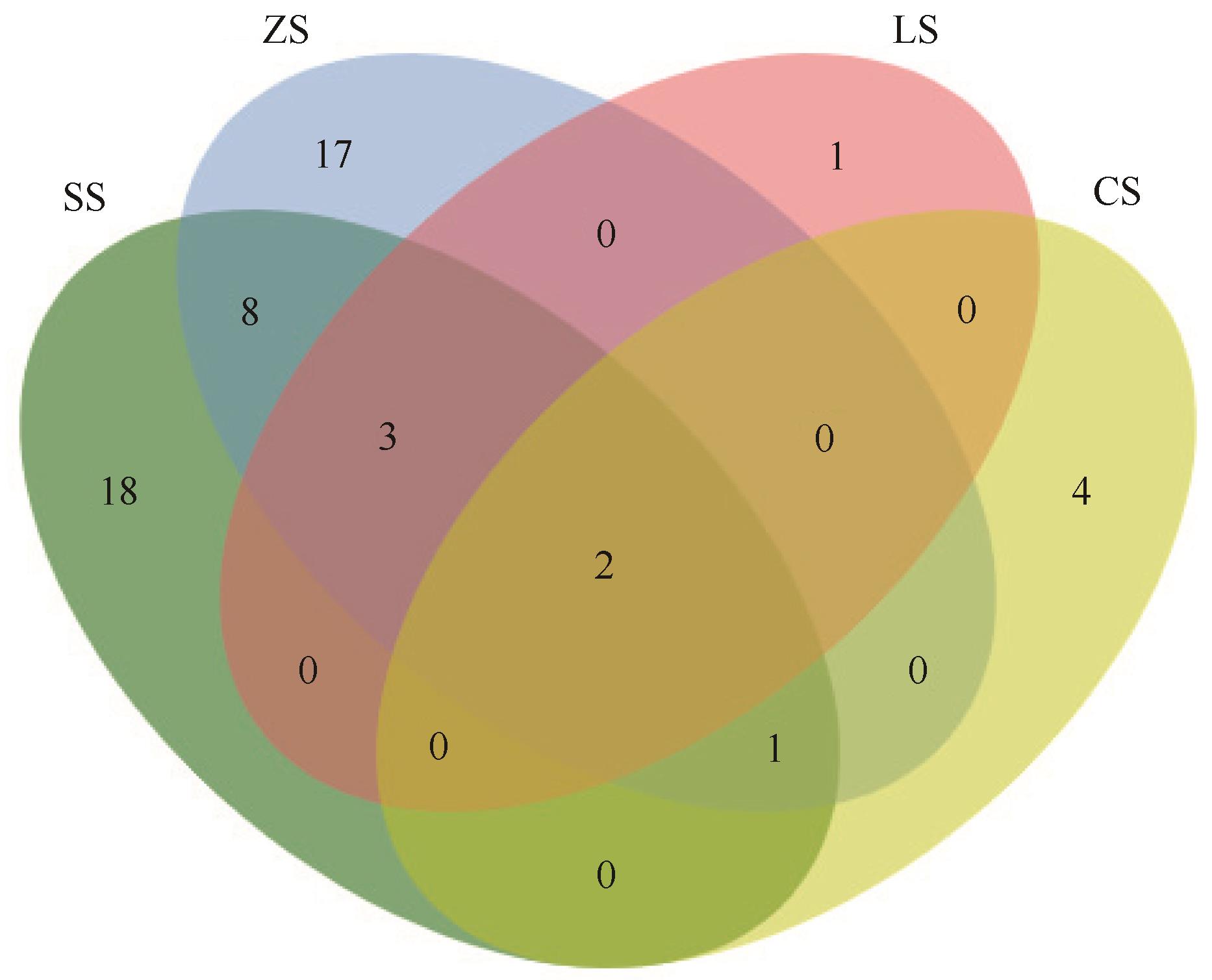
图5 不同生境共有和特有属的韦恩图注:SS-沙土,ZS-珠芽蓼根际沙土,LS-芦苇根际沙土,CS-柽柳根际沙土
Fig.5 Wayne diagram of different habitat common and endemic genera
| 生境 | 菌属 |
|---|---|
| SS | Agrococcus,Pseudoclavibacter,Rhodococcus,Saccharothrix,Sanguibacter,Pontibacter,Rufibacter,Gracilibacillus,Paraliobacillus,Planococcus,Salinicoccus,Sediminibacillus,Streptococcus,Aliihoeflea,Pararoseomonas,Plastorhodobacter,Ramlibacter,Skermanella |
| ZS | Blastococcus,Brachybacterium,Cellulomonas,Dietzia,Geodermatophilus,Gordonia,Nocardioides,Nocardiopsis,Carnobacterium,Neobacillus,Oceanobacillus,Aurantimonas,Azospirillum,Coralloluteibacterium,Geminicoccus,Kushneria,Microvirga |
| LS | Stutzerimonas |
| CS | Isoptericola,Zhihengliuella,Kaistella,Terribacillus |
| SS&ZS | Arthrobacter,Kineococcus,Microbacterium,Bacillus,Metabacillus,Paenibacillus,Halomonas,Paracoccus |
| SS&ZS&LS | Georgenia,Nesterenkonia,Marinilactibacillus |
| SS&ZS&LS&CS | Kocuria,Streptomyces |
| SS&ZS&CS | Modestobacter |
表3 可培养细菌共有和特有菌属
Table 3 Common and endemic bacterial genera that can be cultured
| 生境 | 菌属 |
|---|---|
| SS | Agrococcus,Pseudoclavibacter,Rhodococcus,Saccharothrix,Sanguibacter,Pontibacter,Rufibacter,Gracilibacillus,Paraliobacillus,Planococcus,Salinicoccus,Sediminibacillus,Streptococcus,Aliihoeflea,Pararoseomonas,Plastorhodobacter,Ramlibacter,Skermanella |
| ZS | Blastococcus,Brachybacterium,Cellulomonas,Dietzia,Geodermatophilus,Gordonia,Nocardioides,Nocardiopsis,Carnobacterium,Neobacillus,Oceanobacillus,Aurantimonas,Azospirillum,Coralloluteibacterium,Geminicoccus,Kushneria,Microvirga |
| LS | Stutzerimonas |
| CS | Isoptericola,Zhihengliuella,Kaistella,Terribacillus |
| SS&ZS | Arthrobacter,Kineococcus,Microbacterium,Bacillus,Metabacillus,Paenibacillus,Halomonas,Paracoccus |
| SS&ZS&LS | Georgenia,Nesterenkonia,Marinilactibacillus |
| SS&ZS&LS&CS | Kocuria,Streptomyces |
| SS&ZS&CS | Modestobacter |
| [1] | 樊自立,艾里西尔·库尔班,徐海量,等.塔里木河的变迁与罗布泊的演化[J].第四纪研究,2009,29(2):232-240. |
| [2] | He H, Tang C, Cao Z,et al.Revealing medicinal constituents of Bistorta vivipara based on non-targeted metabolomics and 16S rDNA gene sequencing technology[J].Molecules,2024,29(4):860. |
| [3] | 马登科,何志斌,赵文智,等.干旱区沙生药用植物生态效益综述[J].中国沙漠,2025,45(1):55-62. |
| [4] | 张小霞,陈筱玥,王秋云,等.柽柳根际一株盐单胞菌Bachu 26的分离、鉴定及其盐胁迫下的促生作用研究[J].微生物学报,2024,64(2):607-622. |
| [5] | Li F, Xie W, Ding X,et al.Phytochemical and pharmacological properties of the genus Tamarix:a comprehensive review[J].Archives of Pharmacal Research,2024,47(5):410-441. |
| [6] | Yehia F O, Refaat F J, Zekry A E,et al.Phytochemical and biological profiles of the genus Phragmites (Family Poaceae):a review[J].South African Journal of Botany,2023,163:659-672. |
| [7] | 付爱红,陈亚宁,李卫红.极端干旱区旱生芦苇叶水势变化及其影响因子研究[J].草业学报,2012,21(3):163-170. |
| [8] | 满敬元,刘宇,邢小勇,等.响应面法优化珠芽蓼多糖提取工艺研究[J].中国畜牧兽医,2025,52(3):1416-1427. |
| [9] | Eköberl M, Eschmidt R, Ramadan E M,et al.The microbiome of medicinal plants:diversity and importance for plant growth,quality and health[J].Frontiers in Microbiology,2013,4:400. |
| [10] | Abdul L K, Sajjad A, Raeid M M,et al.Rhizosphere microbiome of arid land medicinal plants and extra cellular enzymes contribute to their abundance[J].Microorganisms,2020,8(2):213-213. |
| [11] | 刘阳.塔克拉玛干沙漠可培养微生物多样性及抗辐射-抗氧化代谢机制研究[D].兰州:西北师范大学,2020. |
| [12] | 张昺林,唐德平,张楠,等.敦煌莫高窟中细菌多样性的研究[J].微生物学通报,2012,39(5):614-623. |
| [13] | Liu Y, Shi A, Chen Y,et al.Beneficial microorganisms:regulating growth and defense for plant welfare[J].Plant Biotechnology Journal,2024,23(3):986-998. |
| [14] | 强梦轲,徐奕卓,高蕊.植物内生细菌介导的植物抗逆性研究进展[J].植物学研究,2020,9(3):226. |
| [15] | 潘颜霞,回嵘,李新荣.中国沙漠微生物分布及特征[J].中国沙漠,2023,43(1):244-256. |
| [16] | Baltz R H.Renaissance in antibacterial discovery from actinomycetes[J].Current Opinion in Pharmacology,2008,8(5):557-563. |
| [17] | 李畅,许苗,游国浩,等.一种最适碳源-氨基酸复配培养基对新疆典型生境土壤微生物分离培养的影响[J].微生物学通报,2025,52(5):2087-2106. |
| [18] | 牛小敏,吴玉洁,于雪,等.沙漠微生物源活性天然产物研究进展[J].微生物学通报,2024,51(9):3303-3316. |
| [19] | Isabel A, Monica S M, Sandra R,et al.Primer,pipelines,parameters:issues in 16S rRNA gene sequencing[J].mSphere,2021,6(1):01202-01220. |
| [20] | Ivica L, Peer B.Interactive Tree Of Life (iTOL) v5:an online tool for phylogenetic tree display and annotation[J].Nucleic Acids Research,2021,49(1):293-296. |
| [21] | Bennur T, Kumar A R, Zinjarde S,et al.Nocardiopsis species:Incidence,ecological roles and adaptations[J].Microbiological Research,2015,174:33-47. |
| [22] | Francisca S E.Seed priming by application of Microbacterium spp. strains for control of Botrytis cinerea and growth promotion of lettuce plants[J].Scientia Horticulturae,2023,313:111901. |
| [23] | Yan Y D, Hong M, Lei D,et al. Streptomyces calidiresistens sp. nov.,isolated from a hot spring sediment[J].Antonie van Leeuwenhoek,2014,106(2):189-196. |
| [24] | 袁世斌,周婷,董微,等.罗布泊沙土微生物生态分布特征[J].兰州大学学报,2009,45(1):19-22. |
| [25] | 关统伟,滕芸,任丹,等.罗布泊盐湖可培养放线菌多样性及PKS Ⅱ功能基因筛选[J].生物技术,2014,24(5):67-71. |
| [26] | 庹利,旭格拉·哈布丁,郭琳,等.罗布泊地区沙生植物根际放线菌多样性及生物活性的研究[J].中国抗生素杂志,2012,37(1):21-26. |
| [27] | Manuel D B T.Increasing aridity reduces soil microbial diversity and abundance in global drylands[J].Proceedings of the National Academy of Sciences of the United States of America,2015,112(51):15684-15689. |
| [28] | Soverini M, Turroni S, Biagi E,et al.Variation of carbohydrate-active enzyme patterns in the gut microbiota of Italian healthy subjects and type 2 diabetes patients[J].Frontiers in Microbiology,2017,8:2079. |
| [29] | Fierer N, Leff J W, Adams B J,et al.Cross-biome metagenomic analyses of soil microbial communities and their functional attributes[J].Proceedings of the National Academy of Sciences of the United States of America,2012,109(52):21390-21395. |
| [30] | 刘阳,王馨悦,陈拓,等.可培养细菌多样性及抗辐射-抗氧化相关性特征:以库姆塔格沙漠东缘为例[J].中国环境科学,2021,41(12):5921-5932. |
| [31] | 文凤,宋迎,张珍,等.添加抗生素对新疆特殊生境微生物分离培养的影响[J].微生物学通报,2023,50(8):3314-3329. |
| [32] | Mancuso S, Giordano S.Influence of projection effects on the observed differential rotation rate in the UV corona[J].Journal of Advanced Research,2013,4(3):283-286. |
| [33] | Wenguang X, Yongxue S, Tong Z,et al.Antibiotics,antibiotic resistance genes,and bacterial community composition in fresh water aquaculture environment in China[J].Microbial Ecology,2015,70(2):425-432. |
| [34] | Sandaa R A, Clokie M, Mann N H.Photosynthetic genes in viral populations with a large genomic size range from Norwegian coastal waters[J].FEMS Microbiology Ecology,2008,63(1):2-11. |
| [35] | Wang J, Nan J, Chen Q,et al.Exploration of aflatoxin B1 degradation products via Kocuria rosea:structure elucidation and toxicity analysis[J].Applied Sciences,2024,14(23):11024. |
| [36] | Bennur T, Kumar A R, Zinjarde S S,et al.Nocardiopsis species:a potential source of bioactive compounds[J].Journal of Applied Microbiology,2016,120(1):1-16. |
| [37] | 徐彤,姚雪丹,王玉苗,等.盐水球菌Salinicoccus ventosaetal B2-3-5的代谢产物分析及其抑制酪氨酸酶活性的机制[J].微生物学通报,2021,48(10):3753-3764. |
| [38] | 康小虎,刘鑫,刘姗姗,等.不同时空尺度下土壤微生物群落分布及驱动因素研究进展[J].土壤,2024,56(4):689-696. |
| [39] | 付莉娇,李雪琴,范继辉,等.藏北高寒草原典型植物根际土壤细菌群落结构多样性及根系特征分析[J].草地学报,2022,30(5):1131. |
| [40] | 康贻军,沈敏,王欢莉,等.根际微生物群落与促生菌多样性及其筛选策略[J].湖北农业科学,2012,51(24):5553-5558. |
| [41] | 陈伟立,李娟,朱红惠,等.根际微生物调控植物根系构型研究进展[J].生态学报,2016,36(17):5285-5297. |
| [42] | 李梦洁,李占彪,周思含,等.植物根际微生物调控根系构型研究[J].中国农业气象,2021,42(11):895-904. |
| [43] | Gang W, Ying R, Xuanjiao B,et al.Contributions of beneficial microorganisms in soil remediation and quality improvement of medicinal plants[J].Plants,2022,11(23):3200. |
| [44] | 曾青,熊超,尹梅,等.植物微生物组生态功能与群落构建过程研究进展[J].生物多样性,2023,31(4):186-202. |
| [45] | Kateryna Z, Katherine B L, Zhao H,et al.Dynamic root exudate chemistry and microbial substrate preferences drive patterns in rhizosphere microbial community assembly[J].Nature Microbiology,2018,3(4):470-480. |
| [46] | Ulrich D E M, Sevanto S, Ryan M,et al.Plant-microbe interactions before drought influence plant physiological responses to subsequent severe drought[J].Scientific Reports,2025.DOI:10.1038/s41598-018-36971-3 . |
| [47] | Pang Z, Xu P.Probiotic model for studying rhizosphere interactions of root exudates and the functional microbiome[J].The ISME Journal,2024. |
| [48] | Daniel T L. Marinilactibacillus piezotolerans sp.nov.,a novel marine lactic acid bacterium isolated from deep sub-seafloor sediment of the Nankai Trough [J].International Journal of Systematic and Evolutionary Microbiology,2005,55(1):345-351. |
| [49] | Zhang P, Luo X, Luo X,et al. Streptomyces pimonensis sp.nov.,isolated from the Taklimakan Desert in Xinjiang,China [J].Archives of Microbiology,2022,204(10):607. |
| [50] | Chen Y H, Zhang J X, Min Y,et al.Two new strains of Streptomyces with metabolic potential for biological control of pear black spot disease[J].BMC Microbiology,2024,24(1):1-14. |
| [51] | 穆文强,康慎敏,李平兰.根际促生菌对植物的生长促进作用及机制研究进展[J].生命科学,2022,34(2):118-127. |
| [52] | 曾先锋,孙钰晨,谢学文,等.滋养节杆菌S17的分离鉴定及其对黄瓜促生能力研究[J].中国生物防治学报,2024,40(1):178-185. |
| [53] | Zhang H, Murzello C, Sun Y,et al.Choline and osmotic-stress tolerance induced in Arabidopsis by the soil microbe Bacillus subtilis (GB03)[J].Molecular Plant-microbe Interactions:MPMI,2010,23(8):1097-1104. |
| [54] | Li Y L, Yan Y C, Deng S G,et al.The Xanthomonas oryzae pv.oryzae type IV pilus alignment subcomplex protein PilN contributes to regulation of bacterial surface‐associated behaviours and T3SS system [J].Plant Pathology,2020,69(4):744-755. |
| [55] | Bhardwaj S, Lee M, O'carroll D,et al.Biotransformation of 6∶2/4∶2 fluorotelomer alcohols by Dietzia aurantiaca J3:enzymes and proteomics[J].Journal of Hazardous Materials,2024,478:135510-135518. |
| [56] | Kumar S A, Nidhi G, Naseer S,et al. Pontibacter ramchanderi sp.nov.,isolated from hexachlorocyclohexane-contaminated pond sediment[J].International Journal of Systematic and Evolutionary Microbiology,2013,63(8):2829-2834. |
| [57] | Wadhawan G, Gupta A.Biological treatment of methyl orange dye and textile wastewater using halo-alkaliphilic bacteria under highly alkaline conditions[J].Extremophiles:Life Under Extreme Conditions,2024,29(1):6-13. |
| [58] | 陆鹏,刘立丽,陈周伟,等.耐辐射动球菌耐辐射及相关特性研究进展[J].微生物学通报,2016,43(6):1345-1350. |
| [59] | Karima H, Faten G G, Carmen M C,et al. Geodermatophilus sabuli sp.nov.,a γ-radiation-resistant actinobacterium isolated from desert limestone[J].International Journal of Systematic and Evolutionary Microbiology,2015,65(10):3365-3372. |
| [60] | Jehani M, Singh S, Archana T,et al.Azospirillum:a free-living nitrogen-fixing bacterium[J].FEMS Microbiology Reviews,2000,24(4):487-506. |
| [61] | Gharibzahedi S M T, Razavi S H, Mousavi M.Potential applications and emerging trends of species of the genus Dietzia:a review[J].Annals of Microbiology,2014,64(2):421-429. |
| [62] | Shivani B, Pratik K H A.Comprehensive updates on the biological features and metabolic potential of the versatile extremophilic actinomycete Nocardiopsis dassonvillei [J].Research in Microbiology,2023,175(4):104171-104179. |
| [1] | 周政, 王成, 杨仕兵, 周玉碧. 柴达木盆地药用植物资源调查[J]. 中国沙漠, 2025, 45(6): 231-238. |
| [2] | 马登科, 何志斌, 赵文智, 杜军, 孙玮皓, 王帅, 李睿, 刘冰. 干旱区沙生药用植物生态效益综述[J]. 中国沙漠, 2025, 45(1): 55-62. |
| [3] | 张振清, 张昺林, 张威, 刘光琇, 陈拓, 刘阳, 陈警伟, 田茂. 河西走廊黑戈壁生态系统中可培养细菌分布特征及抗辐射活性[J]. 中国沙漠, 2020, 40(4): 52-62. |
| [4] | 王少昆, 赵学勇, 贾昆峰, 高宝兰, 曲浩, 毛伟, 连杰, 陈敏, 朱阳春. 乌拉特荒漠草原小针茅(Stipa klemenzii)群落土壤细菌多样性及垂直分布特征[J]. 中国沙漠, 2016, 36(6): 1564-1570. |
| [5] | 韩彩霞, 张丙昌, 张元明, 邰凤姣, 张弛, 邵华. 古尔班通古特沙漠南缘苔藓结皮中可培养真菌的多样性[J]. 中国沙漠, 2016, 36(4): 1050-1055. |
| [6] | 苏志豪, 潘伯荣, 刘会良, 周晓兵, 康晓珊. 新疆贝母(Fritillaria walujewii)的遗传多样性与遗传结构[J]. 中国沙漠, 2015, 35(2): 358-364. |
| [7] | 徐莉, 李艳红, 杨甲全. 罗布泊盐湖表层土地球化学及沉积特征[J]. 中国沙漠, 2014, 34(6): 1552-1557. |
| [8] | 董瑞杰1, 董治宝1,2, 吴晋峰1, 郭 峰1, 崔徐甲1. 罗布泊雅丹地貌旅游资源评价与开发研究[J]. 中国沙漠, 2013, 33(4): 1235-1243. |
| 阅读次数 | ||||||
|
全文 |
|
|||||
|
摘要 |
|
|||||
©2018中国沙漠 编辑部
地址: 兰州市天水中路8号 (730000)
电话:0931-8267545
Email:caiedit@lzb.ac.cn;desert@lzb.ac.cn


 甘公网安备 62010202000688号