
- CN 62-1070/P
- ISSN 1000-694X
- Bimonthly 1981
Journal of Desert Research ›› 2025, Vol. 45 ›› Issue (2): 275-283.DOI: 10.7522/j.issn.1000-694X.2025.00015
Shiyao Zhong( ), Chuanhua Li(), Pengfei Qiao
Received:2025-01-03
Revised:2025-02-03
Online:2025-03-20
Published:2025-03-26
Contact:
Chuanhua Li
CLC Number:
Shiyao Zhong, Chuanhua Li, Pengfei Qiao. Vegetation abrupt changes and attribution in the arid and semi-arid regions of Northwest China under aridity gradients from 2000 to 2020[J]. Journal of Desert Research, 2025, 45(2): 275-283.
Add to citation manager EndNote|Ris|BibTeX
URL: http://www.desert.ac.cn/EN/10.7522/j.issn.1000-694X.2025.00015
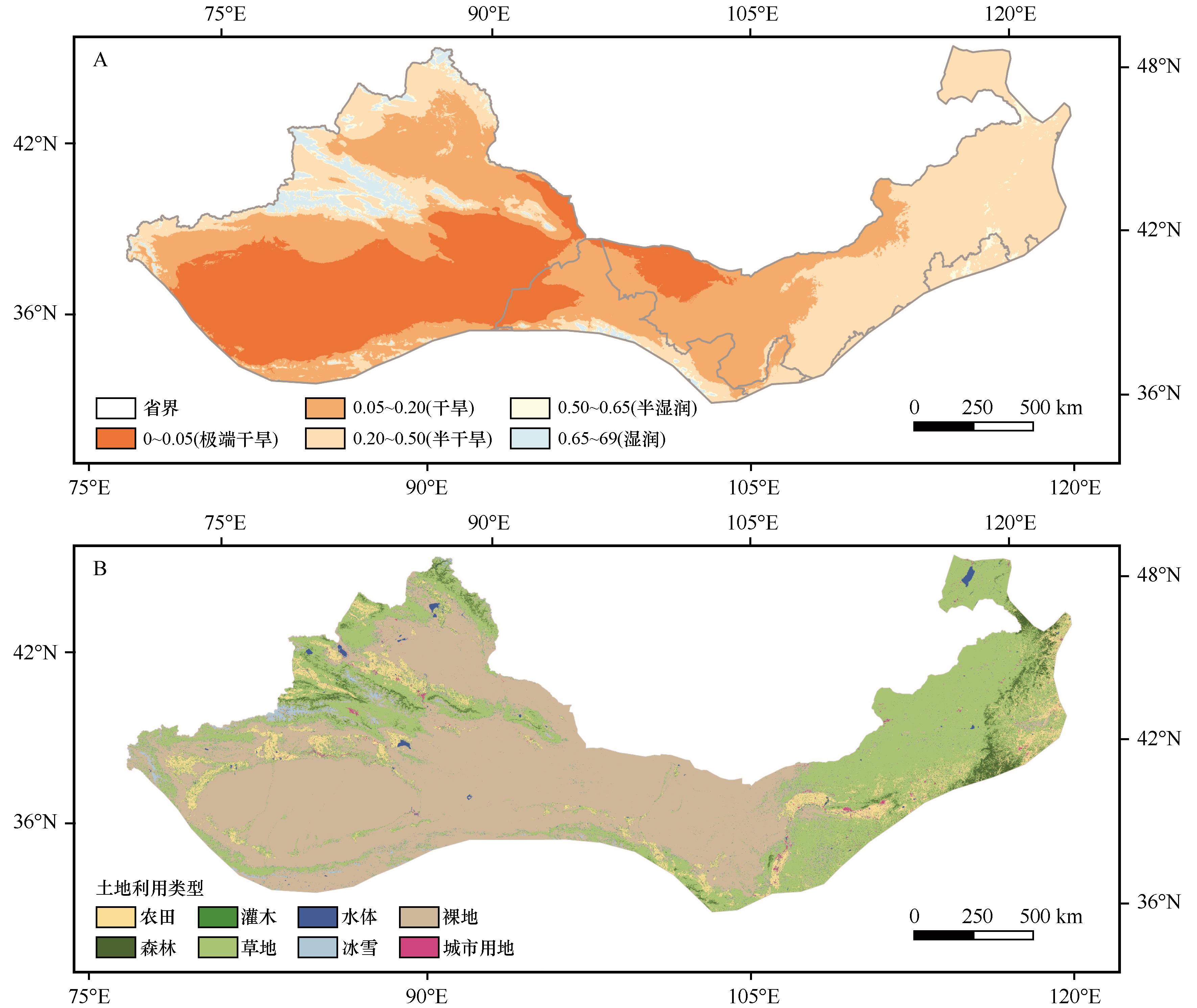
Fig.1 Aridity gradients (A) and land use type (B) of the semi-arid and arid region in Northwest China
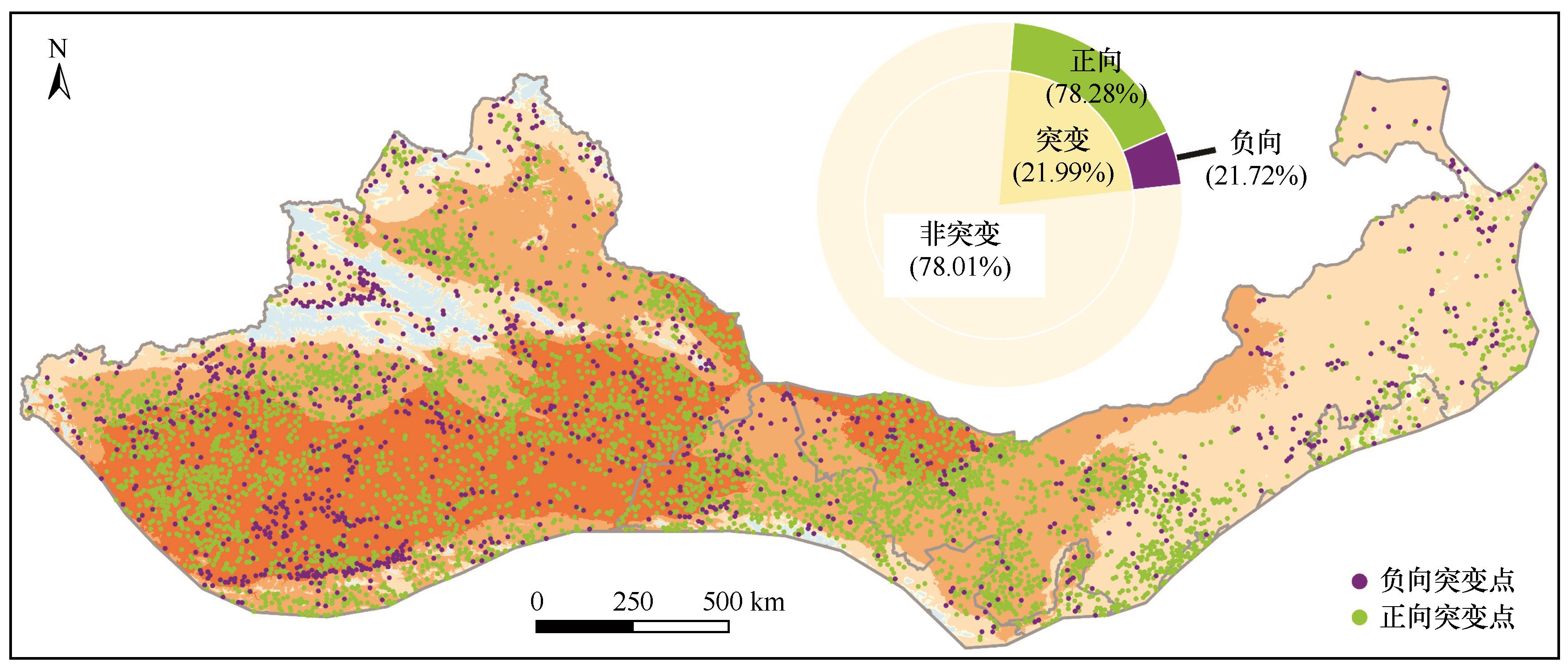
Fig.2 Spatial pattern of vegetation abrupt breakpoint
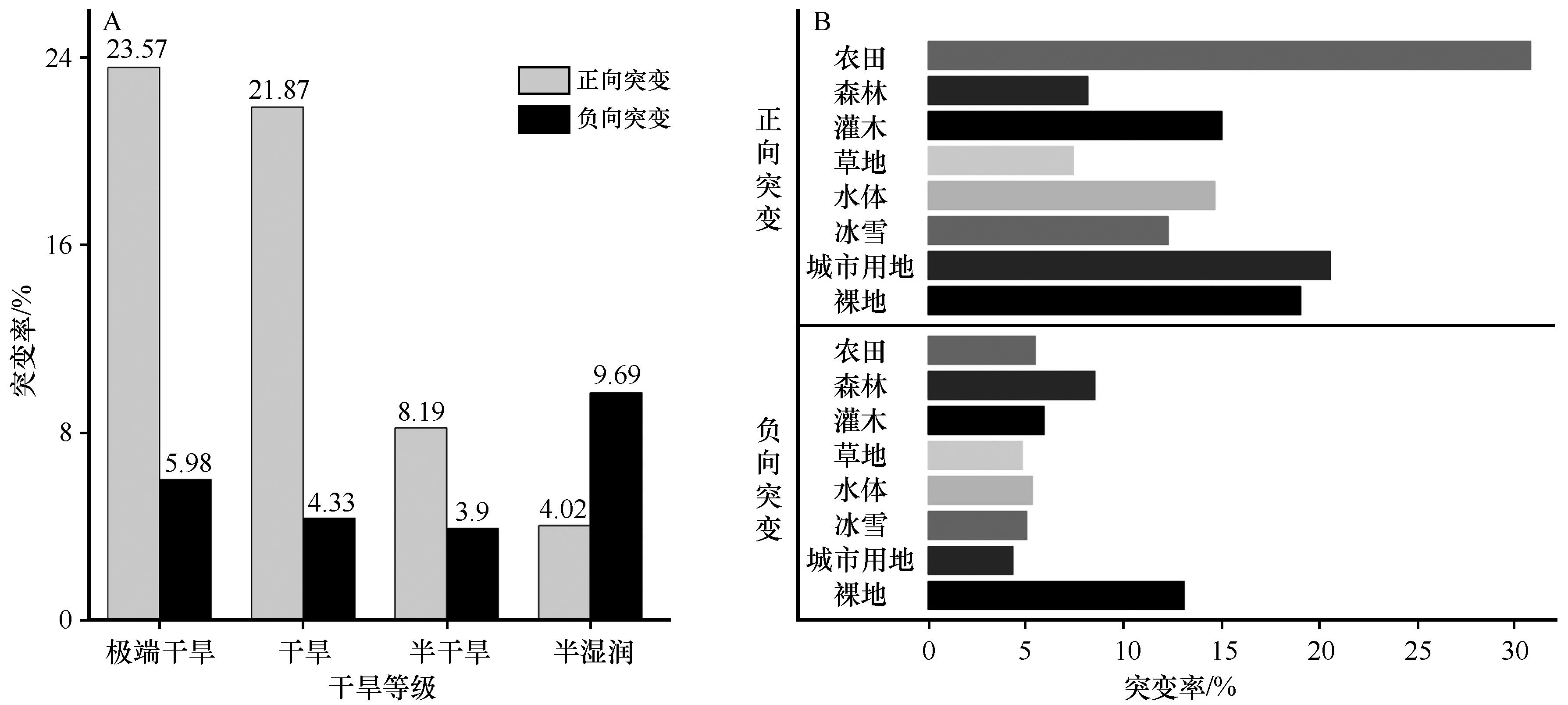
Fig.3 Abrupt rates of positive and negative abrupt in different aridity gradients (A) different land uses (B)
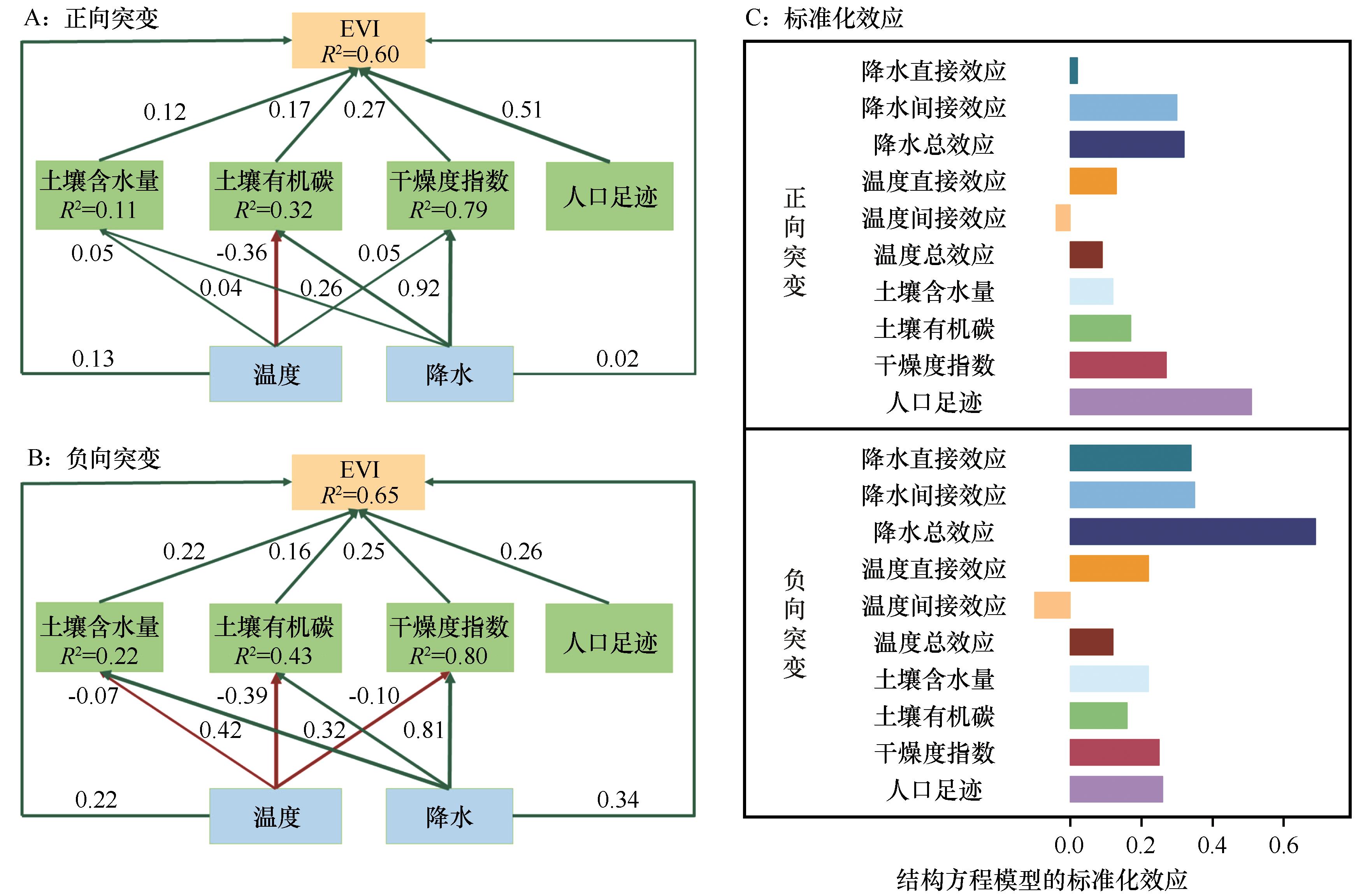
Fig.4 Structural equation models of positive and negative abrupt
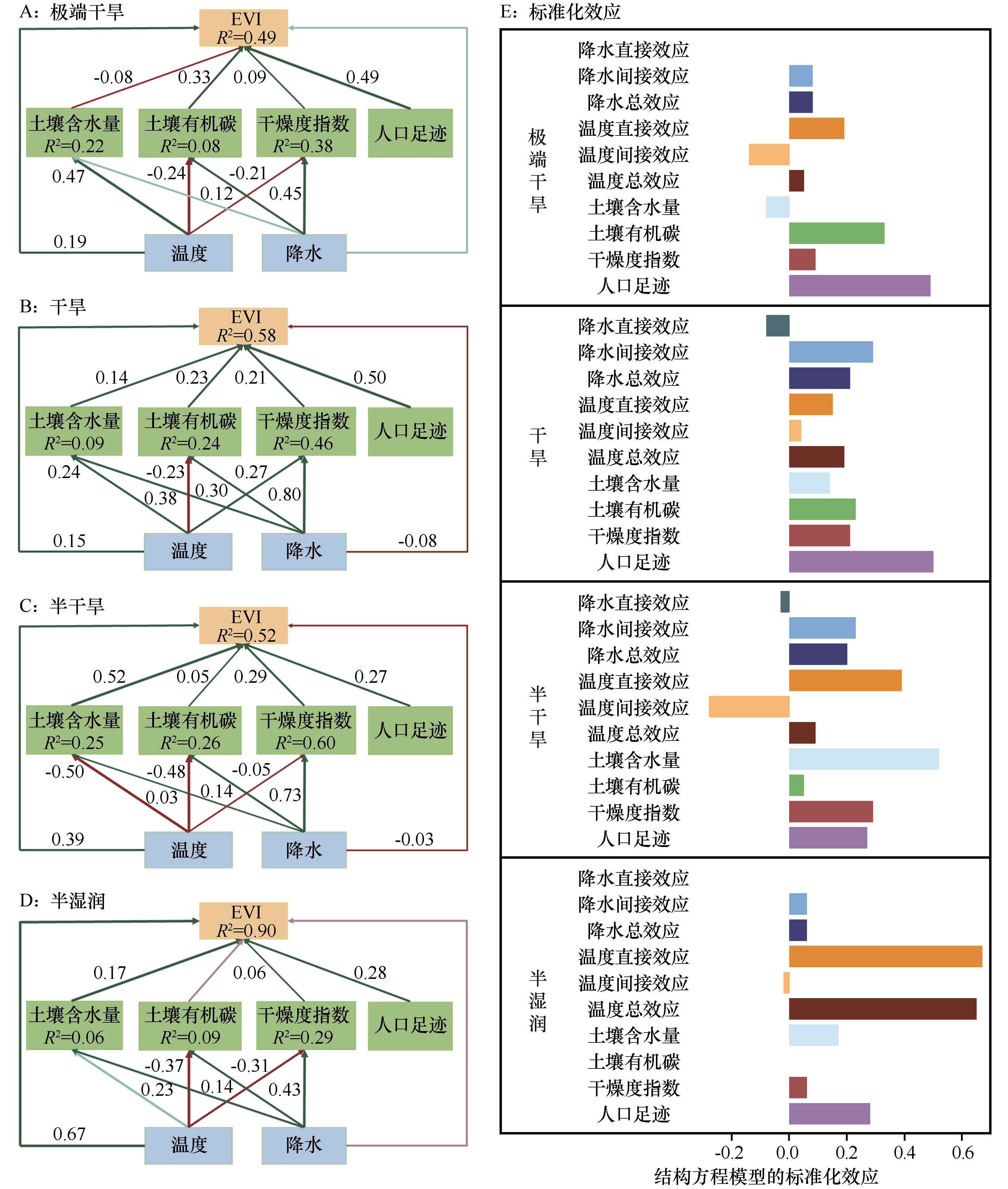
Fig.5 Changes in driving factors of positive abrupt across aridity gradients
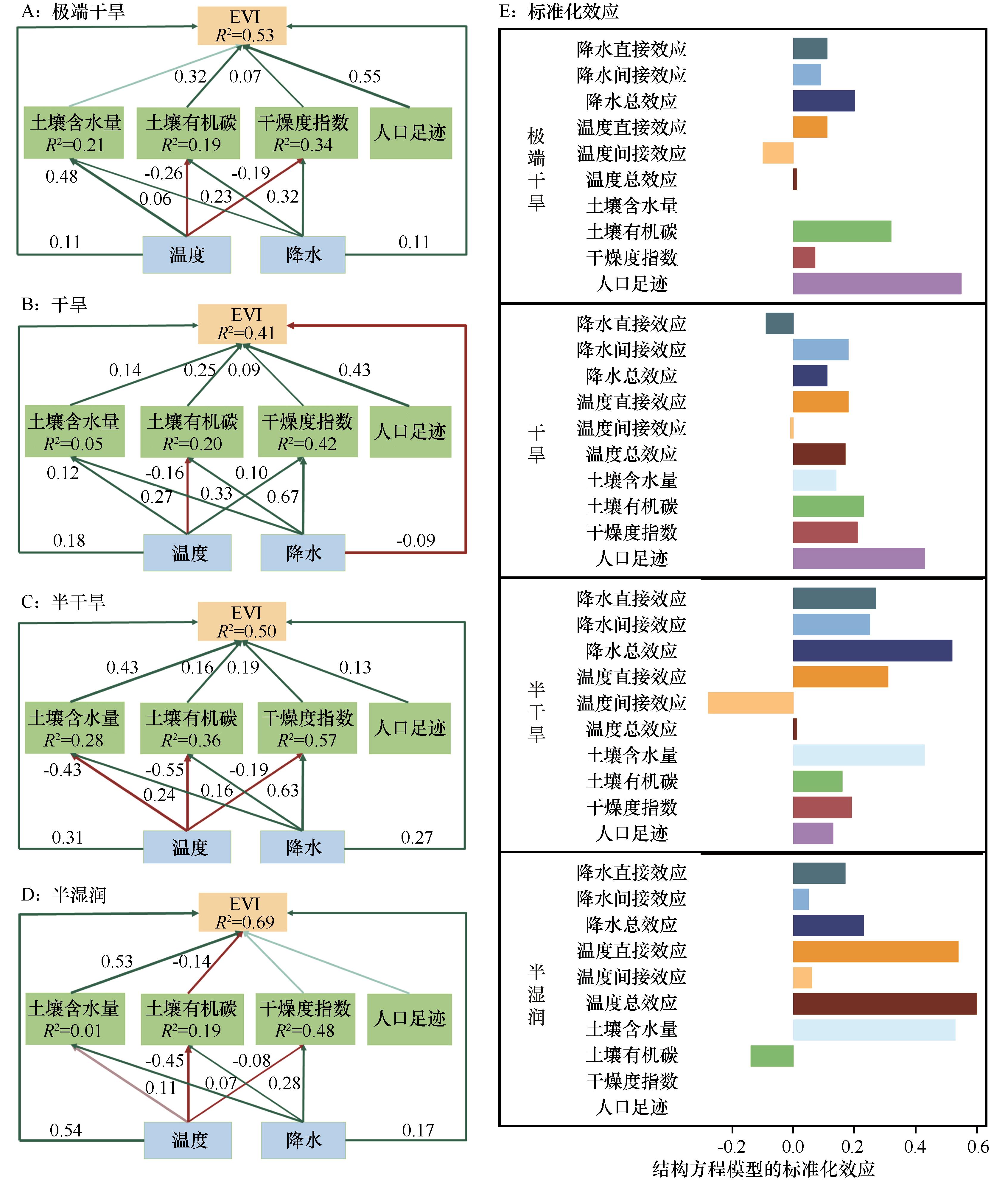
Fig.6 Changes in driving factors of negative abrupt across aridity gradients
| 1 | Fraser E, Dougill A, Klaus H,et al.Assessing vulnerability to climate change in dryland livelihood systems:conceptual challenges and interdisciplinary solutions[J].Ecology and Society,2011,16(3):1-12. |
| 2 | 刘晓圆.城镇化进程中的生态环境问题及对策研究[D].秦皇岛:燕山大学,2014. |
| 3 | 郑诚蔚,邓晓红,李宗省,等.甘肃省河西地区水源涵养功能与人类活动强度演变[J].中国沙漠,2024,44(1):189-200. |
| 4 | 闫丽娟,李广,吴江琪,等.黄土高原4种典型植被对土壤活性有机碳及土壤碳库的影响[J].生态学报,39(15):5546-5554. |
| 5 | Foley J A, Defries R, Asner G P,et al.Global consequences of land use[J].Science,2005,309(5734):570-574. |
| 6 | Knapp A K, Beier C, Briske D D,et al.Consequences of more extreme precipitation regimes for terrestrial ecosystems[J].BioScience,2008,58(9):811-821. |
| 7 | Reichstein M, Bahn M, Ciais P,et al.Climate extremes and the carbon cycle[J].Nature,2013,500(7462):287-295. |
| 8 | Jump A S, Peñuelas J.Running to stand still:adaptation and the response of plants to rapid climate change[J].Ecology Letters,2005,8(9):1010-1020. |
| 9 | Berdugo M, Gaitán J J, Delgado-Baquerizo M,et al.Prevalence and drivers of abrupt vegetation shifts in global drylands[J].Proceedings of the National Academy of Sciences,2022,119(43):e2123393119. |
| 10 | Wang Z, Fu B, Wu X,et al.Distinguishing trajectories and drivers of vegetated ecosystems in China's Loess Plateau[J].Earth's Future,2024,12(2):e2023EF003769. |
| 11 | Sagi O, Rokach L.Approximating XGBoost with an interpretable decision tree[J].Information Sciences,2021,572:522-542. |
| 12 | Hair J, Hult G T M, Ringle C,et al.A Primer on Partial Least Squares Structural Equation Modeling(PLS-SEM)[M].Thousand Oaks,USA:Sage,2022. |
| 13 | Huete A, Didan K, Miura T,et al.Overview of the radiometric and biophysical performance of the MODIS vegetation indices[J].Remote Sensing of Environment,2002,83(1):195-213. |
| 14 | Wei W, Guo Z, Shi P,et al.Spatiotemporal changes of land desertification sensitivity in northwest China from 2000 to 2017[J].Journal of Geographical Sciences,2021,31(1):46-68. |
| 15 | Zomer R J, Xu J, Trabucco A.Version 3 of the global aridity index and potential evapotranspiration database[DS].Sci Data,2022,9(1):409. |
| 16 | 刘伟琦,马绍休,宫毓来,等.农业干旱业务化监测研究进展与展望[J].中国沙漠,2023,43(1):197-211. |
| 17 | Glantz M H.Desertification:Environmental Degradation in and around Arid Lands[M]. Boca Raton,USA:CRC Press,2019. |
| 18 | Didan K.MODIS/Terra Vegetation Indices Monthly L3 Global 1km SIN Grid V006,NASA EOSDIS Land Processes DAAC[DS].2015.. |
| 19 | 彭守璋.中国1 km分辨率逐月平均气温数据集(1901-2023)[DS].国家青藏高原科学数据中心,2024. |
| 20 | 彭守璋.中国1 km分辨率逐月降水量数据集(1901-2023) [DS].国家青藏高原科学数据中心,2024. |
| 21 | 彭守璋.中国1 km逐年干燥度数据集(1901-2023) [DS].国家青藏高原科学数据中心,2024. |
| 22 | Mu H, Li X, Wen Y,et al.A global record of annual terrestrial human footprint dataset from 2000 to 2018[DS].Sci Data,2022,9(1):176. |
| 23 | Sanderson E W, Jaiteh M, Levy M A,et al.The human footprint and the last of the wild:the human footprint is a global map of human influence on the land surface,which suggests that human beings are stewards of nature,whether we like it or not[J].BioScience,2002,52(10):891-904. |
| 24 | Yang J, Huang X.The 30 m annual land cover dataset and its dynamics in China from 1990 to 2019[J].Earth System Science Data,2021,13(8):3907-3925. |
| 25 | Scheffer M, Carpenter S, Foley J A,et al.Catastrophic shifts in ecosystems[J].Nature,2001,413(6856):591-596. |
| 26 | Akaike H.A new look at the statistical model identification[J].IEEE Transactions on Automatic Control,1974,19(6):716-723. |
| 27 | Deng Y, Wang S, Bai X,et al.Vegetation greening intensified soil drying in some semi-arid and arid areas of the world[J].Agricultural and Forest Meteorology,2020,292/293:108103. |
| 28 | Li S P, Jia P, Fan S Y,et al.Functional traits explain the consistent resistance of biodiversity to plant invasion under nitrogen enrichment[J].Ecology Letters,2021,25(4):778-789. |
| 29 | Zhong X, Li J, Wang J,et al.Linear and nonlinear characteristics of long-term NDVI using trend analysis:a case study of Lancang-Mekong River Basin[J].Remote Sensing,2022,14(24):6271. |
| 30 | 李卓忆,杨庆,马柱国,等.中国北方干旱半干旱区植被对气候变化和人类活动的响应[J].大气科学,2024,48(3):859-874. |
| 31 | 中国水利水电科学研究院.西北地区水资源合理开发利用与生态环境保护研究[J].中国水利,2001(5):9-11. |
| 32 | Liu K, Shao X.Grassland ecological management and utilization for sustainability[J].Agronomy,2024,14(1):14010149. |
| 33 | Padowski J, Gorelick S.Global analysis of urban surface water supply vulnerability[J].Environmental Research Letters,2014,9:104004. |
| 34 | Piao S, Ciais P, Huang Y,et al.The impacts of climate change on water resources and agriculture in China[J].Nature,2010,467(7311):43-51. |
| 35 | Huang J, Yu H, Guan X,et al.Accelerated dryland expansion under climate change[J].Nature Climate Change,2016,6(2):166-171. |
| 36 | Zhao M, Running S W.Drought-induced reduction in global terrestrial net primary production from 2000 through 2009[J].Science,2010,329(5994):940-943. |
| 37 | 李京忠,辛振华,谢潇,等.半干旱区植被覆盖时空变化特征及其对气候变化的响应:以锡林郭勒盟为例[J].应用生态学报,2024,35(1):80-86. |
| 38 | 朱飙,张强,李春华,等.我国干旱半干旱区气候变化特征及其对干湿波动的影响[J].大气科学学报,2023,46(1):42-54. |
| 39 | 赵雅静,翁伯琦,王义祥,等.植物对干旱胁迫的生理生态响应及其研究进展[J].福建稻麦科技,2009,27(2):6. |
| 40 | Zhang Z, Xia F, Yang D,et al.Spatiotemporal characteristics in ecosystem service value and its interaction with human activities in Xinjiang,China[J].Ecological Indicators,2020,110:105826. |
| [1] | Yuliang Rao, Chun Cao, Xiaoxue Zhang, Chang Lu, Ping Yue. Response of soil ammonia volatilization to exogenous nitrogen input in Inner Mongolian desert grasslands [J]. Journal of Desert Research, 2024, 44(6): 178-186. |
| [2] | Yanyan Dai, Yiting Jiang, Pengfei Zhang, Geng Liu, Lei Zhang. Coupling coordination and driving factors between water resources and planting structure in Shanxi, China [J]. Journal of Desert Research, 2024, 44(6): 37-47. |
| [3] | Ziao Shen, Jing Wu, Chunbin Li. Temporal and spatial changes of vegetation cover and its driving forces in the Hexi inland river basin from 2000 to 2020 [J]. Journal of Desert Research, 2024, 44(3): 119-127. |
| [4] | Wei Hang, Yongxing Lu, Hao Guo, Xing Guo, Shihang Zhang, Yuanming Zhang, Xiaobing Zhou. Spatial variation in soil nitrogen content along aridity gradients in the northwest desert region in China [J]. Journal of Desert Research, 2024, 44(3): 259-268. |
| [5] | Qing Li, Na Zhou, Sheng Wang, Tongzhou Li, Rende Wang, Jinfeng Wang. Quantitative assessment the impacts of climate change and human actives on wind erosion: a case study of Inner Mongolia Autonomous Region [J]. Journal of Desert Research, 2024, 44(1): 178-188. |
| [6] | Chengwei Zheng, Xiaohong Deng, Zongxing Li, Jian Xue, Libang Ma, Juan He, Shuxiang Lu, Jianxiong Shao, Shiyu Cai, Peiyi Zhao. Analysis of the spatial and temporal evolution of water resources conservation and human activity intensity in the Hexi region of Gansu Province [J]. Journal of Desert Research, 2024, 44(1): 189-200. |
| [7] | Xiao Feng, Jianjun Qu, Xinhui Ding, Qin Tian, Qingbin Fan. Temporal and spatial pattern of NPP in Yulin and its influencing factors during the desertification reversal [J]. Journal of Desert Research, 2024, 44(1): 22-32. |
| [8] | Tiaoxue Lu, Linshan Yang, Qi Feng, Meng Zhu, Naiyu Li. The change of oasis structure / scale and its influencing factors in Zhangye Basin in recent 20 years [J]. Journal of Desert Research, 2023, 43(6): 131-141. |
| [9] | Jianbing Lu, Ke Ju, Weibin Liao. Variation in NDVI and its response to climate change and human activities in Gansu Province during 2000-2020 [J]. Journal of Desert Research, 2023, 43(4): 118-127. |
| [10] | Yaozong Wang, Xinbin Yue, Jiali Xie, Zhipeng Liu, Yuan Ma, Yahui Wang, Yan Gong. Desertification evolution in the sandy region to the east of the Yellow River in Ningxia from 2000 to 2020 [J]. Journal of Desert Research, 2023, 43(4): 31-40. |
| [11] | Shilin Fu, Jiaqiang Lei, Yiqi Zhou, Na Zhou, Malicha Loje Hare, Zinabu Bora Jorro. Analysis of land degradation trends and driving factors in Ethiopia based on NPP-WUE [J]. Journal of Desert Research, 2023, 43(1): 128-141. |
| [12] | Xiaoyun Cheng, Qin Zhang, Fangfang Lan, Yuan Li, Yaxuan Han, Limin Zhang, Yanke Yang, Xinyuan Wang. Dynamic characteristics and driving factors of grassland desertification in Hexi Corridor [J]. Journal of Desert Research, 2022, 42(6): 134-141. |
| [13] | Shihua Zhu, Xia Fang, Xin Hang, Xiaoping Xie, Liangxiao Sun, Liangzhong Cao. Normalized difference vegetation index ( NDVI ) dynamics of grassland in Central Asia and its response to climate change and human activities [J]. Journal of Desert Research, 2022, 42(4): 229-241. |
| [14] | Yun Chen, Yuqiang Li, Xuyang Wang, Caiping Yao, Yayi Niu. Risk and countermeasures of global change in ecologically vulnerable regions of China [J]. Journal of Desert Research, 2022, 42(3): 148-158. |
| [15] | Yongtao Ma, Xiaozong Ren, Huifang Hu, Min Liu, Qi Meng. Vegetation dynamics and its driving force in Otindag Sandy Land based on Geodetector [J]. Journal of Desert Research, 2021, 41(4): 195-204. |
| Viewed | ||||||
|
Full text |
|
|||||
|
Abstract |
|
|||||
Address: No. 8, Tianshui Middle Road, Chengguan District, Lanzhou City, Gansu Province, China (Postcode: 730000)
Tel:0931-8267545
Email:caiedit@lzb.ac.cn;desert@lzb.ac.cn
Support:Magtech
