中国沙漠 ›› 2026, Vol. 46 ›› Issue (5): 371-380.DOI: 10.7522/j.issn.1000-694X.2026.00087
• • 上一篇
许正强1( ), 慕彪彪2, 王兰兰1, 苑力辉1, 姚瑞1
收稿日期:2026-06-12
修回日期:2026-07-28
出版日期:2026-09-20
发布日期:2026-11-02
作者简介:许正强(1970—),男,甘肃镇原人,学士,高级工程师,主要从事园林植物栽培应用研究等。E-mail: xzq006@126.com
基金资助:
Zhengqiang Xu1(), Biaobiao Mu2, Lanlan Wang1, Lihui Yuan1, Rui Yao1
Received:2026-06-12
Revised:2026-07-28
Online:2026-09-20
Published:2026-11-02
摘要:
荒漠植物长期处于水分亏缺、土壤贫瘠、高温强光、盐分胁迫和风沙扰动等复合环境中,其生态适应并非由单一性状决定,而是叶片、根系、茎干水力和碳分配储存等多类功能性状协同调节与权衡优化的结果。本文围绕荒漠植物功能性状体系及其生态功能,综述叶片资源获取与资源保守、根系水分获取与养分获取、水力效率与水力安全、光合碳获取与蒸腾失水、地上生长与地下投入,以及生长、防御与储存等主要权衡机制。荒漠植物通过小叶厚叶、深根或二型根系、高水力安全、气孔调节和非结构性碳水化合物储存等性状组合,在短期资源利用和长期生存风险之间形成动态平衡。功能性状权衡不仅有助于解释荒漠植物抗旱适应和物种共存机制,也可用于预测气候变化背景下荒漠植被变化,并为固沙植物筛选与植被恢复提供性状导向的理论依据。未来研究需加强整株性状网络、复合胁迫、长期动态、干旱—复水循环和恢复应用研究,推动荒漠植物功能性状研究由相关性描述转向机制验证和生态应用。
中图分类号:
许正强, 慕彪彪, 王兰兰, 苑力辉, 姚瑞. 荒漠植物功能性状权衡及其生态适应意义研究进展[J]. 中国沙漠, 2026, 46(5): 371-380.
Zhengqiang Xu, Biaobiao Mu, Lanlan Wang, Lihui Yuan, Rui Yao. Functional trait trade-offs and their ecological significance in desert plants: a review[J]. Journal of Desert Research, 2026, 46(5): 371-380.
| 功能性状类别 | 主要性状指标 | 生态功能及荒漠适应意义 |
|---|---|---|
| 叶片形态性状 | 叶面积、叶厚度、比叶面积(SLA)、叶质量面积(LMA)、叶干物质含量(LDMC)、叶组织密度、叶片肉质化程度 | 反映叶片资源获取、建成成本、寿命和抗脱水能力[ |
| 叶片生理性状 | 净光合速率(Pn)、气孔密度、气孔大小、气孔导度(Gs)、蒸腾速率(Tr)、胞间CO₂浓度、水分利用效率(WUE)、叶绿素含量、叶片温度 | 表征光合获碳、蒸腾耗水、气孔调节和水分利用效率;较高光合速率利于短期碳积累,较强气孔调节和较高WUE有助于维持干旱下碳—水平衡 |
| 叶片化学计量性状 | 叶碳、氮、磷含量,C:N、C:P、N:P,叶片可溶性糖、脯氨酸、抗氧化酶活性 | 反映养分投资、光合潜力及抗逆防御能力;较高叶氮、叶磷利于光合提升,渗透调节物质和抗氧化系统有助于抵御干旱、高盐和强辐射胁迫[ |
| 根系构型性状 | 根深、最大根系深度、根冠比、根长密度(RLD)、根系水平扩展范围、浅层根与深层根比例、二型根系特征 | 决定不同土层水分和养分获取能力;深根利于稳定利用深层水源,浅根利于快速响应降水脉冲,二型根系兼具表层资源利用和深层取水优势[ |
| 细根经济性状 | 比根长(SRL)、比根面积(SRA)、细根直径、根组织密度(RTD)、根干物质含量、细根寿命、细根周转速率 | 表征根系吸收效率、建成成本和资源周转;高SRL、高SRA利于快速捕获水分和养分热点,高RTD及较长细根寿命有助于长期维持[ |
| 茎干结构性状 | 木材密度、导管直径、导管密度、导管壁厚、导管连通性、边材面积、木质部解剖结构 | 决定水分运输、机械支持和抗栓塞能力;大导管利于提高水力效率和生长潜力,小导管、高木材密度和厚导管壁则增强水力安全和长期存活[ |
| 水力功能性状 | 木质部导水率、边材比导率、叶片水力导度、根水力导度、叶水势、枝水势、膨压丧失点、木质部导水率损失50%时的水势(P50)、木质部导水率损失88%时的水势(P88)、水力安全边际、气孔关闭阈值 | 表征水分运输、抗栓塞、气孔调节和干旱死亡风险;高水力效率利于水分改善时快速获碳,高水力安全性则降低长期干旱和高VPD下的水力失败风险[ |
| 生物量分配性状 | 地上生物量、地下生物量、根冠比、叶生物量比例、茎生物量比例、根生物量比例、繁殖分配比例 | 反映光合产物在获碳、取水、支撑、繁殖和储存间的分配;地下投入利于稳定获取水分养分,地上投入则利于短期生产和快速更新[ |
| 碳储存性状 | 非结构性碳水化合物(NSC)含量、可溶性糖、淀粉、不同器官NSC分配、结构性碳投入、碳储备动员速率 | 维持干旱期代谢、渗透调节、防御修复和复水后生长;可溶性糖利于渗透调节和细胞保护,淀粉则支持持续干旱与复水阶段的呼吸维持、器官再生和水力修复[ |
表1 荒漠植物功能性状体系及其生态功能
Table 1 Functional trait and their ecological significance in desert plants
| 功能性状类别 | 主要性状指标 | 生态功能及荒漠适应意义 |
|---|---|---|
| 叶片形态性状 | 叶面积、叶厚度、比叶面积(SLA)、叶质量面积(LMA)、叶干物质含量(LDMC)、叶组织密度、叶片肉质化程度 | 反映叶片资源获取、建成成本、寿命和抗脱水能力[ |
| 叶片生理性状 | 净光合速率(Pn)、气孔密度、气孔大小、气孔导度(Gs)、蒸腾速率(Tr)、胞间CO₂浓度、水分利用效率(WUE)、叶绿素含量、叶片温度 | 表征光合获碳、蒸腾耗水、气孔调节和水分利用效率;较高光合速率利于短期碳积累,较强气孔调节和较高WUE有助于维持干旱下碳—水平衡 |
| 叶片化学计量性状 | 叶碳、氮、磷含量,C:N、C:P、N:P,叶片可溶性糖、脯氨酸、抗氧化酶活性 | 反映养分投资、光合潜力及抗逆防御能力;较高叶氮、叶磷利于光合提升,渗透调节物质和抗氧化系统有助于抵御干旱、高盐和强辐射胁迫[ |
| 根系构型性状 | 根深、最大根系深度、根冠比、根长密度(RLD)、根系水平扩展范围、浅层根与深层根比例、二型根系特征 | 决定不同土层水分和养分获取能力;深根利于稳定利用深层水源,浅根利于快速响应降水脉冲,二型根系兼具表层资源利用和深层取水优势[ |
| 细根经济性状 | 比根长(SRL)、比根面积(SRA)、细根直径、根组织密度(RTD)、根干物质含量、细根寿命、细根周转速率 | 表征根系吸收效率、建成成本和资源周转;高SRL、高SRA利于快速捕获水分和养分热点,高RTD及较长细根寿命有助于长期维持[ |
| 茎干结构性状 | 木材密度、导管直径、导管密度、导管壁厚、导管连通性、边材面积、木质部解剖结构 | 决定水分运输、机械支持和抗栓塞能力;大导管利于提高水力效率和生长潜力,小导管、高木材密度和厚导管壁则增强水力安全和长期存活[ |
| 水力功能性状 | 木质部导水率、边材比导率、叶片水力导度、根水力导度、叶水势、枝水势、膨压丧失点、木质部导水率损失50%时的水势(P50)、木质部导水率损失88%时的水势(P88)、水力安全边际、气孔关闭阈值 | 表征水分运输、抗栓塞、气孔调节和干旱死亡风险;高水力效率利于水分改善时快速获碳,高水力安全性则降低长期干旱和高VPD下的水力失败风险[ |
| 生物量分配性状 | 地上生物量、地下生物量、根冠比、叶生物量比例、茎生物量比例、根生物量比例、繁殖分配比例 | 反映光合产物在获碳、取水、支撑、繁殖和储存间的分配;地下投入利于稳定获取水分养分,地上投入则利于短期生产和快速更新[ |
| 碳储存性状 | 非结构性碳水化合物(NSC)含量、可溶性糖、淀粉、不同器官NSC分配、结构性碳投入、碳储备动员速率 | 维持干旱期代谢、渗透调节、防御修复和复水后生长;可溶性糖利于渗透调节和细胞保护,淀粉则支持持续干旱与复水阶段的呼吸维持、器官再生和水力修复[ |
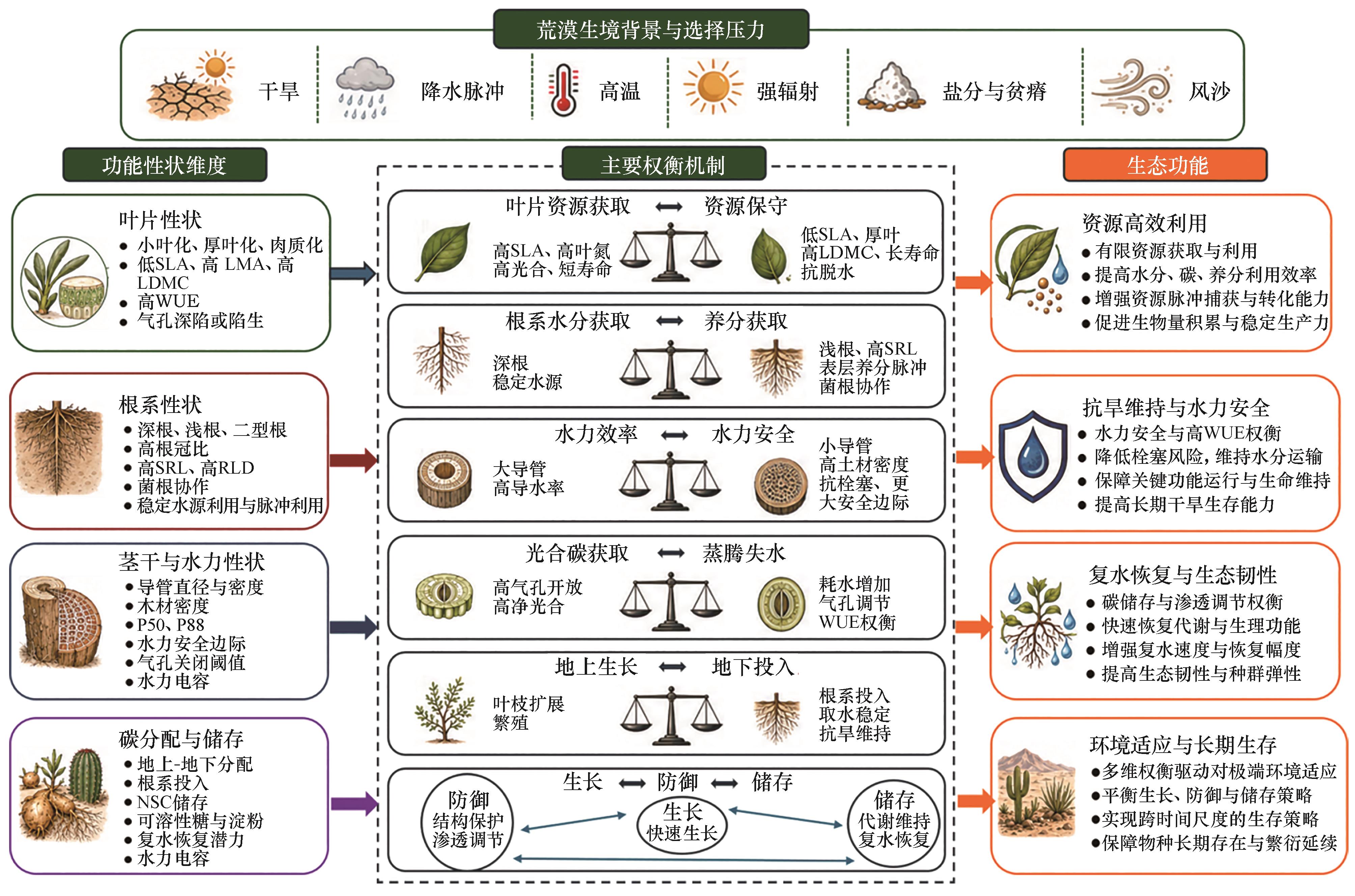
图1 荒漠植物功能性状的主要权衡机制示意图
Fig.1 Schematic diagram of the main functional trait trade-off mechanisms in desert plants
| [1] | Schwinning S, Sala O E.Hierarchy of responses to resource pulses in arid and semi-arid ecosystems[J].Oecologia,2004,141(2):211-220. |
| [2] | Reynolds J F, Kemp P R, Ogle K,et al.Modifying the 'pulse-reserve' paradigm for deserts of North America:precipitation pulses,soil water,and plant responses[J].Oecologia,2004,141(2):194-210. |
| [3] | Violle C, Navas M L, Vile D,et al.Let the concept of trait be functional[J].Oikos,2007,116(5):882-892. |
| [4] | Wright I J, Reich P B, Westoby M,et al.The worldwide leaf economics spectrum[J].Nature,2004,428(6985):821-827. |
| [5] | Reich P B, Walters M B, Ellsworth D S.From tropics to tundra:Global convergence in plant functioning[J].Proceedings of the National Academy of Sciences of the United States of America,1997,94 (25):13730-13734. |
| [6] | 李善家,李来周,缪潆祥,等.河西走廊荒漠植物优势种叶片功能性状变异及权衡[J].干旱区研究,2025,42(3):480-488. |
| [7] | Ogle K, Reynolds J F.Plant responses to precipitation in desert ecosystems:integrating functional types,pulses,thresholds,and delays[J].Oecologia,2004,141(2):282-294. |
| [8] | Huxman T E, Smith M D, Fay P A,et al.Convergence across biomes to a common rain-use efficiency[J].Nature,2004,429(6992):651-654. |
| [9] | Schwinning S, Kelly C K.Plant competition,temporal niches and implications for productivity and adaptability to climate change in water-limited environments[J].Functional Ecology,2013,27(4):886-897. |
| [10] | Akram M A, Wang X, Shrestha N,et al.Variations and driving factors of leaf functional traits in the dominant desert plant species along an environmental gradient in the drylands of China[J].Science of the Total Environment,2023,897:165394. |
| [11] | Kattge J, Bönisch G, Díaz S,et al.TRY plant trait database-enhanced coverage and open access[J].Global Change Biology,2020,26(1):119-188. |
| [12] | Díaz S, Kattge J, Cornelissen J H C,et al.The global spectrum of plant form and function[J].Nature,2016,529(7585):167-171. |
| [13] | Reich P B.The world-wide "fast-slow" plant economics spectrum:a traits manifesto[J].Journal of Ecology,2014,102(2):275-301. |
| [14] | Cornelissen J H C, Lavorel S, Garnier E,et al.A handbook of protocols for standardised and easy measurement of plant functional traits worldwide[J].Australian Journal of Botany.2003,51:335-380. |
| [15] | Pérez-Harguindeguy N, Díaz S, Garnier E,et al.New handbook for standardised measurement of plant functional traits worldwide[J].Australian Journal of Botany,2013,61(3):167-234. |
| [16] | Weemstra M, Mommer L, Visser E J W,et al.Towards a multidimensional root trait framework:a tree root review[J].New phytologist,2016,211:1159-1169. |
| [17] | Xu S, Ji X, Jin B,et al.Root distribution of three dominant desert shrubs and their water uptake dynamics[J].Journal of Plant Ecology,2016,10(5):780-790. |
| [18] | Rodríguez-Alarcón S, Tamme R, Carmona C P.Intraspecific variation in fine-root traits is larger than in aboveground traits in European herbaceous species regardless of drought[J].Frontiers in Plant Science,2024,15:1375371. |
| [19] | Tyree M T, Sperry J S.Vulnerability of xylem to cavitation and embolism[J].Annual Review of Plant Biology,1989,40:19-36. |
| [20] | Meinzer F C, Johnson D M, Lachenbruch B,et al.Xylem hydraulic safety margins in woody plants:coordination of stomatal control of xylem tension with hydraulic capacitance[J].Functional Ecology,2009,23(5):922-930. |
| [21] | Wang H, Ma J, Wang Y,et al.Xylem anatomical structure as a determinant of hydraulic trait variation in C3 plant Reaumuria soongorica and C4 plant Salsola passerina [J].Environmental and Experimental Botany,2025,229:106055. |
| [22] | Tan F, Cao W, Li X,Et Al.Characteristics,relationships,and anatomical basis of leaf hydraulic traits and economic traits in temperate desert shrub species[J].Life,2024,14(7):834. |
| [23] | Lens F, Gleason S M, Bortolami G,et al.Functional xylem characteristics associated with drought-induced embolism in angiosperms[J].New Phytologist,2022,236:2019-2036. |
| [24] | Huo J, Shi Y, Chen J,et al.Hydraulic trade-off and coordination strategies mediated by leaf functional traits of desert shrubs[J].Frontiers in Plant Science,2022,13:938758. |
| [25] | Gleason S M, Westoby M, Jansen S,et al.Weak tradeoff between xylem safety and xylem-specific hydraulic efficiency across the world's woody plant species[J].New Phytologist,2016,209(1):123-136. |
| [26] | Eziz A, Yan Z, Tian D,et al.Drought effect on plant biomass allocation:a meta-analysis[J].Ecology and Evolution,2017,7(24):11002-11010. |
| [27] | Li B, Wang X, Li Z.Plants extend root deeper rather than increase root biomass triggered by critical age and soil water depletion[J].Science of the Total Environment,2024,914:169689. |
| [28] | Guo J S, Gear L, Hultine K R,et al.Non-structural carbohydrate dynamics associated with antecedent stem water potential and air temperature in a dominant desert shrub[J].Plant Cell and Environment,2020,43(6):1467-1483. |
| [29] | Qin H, Guo Y, Li C,et al.Carbohydrate allocation strategies in leaves of dominant desert shrubs in response to precipitation variability[J].Agricultural and Forest Meteorology,2025,362:110386. |
| [30] | 李民青,周乐,王喜勇,等.7种荒漠木本植物枝干与叶片光合特征及其影响因素[J].应用生态学报,2023,34(10):2637-2643. |
| [31] | Xiao J, Zhao Z, Deng X,et al.Non-structural carbohydrate dynamics of Pinus yunnanensis seedlings under drought stress and re-watering[J].Frontiers in Ecology and Evolution,2024,12:1343258. |
| [32] | Peng L, Hao G, Liu H,et al.Impacts of groundwater depth and tree age on the non-structural carbohydrates of Haloxylon ammodendron [J].Plant Stress,2024,14:100659. |
| [33] | 张雪妮,李岩,杨晓东,等.荒漠植物叶片化学性状及其经济谱对水盐变化的响应[J].生态学杂志,2018,37(5):1299-1306. |
| [34] | 李善家,王子濠,苏培玺,等.荒漠植物性状权衡策略及功能多样性研究进展[J].生态学报,2022,42(18):7308-7320. |
| [35] | 蒋燕,靳川,姜晓燕,等.油蒿叶片资源利用效率变化及其影响因素[J].生态学报,2022,42(15):6196-6208. |
| [36] | 张泽琦,丁甲,王君,等.西鄂尔多斯地区3种荒漠植物的功能性状特征及生态策略[J].植物资源与环境学报,2026,35(2):1-10. |
| [37] | 柴巧弟,马瑞,王安林,等.河西走廊阻沙固沙带典型荒漠植物叶功能性状[J].干旱区研究,2024,41(11):1898-1907. |
| [38] | Li S, Wang H, Gou W,et al.Leaf functional traits of dominant desert plants in the Hexi Corridor,Northwestern China:trade-off relationships and adversity strategies[J].Global Ecology and Conservation,2021,28:e01666. |
| [39] | Ma J, Wang T, Wang H,et al.Variation and correlation among fine root traits of desert plants in arid areas of Northwest China[J].Forests,2024,15(3):476. |
| [40] | Bergmann J, Weigelt A, Van Der Plas F,et al.The fungal collaboration gradient dominates the root economics space in plants[J].Science Advances,2020,6:eaba3756. |
| [41] | 申惠,单立山,马静,等.水分变化对荒漠植物红砂和珍珠猪毛菜细根性状的影响[J].草地学报,2024,32(11):3530-3538. |
| [42] | Gebauer R L E, Ehleringer J R.Water and nitrogen uptake patterns following moisture pulses in a cold desert community[J].Ecology,2000,81(5):1415-1424. |
| [43] | Miao Y J, Zong N, Li Z W,et al.Complementary trade-offs between plant roots and mycorrhizal fungi traits across four alpine grasslands along a precipitation gradient in the northern Xizang Plateau[J].Journal of Plant Ecology,2025,18(4). |
| [44] | 李善家,苏培玺,张海娜,等.荒漠植物叶片水分和功能性状特征及其相互关系[J].植物生理学报,2013,49(2):153-160. |
| [45] | Zhang X, Ma S, Hu H,et al.A trade-off between leaf hydraulic efficiency and safety across three xerophytic species in response to increased rock fragment content[J].Tree Physiology,2024,44(3):tpae010. |
| [46] | Huo J, Li C, Zhao Y,et al.Hydraulic mechanism of limiting growth and maintaining survival of desert shrubs in arid habitats[J].Plant Physiology,2024,196(4):2450-2462. |
| [47] | Zhang H, Mcdowell N G, Li X,et al.Hydraulic safety and growth rather than climate of origin influence survival in desert shrubs and trees[J].Forest Ecology and Management,2023,543:121130. |
| [48] | Duan R, Shi Z, Zhang R,et al.Leaf hydraulic and stomatal traits coordinated with rooting depth in desert species[J].Journal of Plant Ecology,2026,19(2):rtaf196. |
| [49] | Wang H, Tian L, Zhang H,et al.Water Uptake by Artemisia ordosica roots at different topographic positions in an alpine desert dune on the northeastern Qinghai-Tibet Plateau[J].Frontiers in Earth Science,2022,10:686441. |
| [50] | Borland A M, Hartwell J, Weston D J,et al.Engineering crassulacean acid metabolism to improve water-use efficiency[J].Trends in Plant Science,2014,19(5):327-338. |
| [51] | Petrík P, Petek-Petrik A, Mukarram M,et al.Leaf physiological and morphological constraints of water-use efficiency in C3 plants[J].AoB PLANTS,2023,15(4):plad047. |
| [52] | Mccarthy M C, Enquist B J.Consistency between an allometric approach and optimal partitioning theory in global patterns of plant biomass allocation[J].Functional Ecology,2007,21(4):713-720. |
| [53] | Poorter H, Niklas K J, Reich P B,et al.Biomass allocation to leaves,stems and roots:meta-analyses of interspecific variation and environmental control[J].New Phytologist,2012,193:30-50. |
| [54] | Chen R, Ran J, Huang H,et al.Life history strategies drive size-dependent biomass allocation patterns of dryland ephemerals and shrubs[J].Ecosphere,2019,10(4):e02709. |
| [55] | 张晓雪,左小安,岳平,等.内蒙古荒漠草原优势植物叶形态性状与地上生物量对多资源协同的响应[J].生态学报,2025,45(6):2811-2820. |
| [56] | Hartmann H, Trumbore S.Understanding the roles of nonstructural carbohydrates in forest trees-from what we can measure to what we want to know[J].New phytologist,2016,211:386-403. |
| [57] | Mcdowell N, Pockman W T, Allen C D,et al.Mechanisms of plant survival and mortality during drought:why do some plants survive while others succumb to drought?[J].New Phytologist,2008,178:719-739. |
| [58] | Zhang Y, Li Y, Xie J B.Fixed allocation patterns,rather than plasticity,benefit recruitment and recovery from drought in seedlings of a desert shrub[J].AoB PLANTS,2016,8:plw020. |
| [59] | Blumenthal D M, Mueller K E, Kray J A,et al.Traits link drought resistance with herbivore defence and plant economics in semi-arid grasslands:the central roles of phenology and leaf dry matter content[J].Journal of Ecology,2020,108(6):2336-2351. |
| [60] | Valliere J M, Nelson K C, Martinez M C.Functional traits and drought strategy predict leaf thermal tolerance[J].Conservation Physiology,2023,11(1):coad085. |
| [61] | 孙启兴,杨晓东,李浡睿,等.水力性状对荒漠植物群落物种多度分布格局的影响[J].干旱区研究,2023,40(3):412-424. |
| [62] | Wei H, Wu B, Yang W,et al.Low rainfall-induced shift in leaf trait relationship within species along a semi-arid sandy land transect in Northern China[J].Plant Biology,2011,13(1):85-92. |
| [63] | 宋珂辰,张浩,雍嘉仪,等.降水变化下荒漠草原植物群落共存物种根、叶功能性状的差异与权衡[J].生态学报,2026,46(2):1034-1051. |
| [64] | Merchant T K, Henn J J, De Silva I,et al.Aspirational goals for the future of functional traits in restoration:a response to Gornishet al.(2023)[J].Restoration Ecology,2025,33(3):e14336. |
| [65] | Carlucci M B, Brancalion P H S, Rodrigues R R,et al.Functional traits and ecosystem services in ecological restoration[J].Restoration Ecology,2020,28:1372-1383. |
| [66] | Merchant T K, Henn J J, De Silva I,et al.Four reasons why functional traits are not being used in restoration practice[J].Restoration Ecology,2023,31(3):e13788. |
| [67] | Coutinho A G, Nunes A, Branquinho C,et al.Boosting multifunctionality through adaptive trait-based species addition in ongoing restoration projects[J].Ecological Applications,2026,36(1):e70197 |
| [68] | Gornish E S, Campbell C, Svejcar L,et al.Functional traits are used in restoration practice:a response to Merchantet al.(2022)[J].Restoration Ecology,2023,31(7):e13880. |
| [69] | Elhady A, Hirt H.Harnessing plant-soil-microbiome synergy for resilient desert restoration[J].iScience,2025,28(11):113748. |
| [1] | 许正强, 王兴东, 万仲武, 王瑞霞, 杨学龙. 柠条( Caragana korshinskii )固沙林恢复过程中表层土壤有机碳累积特征及其驱动机制[J]. 中国沙漠, 2026, 46(4): 343-353. |
| [2] | 严祺涵, 刘继亮, 王永珍, 冯怡琳, 秦畅, 任嘉隆, 辛未冬, 罗亚勇. 降水减少对戈壁荒漠地表节肢动物多样性的影响[J]. 中国沙漠, 2026, 46(4): 365-376. |
| [3] | 徐永武, 韩高玲. 库布齐沙漠和乌兰布和沙漠植被特征比较[J]. 中国沙漠, 2026, 46(4): 48-58. |
| [4] | 马圆圆, 马登科, 岳奕帆, 康文蓉, 刘鹄, 周国英, 赵文智. 2000—2024年青海省沙区植被覆盖时空变化及其驱动机制[J]. 中国沙漠, 2026, 46(2): 288-300. |
| [5] | 庄艳丽, 赵文智, 刘楷愈. 荒漠凝结水形成过程及其生态水文效应研究进展[J]. 中国沙漠, 2026, 46(1): 162-174. |
| [6] | 何娜娜, 胡广录, 陈坤, 靳涛阳, 田凯夫. 黑河中游荒漠-绿洲过渡带典型固沙植物周围风沙运动模拟[J]. 中国沙漠, 2025, 45(6): 300-311. |
| [7] | 石洋, 刘树林, 康文平, 支莹, 芦瑞杰, 张嗣虎. 2001—2022年青海省植被动态及恢复潜力[J]. 中国沙漠, 2025, 45(5): 34-44. |
| [8] | 周尚哲, 席磊, 崔梦淳, 崔桂鹏, 孔维远, 高攀, 卢琦. 乌兰布和沙漠北部典型植被的叶蜡正构烷烃特征及指示[J]. 中国沙漠, 2025, 45(5): 45-54. |
| [9] | 王立龙, 段育龙, 陈伊迪, 李玉强, 刘新平. 模拟风胁迫对杨树幼苗叶性状和养分回收特征的影响[J]. 中国沙漠, 2025, 45(4): 130-138. |
| [10] | 南益聪, 霍建强, 韩高玲, 周元贞, 赵自强, 张志山. 干旱区植物水力传导与抗旱性研究进展[J]. 中国沙漠, 2025, 45(3): 113-120. |
| [11] | 丁甲, 唐逸云, 李蕾, 杨宏玉, 张泽琦, 王君, 余舒畅, 冯金朝, 石莎, 杨昊天. 土壤水分与氮含量对宁夏荒漠草原甘肃蒿( Artemisia gansuensis )、胡枝子( Lespedeza bicolor )、针茅( Stipa capillata )生理的影响[J]. 中国沙漠, 2025, 45(3): 271-282. |
| [12] | 左强, 杨昊天, 杨奕颖, 蔺锴, 李云飞, 王艳莉. 沙漠光伏建设模式通过土壤水分影响固沙草本植物生长特征[J]. 中国沙漠, 2025, 45(3): 291-301. |
| [13] | 杨岩岩, 刘连友, 吴波, 庞营军. 沙丘埋压对典型荒漠植物枝条枯落物分解的影响[J]. 中国沙漠, 2025, 45(3): 313-325. |
| [14] | 张红霞, 贾荣亮, 赵鹏善, 赵昕, 崔晓云. 荒漠植物逆境生理生态学研究进展[J]. 中国沙漠, 2025, 45(3): 72-79. |
| [15] | 虎瑞, 高艳红, 张鹏, 李小军. 干旱沙区植被恢复与重建对碳循环关键过程的影响研究进展[J]. 中国沙漠, 2025, 45(3): 60-71. |
| 阅读次数 | ||||||
|
全文 |
|
|||||
|
摘要 |
|
|||||
©2018中国沙漠 编辑部
地址: 兰州市天水中路8号 (730000)
电话:0931-8267545
Email:caiedit@lzb.ac.cn;desert@lzb.ac.cn


 甘公网安备 62010202000688号