
- CN 62-1070/P
- ISSN 1000-694X
- Bimonthly 1981
Journal of Desert Research ›› 2025, Vol. 45 ›› Issue (2): 184-190.DOI: 10.7522/j.issn.1000-694X.2024.00121
Haifu Fang1,2,3( ), Xiang Chen4, Hongling Yang1,2,3, Li Cheng1,2,3, Yulin Li1,2()
Received:2024-10-31
Revised:2024-12-12
Online:2025-03-20
Published:2025-03-26
Contact:
Yulin Li
CLC Number:
Haifu Fang, Xiang Chen, Hongling Yang, Li Cheng, Yulin Li. A review of response of nitrous oxide emissions to anthropogenic perturbation in grassland soil[J]. Journal of Desert Research, 2025, 45(2): 184-190.
Add to citation manager EndNote|Ris|BibTeX
URL: http://www.desert.ac.cn/EN/10.7522/j.issn.1000-694X.2024.00121
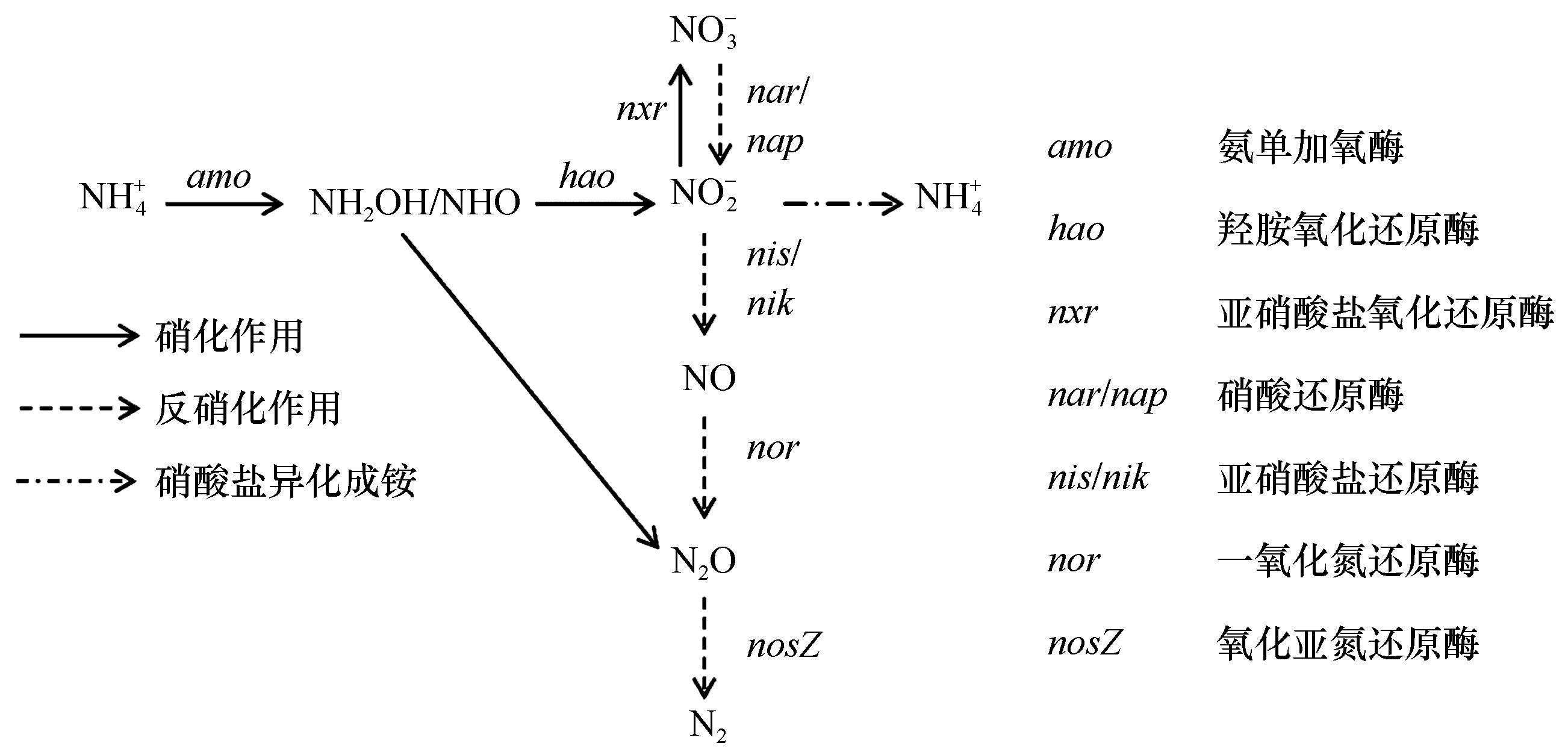
Fig.1 Microbiological mediation of soil N2O emissions[15,19,27]
| 1 | IPCC.Summary for Policymakers//Global Warming of 1.5 ℃[M].Geneva,Switzerland:IPCC,2018. |
| 2 | 任宏芳.气候变化背景下秸秆还田方式对大豆土壤温室气体排放及相关酶活性的影响[D].太原:山西农业大学,2021. |
| 3 | 余雅迪,张茜,王皓,等.土壤二氧化碳及氧化亚氮排放对毛竹扩张的响应及机制[J].浙江农林大学学报,2024,41(3):659-668. |
| 4 | 谢君毅,徐侠,蔡斌,等.“碳中和”背景下碳输入方式对森林土壤活性氮库及氮循环的影响[J].南京林业大学学报(自然科学版),2022,46(2):1-11. |
| 5 | 解李娜,吴祺琪,王宇萌,等.锦鸡儿属灌木阻止干旱草地沙漠化生态过程[J].生态学报,2024,44(4):1680-1691. |
| 6 | 何磊.基于遥感方法的阿拉善盟荒漠化研究[D].兰州:兰州大学,2013. |
| 7 | 向宇,李玉强,郑成卓,等.生物炭在沙质土壤修复中的应用研究进展[J].中国沙漠,2024,44(4):315-326. |
| 8 | 刘仁燕,赵媛媛,周蝶,等.科尔沁-浑善达克沙地2000-2020年土地沙化时空变化格局[J].中国沙漠,2024,44(4):46-56. |
| 9 | 裴广廷,孙建飞,贺同鑫,等.长期人为干扰对桂西北喀斯特草地土壤微生物多样性及群落结构的影响[J].植物生态学报,2021,45(1):74-84. |
| 10 | Zhang K, Zhu Q A, Liu J X,et al.Spatial and temporal variations of N2O emissions from global forest and grassland ecosystems[J].Agricultural and Forest Meteorology,2019,266/267:129-139. |
| 11 | Oertel C, Matschullat J, Zurba K,et al.Greenhouse gas emissions from soils:a review[J].Chemie Der Erde-geochemistry,2016,76(3):327-352. |
| 12 | Kuypers M M M, Marchant H K, Kartal B.The microbial nitrogen-cycling network[J].Nature Reviews Microbiology,2018,16(5):263-276. |
| 13 | 郑翔,刘琦,曹敏敏,等.森林土壤氧化亚氮排放对氮输入的响应研究进展[J].土壤学报,2022,59(5):1190-1203. |
| 14 | 刘峰.不同施肥处理下三种典型旱地土壤N2O排放特征和微生物机理的研究[D].太原:山西大学,2017. |
| 15 | 方海富.毛竹扩张对日本柳杉林土壤N2O排放的影响及微生物机制研究[D].南昌:江西农业大学,2021. |
| 16 | 陈伏生,曾德慧,何兴元.森林土壤氮素的转化与循环[J].生态学杂志,2004,23(5):126-133. |
| 17 | David F, John A P, John A R,et al.The global nitrogen cycle in the twenty-first century[J].Philosophical Transactions of the Royal Society B:Biological Sciences,2013,1621(368):20130164. |
| 18 | Kochian L V, Pineros M A, Liu J,et al.Plant adaptation to acid soils:the molecular basis for crop aluminum resistance[J].Annual Review of Plant Biology,2015,66(1):571-598. |
| 19 | 邓邦良.改良剂应用对油茶林施氮肥土壤温室气体排放的影响[D].南昌:江西农业大学,2020. |
| 20 | 贺纪正,张丽梅.土壤氮素转化的关键微生物过程及机制[J].微生物学通报,2013,40(1):98-108. |
| 21 | Zhang J B, Müller C, Cai Z C.Heterotrophic nitrification of organic N and its contribution to nitrousoxide emissions in soils[J].Soil Biology & Biochemistry,2015,84:199-209. |
| 22 | Stange C F, Spott O, Arriaga H,et al.Use of the inverse abundance approach to identify the sources of NO and N2O release from Spanish forest soils under oxic and hypoxic conditions[J].Soil Biology & Biochemistry,2013(57):451-458. |
| 23 | Wrage N, Velthof G L, Beusichem M L V,et al.Role of nitrifier denitrification in the production of nitrous oxide[J].Soil Biology & Biochemistry,2001,33(12/13):1723-1732. |
| 24 | Fang H F, Liu Y Q, Bai J,et al.Impact of Moso Bamboo (Phyllostachys edulis) expansion into Japanese Cedar plantations on soil fungal and bacterial community compositions[J].Forests,2022,13:1190. |
| 25 | Shoun H, Fushinobu S, Jiang L,et al.Fungal denitrification and nitric oxide reductase cytochrome P450nor[J].Philosophical transactions of the Royal Society of London.Series B.Biological Sciences,2012,367(1593):1186-1194. |
| 26 | Lipschultz F, Zafiriou O C, Wofsy S C,et al.Production of NO and N2O by soil nitrifying bacteria[J].Nature,1981,294(5842):641-643. |
| 27 | 王佰慧.不同硅含量生物质炭对油茶林土壤酸化改良及温室气体排放的影响[D].南昌:江西农业大学,2022. |
| 28 | Davidsion E A, Keller M, Erickson H E,et al.Testing a conceptual model of soil emissions of nitrous and nitric oxides[J].Bioscience,2000,5(8):667-680. |
| 29 | Park S, Croteau P, Boering K A,et al.Trends and seasonal cycles in the isotopic composition of nitrous oxide since 1940[J].Nature Geoscience,2012,5(4):261-265. |
| 30 | 黄莹,龙锡恩.真菌对土壤N2O释放的贡献及其研究方法[J].应用生态学报,2014,25(4):1213-1220. |
| 31 | Fang H F, Xu X T, Zhang Q,et al.Biochar mitigated more N2O emissions from soils with the same origin ecosystem as its feedstocks:implications for application of biochar[J].Journal of Soil Sediments,2024,24(6):2458-2466. |
| 32 | Stehfest E, Lex B.N2O and NO emission from agricultural fields and soils under natural vegetation summarizing available measurement data and modeling of global annual emissions[J].Nutrient Cycling in Agroecosystems,2006,74(3):207-228. |
| 33 | Banerjee S, Helgason B, Wang L,et al.Legacy effects of soil moisture on microbial community structure and N2O emissions[J].Soil Biology & Biochemistry,2016,95:40-50. |
| 34 | Deng B L, Shi Y Z, Zhang L,et al.Effects of spent mushroom substrate-derived biochar on soil CO2 and N2O emissions depend on pyrolysis temperature[J].Chemosphere,2020,246:125608. |
| 35 | Fang H F, Gao Y, Zhang Q,et al.Moso bamboo and Japanese cedar seedlings differently affected soil N2O emissions[J].Journal of Plant Ecology,2021,15:277-285. |
| 36 | 黄俊翔,刘春岩,姚志生,等.放牧草地氧化亚氮排放:研究进展与展望[J].农业环境科学学报,2020,39(4):700-706. |
| 37 | Huang B, Chen G X, Huang G H,et al.Nitrous oxide emission from temperate meadow grassland and emission estimation for temperate grassland of China[J].Nutrient Cycling in Agroecosystems,2003,67(1):31-36. |
| 38 | Zhang F, Qi J, Li M F,et al.Quantifying nitrous oxide emissions from Chinese grasslands with a process-based model[J].Biogeosciences,2010,7(6):2039-2050. |
| 39 | Xu R, Wang Y S, Niu H S,et al.Estimating N2O emissions from soils under natural vegetation in China[J].Plant & Soil,2018,434(1/2):271-287. |
| 40 | Tian H, Xu X F, Lu C Q,et al.Net exchanges of CO2,CH4 and N2O between China's terrestrial ecosystems and the atmosphere and their contributions to global climate warming[J].Journal of Geophysical Research Biogeosciences,2011,116:G2011. |
| 41 | Peng Q, Qi Y C, Dong Y S,et al.Soil nitrous oxide emissions from a typical semiarid temperate steppe in Inner Mongolia:effects of mineral nitrogen fertilizer levels and forms[J].Plant & Soil,2011,342(1/2):345-357. |
| 42 | Liu X R, Dong Y S, Qi Y C,et al.N₂O fluxes from the native and grazed semi-arid steppes and their driving factors in Inner Mongolia,China[J].Nutrient Cycling in Agroecosystems,2010,86(2):231-240. |
| 43 | Holst J, Liu C, Yao Z,et al.Importance of point sources on regional nitrous oxide fluxes in semi-arid steppe of Inner Mongolia,China[J].Plant & Soil,2007,296(1/2):209-226. |
| 44 | Du Y G, Cui Y G, Xu X L,et al.Nitrous oxide emissions from two alpine meadows in the Qinghai-Tibetan Plateau[J].Plant & Soil,2008,311(1/2):245-254. |
| 45 | 吴晓芬,陈有超,蒋文婷,等.模拟牲畜采食对高寒草甸土壤潜在氧化亚氮排放的影响[J].草地学报,2024,39(9):2794-2802. |
| 46 | Vermoesen A, Van C O, Hofman G.Contribution of urine patches to the emission of N2 O[M]//Jarvis S C and Pain B F.Gaseous Nitrogen Emissions from Grasslands.Wallingford,USA:CABI,1997. |
| 47 | Clough T J, Sherlock R R, Cameron K C,et al.Fate of urine nitrogen on mineral and peat soils in New Zealand[J].Plant & Soil,1996,178(1):141-152. |
| 48 | Velthof G L, Jarvis S C, Allen A G,et al.Spatial variability of nitrous oxide fluxes in mown and grazed grassland on a poorly clay soil[J].Soil Biology & Biocheemistry,1996,28(9):1215-1225. |
| 49 | Deng B L, Yuan X, Siemann E,et al.Feedstock particle size and pyrolysis temperature regulate effects of biochar on soil nitrous oxide and carbon dioxide emissions[J].Waste Management,2021,120:33-40. |
| 50 | Zhang L, Hou L, Laanbroek H,et al.Effects of mowing heights on N2O emission from temperate grasslands in Inner Mongolia,Northern China[J].American Journal of Climate Change,2015,4(5):397-407. |
| 51 | 周磊榴,祝贵兵,王衫允,等.洞庭湖岸边带沉积物氨氧化古菌的丰度、多样性及对氨氧化的贡献[J].环境科学学报,2013,33(6):1741-1747. |
| 52 | Yin M Y, Gao X P, Kuang W N,et al.Soil N2O emissions and functional genes in response to grazing grassland with livestock:a meta-analysis[J].Geoderma,2023,436:116538. |
| 53 | 郭小伟,戴黎聪,李茜,等.青藏高原放牧高寒草甸主要温室气体通量及其主控因素研究[J].草原与草坪,2019,39(3):72-78. |
| 54 | 杨鼎.高原鼢鼠影响高寒草甸土壤碳氮含量的时间有效性研究[D].兰州:兰州大学,2021. |
| 55 | Yamulki S, Jarvis S C, Owen P.Nitrous oxide emissions from excrecta applied in a simulated grazing pattern[J].Soil Biology & Biochemistry,1998,30(4):491-500. |
| 56 | Flessa H, Dorsch P, Beese F,et al.Influence of cattle wastes on nitrous oxide and methane fluxes in pasture land[J].Journal of Environment Quality,1996,25:1366-1370. |
| 57 | Allen A G, Jarvis S C, Headon D M.Nitrous oxide emissions from soils due to inputs of nitrogen from excreta return by livestock on grazed grassland in the U.K[J].Soil Biology & Biochemistry,1996,28(4/5):597-607. |
| 58 | Oenema O, Velthof G L, Yarnulk S,et al.Nitrous oxide emissions from grazed grassland[J].Soil Use and Management,1997,13(1):288-295. |
| 59 | Yamulki S, Jarvis S C.Nitrous oxide emission from excreta from a simulated grazing pattern and fertilizer application to grassland[M]//Jarvis S C and Pain B F.Gaseous Nitrogen Emissions from Grasslands.Wallingford,USA:CABI,1997. |
| 60 | Yue P, Li K H, Hu Y,et al.The effect of nitrogen input on N2O emission depends on precipitation in a temperate desert steppe[J].Science of The Total Environment,2024,924:171572. |
| 61 | Yue P, Zuo X A, Li K H,et al.No significant change noted in annual nitrous oxide flux under precipitation changes in a temperate desert steppe[J].Land Degradation & Development,2022,33:94-103. |
| 62 | Tang S M, Wang K, Xiang Y Z,et al.Heavy grazing reduces grassland soil greenhouse gas fluxes:a global meta-analysis[J].Science of the Total Environment,2019,654:1218-1224. |
| 63 | Bilotta G S, Brazier R E, Haygarth P M.The impacts of grazing animals on the quality of soils,vegetation,and surface waters in intensively managed grasslands[J].Advances in Agronomy,2007,94:237-280. |
| 64 | Chroňáková A, Radl V, Čuhel J,et al.Overwintering management on upland pasture causes shifts in an abundance of denitrifying microbial communities,their activity and N2O-reducing ability[J].Soil Biology & Biochemistry,2009,41(6):1132-1138. |
| 65 | Yamulki S, Goulder K W T, Webster C P.Studies on NO and N2O fluxes from a wheat field[J].Atmospheric Environment,1995,29(14):1627-1635. |
| 66 | 王志瑞,杨山,马锐骜,等.内蒙古草甸草原土壤理化性质和微生物学特性对刈割与氮添加的响应[J].应用生态学报,2019,30(9):3010-3018. |
| 67 | Wan S Q, Luo Y Q.Substrate regulation of soil respiration in a tallgrass prairie Results of a clipping and shading experiment[J].Global Biogeochemical Cycles,2003,17(2):1054. |
| 68 | Kögel-Knabner I.Chemical structure of organic N and organic P in soil[J].Nucleic Acids and Proteins in Soil,2006,8(1):23-48. |
| 69 | Yang S, Xu Z W, Wang R Z,et al.Variations in soil microbial community composition and enzymatic activities in response to increased N deposition and precipitation in Inner Mongolian grassland[J].Applied Soil Ecology:A Section of Agriculture,Ecosystems & Environment,2017,119:275-285. |
| 70 | Dong W Y, Zhang X Y, Liu X Y,et al.Responses of soil microbial communities and enzyme activities to nitrogen and phosphorus additions in Chinese fir plantations of subtropical China[J].Biogeosciences,2015,12(18):5537-5546. |
| 71 | 赵欣鑫,李玉霖,李有文,等.氮沉降增加和人类干扰对半干旱草地土壤呼吸的影响[J].农业工程学报,2020,36(15):120-127. |
| 72 | 李兆国.地表火对红松凋落物燃烧剩余物水溶性成分和特性的影响[D].哈尔滨:东北林业大学,2021. |
| 73 | Gang Q, Chang S X, Lin G,et al.Exogenous and endogenous nitrogen differentially affect the decomposition of fine roots of different diameter classes of Mongolian pine in semi-arid northeast China[J].Plant & Soil,2019,436(1/2):109-122. |
| 74 | Maron J L, Jefferies R L.Restoring enriched grasslands:effects of mowing on species richness productivity,and nitrogen retention[J].Ecological Applications,2001,11(4):1088-1100. |
| 75 | Collins S L, Knapp A K, Briggs J M,et al.Modulation of diversity by grazing and mowing in native Tallgrass Prairie[J].Science,1998,280(1):745-747. |
| 76 | Bahn M, Knapp M, Garajova Z,et al.Root respiration in temperate mountain grasslands differing in land use[J].Global Change Biology,2006,12:995-1006. |
| 77 | 阚雨晨,吴瑞鑫,钟梦莹,等.干扰对典型草原生态系统土壤净呼吸特征的影响[J].生态学报,2015,35(18):6041-6050. |
| 78 | 杨思航.气候多因子对典型温带草原土壤微生物群落的影响研究[D].北京:清华大学,2019. |
| 79 | 胡海清,罗斯生,罗碧珍,等.林火干扰对森林生态系统土壤有机碳的影响研究进展[J].生态学报,2020,40(6):1839-1850. |
| [1] | Jianjun Kang, Dongmei Zhang, Liwen Zhao, Fan Yang. Si and N stoichiometry and homeostasis characteristics of Phragmites australis in desert oasis [J]. Journal of Desert Research, 2025, 45(2): 166-175. |
| [2] | Zhengjiaoyi Wang, Min Chen, Huaihai Wang, Haojiang Bai, Zhaobin Song, Xiaoxue Zhang. Effects of grazing intensities on soil carbon, nitrogen, phosphorus stoichiometric ratiosin andreproductive traits of Reaumuria soongorica [J]. Journal of Desert Research, 2025, 45(2): 119-128. |
| [3] | Chunlong Jiang, Hongye Jiang, Linyue Dai, Chen Chen, Chenyu Zhao, Zhongling Guo, Jifeng Li, Huiru Li, Xueyong Zou, Rende Wang, Qing Li, Na Zhou, Yixiao Yuan, Chunping Chang. Enrichment characteristics of microplastics in wind-eroded soils of mulched farmland and the adjacent grassland [J]. Journal of Desert Research, 2025, 45(1): 94-102. |
| [4] | Yuliang Rao, Chun Cao, Xiaoxue Zhang, Chang Lu, Ping Yue. Response of soil ammonia volatilization to exogenous nitrogen input in Inner Mongolian desert grasslands [J]. Journal of Desert Research, 2024, 44(6): 178-186. |
| [5] | Haoyu He, Wei Liu, Zongqiang Chang, Chunmei Hou, Liwei Sun, Xiuli Chi. Effects of revegetation on soil organic carbon composition and stability in the southern edge of the Tengger Desert [J]. Journal of Desert Research, 2024, 44(6): 307-317. |
| [6] | Tian Yong, Jinxia Zhang, Lijuan Chen, Haiyang Xi, Binwu Zhang, Kaiyuan Gan. Characteristics of soil water and salt spatial differentiation along the Yellow River section of Ulan Buh Desert and its causes [J]. Journal of Desert Research, 2024, 44(3): 247-258. |
| [7] | Wei Hang, Yongxing Lu, Hao Guo, Xing Guo, Shihang Zhang, Yuanming Zhang, Xiaobing Zhou. Spatial variation in soil nitrogen content along aridity gradients in the northwest desert region in China [J]. Journal of Desert Research, 2024, 44(3): 259-268. |
| [8] | Li Cheng, Zhiying Ning, Hongling Yang, Yulin Li. Effects of different sand-fixation measures on vegetation and soil characteristics of high and flat mobile dunes [J]. Journal of Desert Research, 2024, 44(2): 273-282. |
| [9] | Hongling Yang, Bo Yao, Yongzhong Su, Yulin Li. Distribution pattern of soil physical and chemical properties of plantation forest in northern agro-pastoral ecotone [J]. Journal of Desert Research, 2024, 44(2): 283-294. |
| [10] | Xiaofang Jiang, Qingxia Xu, Hanchen Duan, Jie Liao, Pinglin Guo, Cuihua Huang, Xian Xue. Multi-model comparison on soil salinization inversion in Jingdian irrigation area of the Yellow River [J]. Journal of Desert Research, 2023, 43(5): 18-30. |
| [11] | Qingshuang Meng, Hejun Zuo, Min Yan, Haibing Wang, Cheng Xi. Relationship between constant elements and granularity of the surface sediment in the Kubuqi Desert [J]. Journal of Desert Research, 2023, 43(4): 107-117. |
| [12] | Yansong Feng, Caihong Yang, Yuquan Qiang. Effects of tillage patterns on soil respiration in summer maize field in Hexi Oasis irrigation area [J]. Journal of Desert Research, 2023, 43(4): 200-208. |
| [13] | Shihang Zhang, Ping Yue, Yusen Chen, Hao Guo, Yongxing Lu, Xing Guo, Chaohong Liu, Xuejun Liu, Xiaobing Zhou, Yuanming Zhang. Simulation of changes in CH4 and N2O fluxes in desert soils by the DNDC model [J]. Journal of Desert Research, 2023, 43(3): 220-229. |
| [14] | Yaofang Shi, Xian Xue, Quangang You, Fei Peng, Cuihua Huang. Distribution characteristics of soil organic carbon and its relationship with soil physical properties in Ali Desert Area, Tibetan Plateau [J]. Journal of Desert Research, 2023, 43(3): 284-294. |
| [15] | Yuqing Chen, Haiyang Xi, Wenju Cheng, Xinyue Zhao. Characteristics of soil carbon and nitrogen change in three typical plant communities in desert riparian forest area [J]. Journal of Desert Research, 2023, 43(1): 150-159. |
| Viewed | ||||||
|
Full text |
|
|||||
|
Abstract |
|
|||||
Address: No. 8, Tianshui Middle Road, Chengguan District, Lanzhou City, Gansu Province, China (Postcode: 730000)
Tel:0931-8267545
Email:caiedit@lzb.ac.cn;desert@lzb.ac.cn
Support:Magtech
