
- CN 62-1070/P
- ISSN 1000-694X
- Bimonthly 1981
Journal of Desert Research ›› 2026, Vol. 46 ›› Issue (1): 199-208.DOI: 10.7522/j.issn.1000-694X.2026.00004
Previous Articles Next Articles
Dengke Ma( ), Wenzhi Zhao(), Zhibin He
Received:2025-11-23
Revised:2026-01-11
Online:2026-01-20
Published:2026-03-09
Contact:
Wenzhi Zhao
CLC Number:
Dengke Ma, Wenzhi Zhao, Zhibin He. Research progress on vegetation structure in artificial windbreak and sand-fixation ecosystem[J]. Journal of Desert Research, 2026, 46(1): 199-208.
Add to citation manager EndNote|Ris|BibTeX
URL: http://www.desert.ac.cn/EN/10.7522/j.issn.1000-694X.2026.00004
| 指标 | 定义 | 测定/计算方法 |
|---|---|---|
| 株高 | 植物从地面到顶端的高度 | 直接测量、投影测量 |
| 冠幅 | 植物冠层在水平方向上伸展的宽度 | 直接测量、投影测量 |
| 分枝率 | 单位长度内植物主干上形成侧枝的数量 | 计数法 |
| 胸径 | 地面起1.3 m高度处的树干直径 | 立木测定法 |
| 生物量 | 单位面积内的植物干重或鲜重 | 称重法、标准枝法等 |
| 侧影面积 | 植株在迎风方向上的投影面积(不包括枝叶间空隙的投影面积)[ | 数字图像法、高宽法、分段求和法[ |
| 根系结构 | 包括植物根系在土壤中的垂直分布深度及密度等 | 根系分析仪法 |
| 枝下高 | 从地面到树冠最下方一级显著侧枝的垂直高度 | 直接测量、投影测量 |
| 植被盖度 | 单位水平地表面积上的植被地上部垂直投影面积[ | 数字图像法 |
| 叶面积指数 | 单位地面面积上的叶片总表面积[ | 扫描法、传感器法、遥感技术 |
| 疏透度 | 林带纵断面上透光孔隙的投影面积与林带纵断面面积之比[ | 数字图像法 |
| 孔隙度 | 单位面积内林带中未被植物枝叶遮挡的空间比例 | 数字图像法 |
| 株行距 | 同一行内相邻两棵树之间的距离(株距),以及不同行之间或树列之间的距离(行距) | 直接测量法 |
| 林带宽度 | 从林带迎风面到背风面之间的水平距离 | 标准带法 |
| 林带密度 | 单位面积内的植物个体数量 | 计数法 |
| 林带高度 | 林带内树木高度的平均值 | 直接测量、投影测量 |
| 垂直结构层次 | 林带垂直方向上的空间结构和层次分布 | |
| 配置方式 | 防护林在空间上的组织形式 | |
| 带斑比 | 林网在所庇护斑块上的覆被率,体现林带在景观中的丰盛程度[ | 带丰度和斑丰度之比 |
| 连接度 | 林网系统中各林带之间在空间上的联系程度,体现林网的成型状况[ | 林网节点数、林网最多林带连边数的函数[ |
| 环度 | 林网系统中林带在空间上的闭合程度[ | 林网节点数、林网环路数的函数[ |
| 种类组成 | 防护系统中的物种构成及丰富度 | 计数法 |
| 归一化植被指数(NDVI) | 综合反映植被生长状况及生物量的遥感指标[ | 基于遥感影像的近红外反射率(NIR)和红光反射率(Red)计算[ |
Table 1 Main indicators used to characterize vegetation structure in windbreak and sand-fixation ecosystems
| 指标 | 定义 | 测定/计算方法 |
|---|---|---|
| 株高 | 植物从地面到顶端的高度 | 直接测量、投影测量 |
| 冠幅 | 植物冠层在水平方向上伸展的宽度 | 直接测量、投影测量 |
| 分枝率 | 单位长度内植物主干上形成侧枝的数量 | 计数法 |
| 胸径 | 地面起1.3 m高度处的树干直径 | 立木测定法 |
| 生物量 | 单位面积内的植物干重或鲜重 | 称重法、标准枝法等 |
| 侧影面积 | 植株在迎风方向上的投影面积(不包括枝叶间空隙的投影面积)[ | 数字图像法、高宽法、分段求和法[ |
| 根系结构 | 包括植物根系在土壤中的垂直分布深度及密度等 | 根系分析仪法 |
| 枝下高 | 从地面到树冠最下方一级显著侧枝的垂直高度 | 直接测量、投影测量 |
| 植被盖度 | 单位水平地表面积上的植被地上部垂直投影面积[ | 数字图像法 |
| 叶面积指数 | 单位地面面积上的叶片总表面积[ | 扫描法、传感器法、遥感技术 |
| 疏透度 | 林带纵断面上透光孔隙的投影面积与林带纵断面面积之比[ | 数字图像法 |
| 孔隙度 | 单位面积内林带中未被植物枝叶遮挡的空间比例 | 数字图像法 |
| 株行距 | 同一行内相邻两棵树之间的距离(株距),以及不同行之间或树列之间的距离(行距) | 直接测量法 |
| 林带宽度 | 从林带迎风面到背风面之间的水平距离 | 标准带法 |
| 林带密度 | 单位面积内的植物个体数量 | 计数法 |
| 林带高度 | 林带内树木高度的平均值 | 直接测量、投影测量 |
| 垂直结构层次 | 林带垂直方向上的空间结构和层次分布 | |
| 配置方式 | 防护林在空间上的组织形式 | |
| 带斑比 | 林网在所庇护斑块上的覆被率,体现林带在景观中的丰盛程度[ | 带丰度和斑丰度之比 |
| 连接度 | 林网系统中各林带之间在空间上的联系程度,体现林网的成型状况[ | 林网节点数、林网最多林带连边数的函数[ |
| 环度 | 林网系统中林带在空间上的闭合程度[ | 林网节点数、林网环路数的函数[ |
| 种类组成 | 防护系统中的物种构成及丰富度 | 计数法 |
| 归一化植被指数(NDVI) | 综合反映植被生长状况及生物量的遥感指标[ | 基于遥感影像的近红外反射率(NIR)和红光反射率(Red)计算[ |
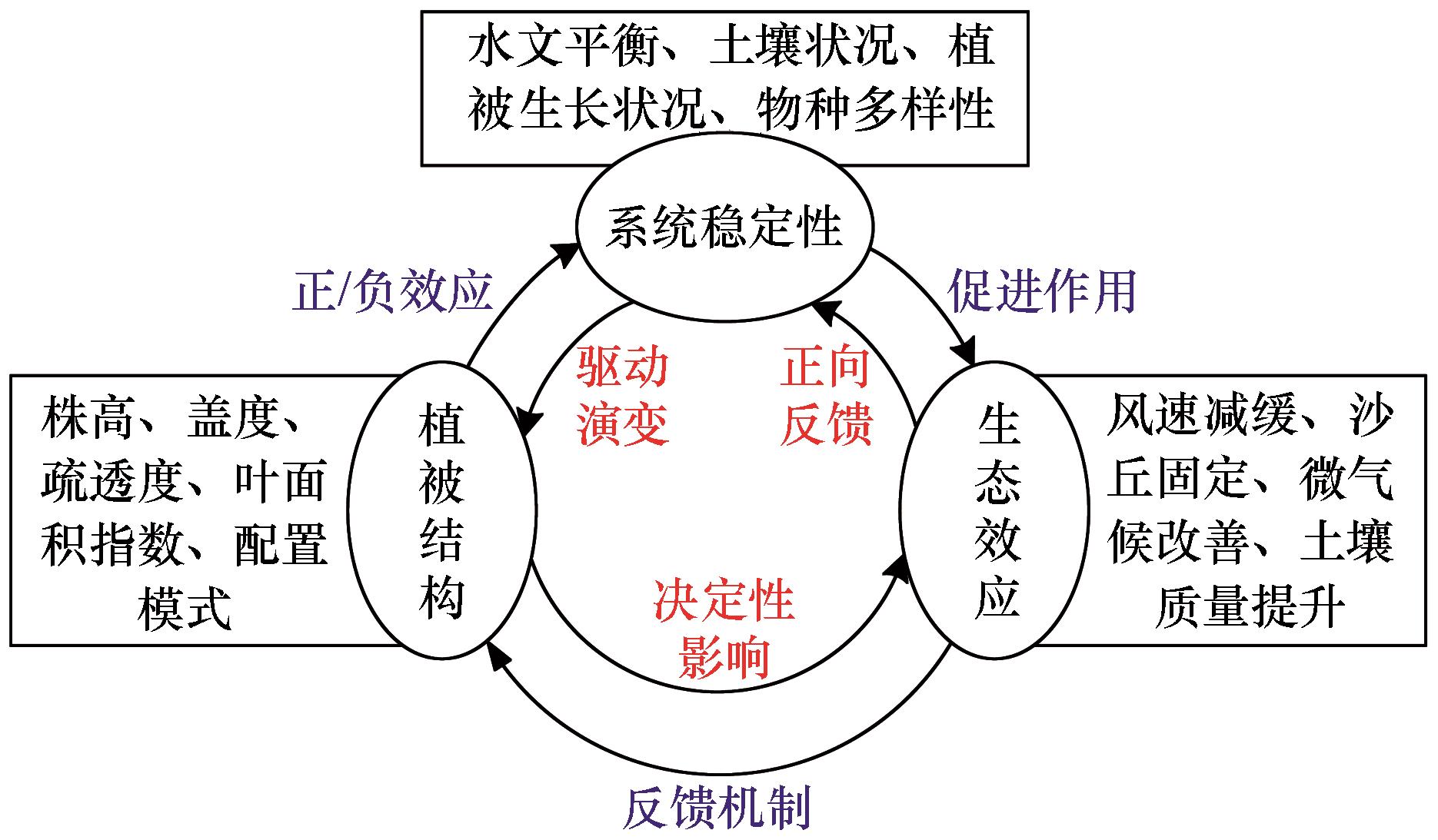
Fig.1 Schematic diagram of the relationship between sand-fixing vegetation structure and protection effect and stability of protection system
| [1] | 李新荣,张志山,黄磊,等.我国沙区人工植被系统生态-水文过程和互馈机理研究评述[J].科学通报,2013,58():397-410. |
| [2] | 王涛.荒漠化治理中生态系统、社会经济系统协调发展问题探析:以中国北方半干旱荒漠区沙漠化防治为例[J].生态学报,2016,36(22):7045-7048. |
| [3] | Wei W J, Wang B, Niu X.Soil erosion reduction by grain for Green Project in desertification areas of northern China[J].Forests,2020,11(4):473. |
| [4] | Dang X H, Na Y, Chi W F,et al.Spatio-temporal evolution of sandy land and its impact on soil wind erosion in the Kubuqi Desert in recent 30 years[J].Frontiers in Environmental Science,2022,10:950196. |
| [5] | 黄麟,祝萍,肖桐,等.近35年三北防护林体系建设工程的防风固沙效应[J].地理科学,2018,38(4):600-609. |
| [6] | 王涛,宋翔,颜长珍,等.近35 a来中国北方土地沙漠化趋势的遥感分析[J].中国沙漠,2011,31(6):1351-1356. |
| [7] | 屈建军,王涛,牛清河,等.刷状草方格固沙障机织工艺与防沙效果研究[J].中国科学:技术科学,2024,54(8):1601-1610. |
| [8] | 范志平,曾德慧,朱教君,等.农田防护林生态作用特征研究[J].水土保持学报,2002(4):130-133. |
| [9] | Cleugh H.Effects of windbreaks on airflow,microclimates and crop yields[J].Agroforestry Systems,1998,41:55-84. |
| [10] | Vacek Z, Rehácek D, Cukor J,et al.Windbreak efficiency in agricultural landscape of the central Europe:multiple approaches to wind erosion control[J].Environmental Management,2018,62:942-954. |
| [11] | Tian L, Wu W Y, Zhou X,et al.The ecosystem effects of sand-binding shrub hippophae rhamnoides in alpine semi-arid desert in the northeastern Qinghai-Tibet Plateau[J].Land,2019,8(12):183-183. |
| [12] | Liao C, Li H D, Lv G P,et al.Effects of ecological restoration on soil properties of the aeolian sandy land around Lhasa,southern Tibetan Plateau[J].Ecosphere,2020,11(1):e03009. |
| [13] | 牛丹妮,韩蓉,马瑞,等.林分密度和种植点配置对梭梭人工林防风效应的影响[J].干旱区研究,2023,40(1):143-151. |
| [14] | 杨彦,沈留记,姜乐璞,等.风沙区不同配置农田防护林防护效应及其对农田土壤水分的影响[J].水土保持通报,2024,44(2):11-21. |
| [15] | 唐玉龙,安志山,张克存,等.不同结构单排林带防风效应的风洞模拟[J].中国沙漠,2012,32(3):647-654. |
| [16] | Wu T G, Zhang P, Zhang L,et al.Relationships between shelter effects and optical porosity:a meta-analysis for tree windbreaks[J].Agricultural and Forest Meteorology,2018,259:75-81. |
| [17] | Bird P, Jackson T T, Kearney G A,et al.Effects of windbreak structure on shelter characteristics[J].Australian Journal of Experimental Agriculture,2007,47(6):727-737. |
| [18] | 白子怡,董治宝,南维鸽,等.两种草本植物群落的防风固沙效能对比[J].地理科学,2025,45(2):438-448. |
| [19] | 周云鹤,陈智,佟鑫,等.不同疏透度的柠条带防风效果研究[J].中国水土保持科学,2022,5:60-64. |
| [20] | 杨文斌,卢琦,吴波,等.低覆盖度不同配置灌丛内风流结构与防风效果的风洞实验[J].中国沙漠,2007,27(5):791-796. |
| [21] | Ferreira A.Structural design of a natural windbreak using computational and experimental modeling[J].Environmental Fluid Mechanics,2011,11(5):517-530. |
| [22] | 王彦武,罗玲,张峰,等.民勤县绿洲边缘固沙林防风蚀效应研究[J].西北林学院学报,2018,33(4):64-70. |
| [23] | 屈志强,刘连友,吕艳丽.沙生植物构型及其与抗风蚀能力关系研究综述[J].生态学杂志,2011,30(2):357-362. |
| [24] | 柴成武,徐先英,唐卫东,等.石羊河流域荒漠区主要固沙植物根系研究[J].西北林学院学报,2009,24(4):21-26. |
| [25] | Vandeven T, Fryrear D, Spaan W.Vegetation characteristics and soil loss by wind[J].Journal of Soil and Water Conservation,1989,44(4):347-349. |
| [26] | 刘江,徐先英,丁爱强,等.荒漠灌木侧影面积的数字化测定及应用[J].干旱区研究,2017,34(5):1070-1076. |
| [27] | 孙佳佳,王志刚,张平仓,等.植被结构指标在南方红壤丘陵区水土保持功能研究中的应用[J].长江科学院院报,2013,30(9):27-32. |
| [28] | Parker G.Tamm review:Leaf Area Index (LAI) is both a determinant and a consequence of important processes in vegetation canopies[J].Forest Ecology and Management,2020,477:118496. |
| [29] | 李火根,黄敏仁.分形及其在植物研究中的应用[J].植物学通报,2001,18(6):684-690. |
| [30] | Tracz W, Mozgawa J, Sterenczak K.Fractal dimension as a tool for description of forest structure complexity[J].Sylwan,2011,155(6):384-392. |
| [31] | Mulati Y, Norio T.Effects of windbreak width in wind direction on wind velocity reduction[J].Journal of Forestry Research,2009,20(3):199-204. |
| [32] | 李雪琳,马彦军,马瑞,等.不同带宽的防风固沙林流场结构及防风效能风洞实验[J].中国沙漠,2018,38(5):936-944. |
| [33] | 厉静文, Dosmanbetov D A,郭浩,等.不同配置乔灌混交林防风效益的风洞试验[J].农业工程学报,2020,36(11):95-102. |
| [34] | 王洋,王振亭.植物固沙最低盖度的理论计算[J].中国沙漠,2025,45(2):97-101. |
| [35] | 邹慧,杨文斌,朱斌,等.低覆盖度治沙理论及实践[J].生态学报,2025,45(3):1070-1076. |
| [36] | 范志平,关文彬,曾德慧,等.东北地区农田防护林高效多功能经营的指标体系及标准研究[J].应用生态学报,2001,12(5):701-705. |
| [37] | 厉静文,包岩峰,郭浩,等.梭梭(Haloxylon anmodendron)林带防风效果的风洞试验[J].中国沙漠,2020,40(3):77-84. |
| [38] | 赵亚冲,邓岚,王雄,等.阿拉尔垦区新疆杨农田防护林防风效果研究[J].塔里木大学学报,2023,35(4):105-112. |
| [39] | Torita H, Satou H.Relationship between shelterbelt structureand mean wind reduction[J].Agricultural and Forest Meteorology,2007,145(3/4):186-194. |
| [40] | Zhang S, Yuan W J, Yu Y,et al.Shrubs plays an important role in configuration of shelterbelt in windy and sandy areas[J].Frontiers in Ecology and Evolution,2024,12:1347714. |
| [41] | Li H L, Wang Y D, Li S Y,et al.Shelter efficiency of various shelterbelt configurations:a wind tunnel study[J].Atmosphere,2022,13(7):1022. |
| [42] | Zeng Y L, Hao D L, Huete A,et al.Optical vegetation indices for monitoring terrestrial ecosystems globally[J].Nature Reviews Earth and Environment,2022,3(7):477-493. |
| [43] | 黄富祥,王明星,王跃思.植被覆盖对风蚀地表保护作用研究的某些新进展[J].植物生态学报,2002,26(5):627-633. |
| [44] | Li L Y, Mu X H, Jiang H L,et al.Review of ground and aerial methods for vegetation cover fraction (fCover) and related quantities estimation:definitions,advances,challenges,and future perspectives[J].ISPRS Journal of Photogrammetry and Remote Sensing,2023,199:133-156. |
| [45] | 李正农,周立凡.基于图像处理技术的树木疏透度确定方法研究[J].自然灾害学报,2022,31(5):175-182. |
| [46] | 曹新孙.农田防护林学[M].北京:中国林业出版社,1983:100-109. |
| [47] | Pettorelli N, Vik J O, Mysterud A,et al.Using the satellite-derived NDVI to assess ecological responses to environmental change[J].Trends in Ecology and Evolution,2005,20(9):503-510. |
| [48] | 张慧,李平衡,周国模,等.植被指数的地形效应研究进展[J].应用生态学报,2018,29(2):669-677. |
| [49] | 刘虎俊,袁宏波,郭春秀,等.均匀配置的两种仿真灌木林防风效应野外观测[J].中国沙漠,2015,35(1):8-13. |
| [50] | 胡广录,陈海志,麻进,等.黑河中游荒漠绿洲过渡带典型灌丛植物防风固沙效应[J].中国沙漠,2023,43(5):31-40. |
| [51] | 唐艳,刘连友,屈志强,等.植物阻沙能力研究进展[J].中国沙漠,2011,31(1):43-48. |
| [52] | 张奕,肖辉杰,辛智鸣,等.乌兰布和沙区典型灌木防风阻沙效益[J].中国水土保持科学(中英文),2021,19(1):87-96. |
| [53] | 李映坤,李锦荣,董雷,等.乌兰布和沙漠周边典型植物群落防风阻沙效果[J].中国沙漠,2022,42(6):65-73. |
| [54] | 盛晋华,刘宏义,潘多智,等.梭梭(Haloxylon ammodendron (C.A.Mey.) Bunge)物候期的观察[J].中国农业科技导报,2003,5(3):60-63. |
| [55] | 李鹏,高永,赵青,等.乌兰布和沙漠东北缘人工梭梭林防风效能分析[J].水土保持通报,2017,37(5):34-39. |
| [56] | 钟卫,孔纪名,杨涛.植被沙障对近地表风沙流特征影响的风洞实验[J].干旱区研究,2009,26(6):872-876. |
| [57] | 尚润阳,祁有祥,赵廷宁,等.植被对风及土壤风蚀影响的野外观测研究[J].水土保持研究,2006(4):37-39. |
| [58] | 李亚琦,刘虎俊,刘开琳,等.前密后疏结构林带防风效应的风洞试验[J].西北林学院学报,2023,38(2):126-131. |
| [59] | 喀哈尔·扎依木,买尔旦·阿不都·卡德,杨公新,等.塔克拉玛干西南缘风沙前沿防护林对条田的防护作用[J].水土保持通报,2023,43(3):19-24. |
| [60] | 孙涛,王继和,满多清,等.仿真固沙灌木防风积沙效应的风洞模拟研究[J].水土保持学报,2011,25(6):49-54. |
| [61] | 苏宇.风滚植物沙障防风固沙效应研究[D].呼和浩特:内蒙古农业大学,2024. |
| [62] | 李转桃.基于风洞试验模拟三种典型荒漠植物防风固沙效益的研究[D].兰州:甘肃农业大学,2024. |
| [63] | 买尔旦·阿不都卡德.叶城县风沙前沿区防护林防风固沙效能研究[D].乌鲁木齐:新疆农业大学,2023. |
| [64] | 孙钦明.新疆典型沙区区域防风固沙体系协同配置研究[D].石河子:石河子大学,2016. |
| [65] | 屈志强,张莉,丁国栋,等.不同配置方式沙蒿灌丛对土壤风蚀影响的对比分析[J].水土保持学报,2008(3):1-4. |
| [66] | 杨红艳,戴晟懋,乐林,等.不同分布格局低覆盖度油蒿群丛防风效果[J].林业科学,2008(5):11-16. |
| [67] | 杨文斌,王晶莹.干旱、半干旱区人工林边行水分利用特征与优化配置结构研究[J].林业科学,2004(5):3-9. |
| [68] | Lira-Martins D, Nascimento D L,Abrahao,A,et al.Soil properties and geomorphic processes influence vegetation composition,structure,and function in the Cerrado Domain[J].Plant and Soil,2022,476(1/2):549-588. |
| [69] | Zhai J, Zhang X, Li Z J,et al.Differences in the functional traits of Populus pruinosa leaves in different developmental stages[J].Plant-Basel,2023,12(12):2262. |
| [70] | 张兴,李杰玲,李颖,等.农田防护林林网结构动态变化遥感评价[J].生态学杂志,2024,43(11):3516-3525. |
| [71] | Li F, Zhao W Z.Hydrologic thresholds and changes in ANPP of artificial sand-fixing vegetation in a desert-oasis ecotone in Northwest China[J].Journal of Arid Environments,2017,146:44-52. |
| [72] | 赵文智,郑颖,张格非.绿洲边缘人工固沙植被自组织过程[J].中国沙漠,2018,38(1):1-7. |
| [73] | Moreno-de las Heras M, Saco P M,Willgoose,G R,et al.Assessing landscape structure and pattern fragmentation in semiarid ecosystems using patch-size distributions[J].Ecological Applications,2011,21(7):2793-2805. |
| [74] | 王新军.古尔班通古特沙漠固沙植被格局与水文过程的关系研究[D].乌鲁木齐:新疆农业大学,2017. |
| [75] | Fan D Q, Zhang Y Q, Qin S G,et al.Relationships between Artemisia ordosica communities and environmental factors following sand-dune stabilization in the Mu Us Desert,Northwest China[J].Journal of Forestry Research,2017,28(1):115-124. |
| [76] | 王晗生,刘国彬.植被结构及其防止土壤侵蚀作用分析[J].干旱区资源与环境,1999(2):63-69. |
| [77] | An H, Zhao F Y, Li H N,et al.The typical sand-fixing plants in the Ulan Buh desert-oasis area significantly changed the distribution pattern of surface sediments[J].Frontiers in Environmental Science,2025,13:1556083. |
| [78] | Liu M L, Li X R, Zhu R Q,et al.Vegetation richness,species identity and soil nutrients drive the shifts in soil bacterial communities during restoration process[J].Environmental Microbiology Reports,2021,13(4):411-424. |
| [79] | 王新平,张志山,张景光,等.荒漠植被影响土壤水文过程研究述评[J].中国沙漠,2005,25(2):54-59. |
| [80] | 白壮壮,崔建新,丁晓辉.1986-2015年鄂尔多斯高原沙漠化及其驱动因素研究[J].干旱区研究,2020,37(3):749-756. |
| [81] | Stromberg J, Beauchamp V B, Dixon M D,et al.Importance of low-flow and high-flow characteristics to restoration of riparian vegetation along rivers in and south-western United States[J].Freshwater Biology,2007,52(4):651-679. |
| [82] | 王新平,康尔泗,张景光,等.荒漠地区主要固沙灌木的降水截留特征[J].冰川冻土,2004,26(1):89-94. |
| [83] | Qiu D D, Zhu G F, Lin X R,et al.Dissipation and movement of soil water in artificial forest in arid oasis areas:cognition based on stable isotopes[J].Catena,2023,228:107178. |
| [84] | 尚白军,吴书普,周智彬.新疆莫索湾垦区150团防护林防护效益分析[J].中国水土保持科学(中英文),2021,19(5):45-52. |
| [1] | Junwei Chen, Xuexiang Chang, Quanyan Tian. Response of arboreal forest ecosystem stability to climate change in Qilian Mountain National Park [J]. Journal of Desert Research, 2026, 46(1): 105-120. |
| [2] | Wen Li, Bing Liu, Xiao Wang, Bin Wang, Changkun Yang, Weihao Sun. Mechanism of hydrological connectivity impacts on the stability of hydrology-vegetation-soil systems in oasis wetlands [J]. Journal of Desert Research, 2026, 46(1): 282-290. |
| [3] | Wanghan He, Linshan Yang, Xingyi Zou, Jingru Wang, Tiaoxue Lu, Honghua Xia. Threshold of suitable irrigation scale in Zhangye Basin based on oasis stability evaluation [J]. Journal of Desert Research, 2026, 46(1): 83-94. |
| [4] | Xinru Deng, Qiang Bie, Chunlin Huang, Ying Shi, Xinzhang Li. Cold island effect of typical oasis landscape pattern in arid region [J]. Journal of Desert Research, 2025, 45(6): 12-25. |
| [5] | Rui Zhang, Yalin Wu, Yulin Li, Jie Lian. The influence of fertilization on the sandy farmland productivity and stability of corn in semi-arid areas [J]. Journal of Desert Research, 2025, 45(4): 109-117. |
| [6] | Weihong Zhang, Juan Ma, Ruizhi Zhao, Wei Zhou, Xinyi Zhao, Yanxia Pan. Plant diversity and community stability in forest ecosystems of Ningxia, China [J]. Journal of Desert Research, 2025, 45(3): 210-221. |
| [7] | Juan Ma, Weihong Zhang, Yan Gong, Jie Hu, Zhipeng Liu, Yanxia Pan. Plant diversity and community stability in different grassland types of Ningxia [J]. Journal of Desert Research, 2025, 45(3): 243-252. |
| [8] | Jun Lei, Xinping Cheng, Chun Xue, Hongmei Liu, Yuhong Zhao, Mingmin Xiao. The characteristics and stability of plant communities in the northern desert area of the middle reaches of the Heihe River Basin [J]. Journal of Desert Research, 2024, 44(6): 187-194. |
| [9] | Haoyu He, Wei Liu, Zongqiang Chang, Chunmei Hou, Liwei Sun, Xiuli Chi. Effects of revegetation on soil organic carbon composition and stability in the southern edge of the Tengger Desert [J]. Journal of Desert Research, 2024, 44(6): 307-317. |
| [10] | Congzhen Zhu, Jicheng Luo, Minzhong Wang, Lu Meng, Honglin Pan, Jiantao Zhang. Characteristics of the summer nighttime stable boundary layer in the hinterland of the Taklamakan Desert and its effect on dust aerosols concentration [J]. Journal of Desert Research, 2024, 44(5): 1-12. |
| [11] | Fanrui Bu, Ying Liu, Xueyong Zou, Chunlai Zhang. Vegetation sustainability in relation to water resources in typical sandy areas of eastern China [J]. Journal of Desert Research, 2024, 44(4): 111-125. |
| [12] | Yuchen Wan, Yanping Liu, Yongsheng Wu, Hongfei Jia, Tian Zhang, Yanhong Gao, Haotian Yang, Wanxue You, Jun Du, Rongliang Jia. Morphologic evolution features of mosses in artificial sand-fixing vegetation in the Tengger Desert [J]. Journal of Desert Research, 2024, 44(3): 298-307. |
| [13] | Xiaomei Peng, Cunwei Che, Jingrong Su, Shengchun Xiao. Construction and application of a dendrochronological evaluation method for the stability and suitability of artificial forests in arid areas [J]. Journal of Desert Research, 2024, 44(1): 33-42. |
| [14] | Junhao Liu, Haisheng Zhou, Qun Guo. The effects of desertification control on the patterns of vegetation in arid and semi-arid regions of northern China [J]. Journal of Desert Research, 2023, 43(5): 204-213. |
| [15] | Qi You, Baorong Xu, Songbing Zou, Yihao Qin, Duo Wang, Dong Yu. The vegetation-climate quantitative relationship and characteristics in arid and semi-arid region of northern China [J]. Journal of Desert Research, 2023, 43(4): 274-287. |
| Viewed | ||||||
|
Full text |
|
|||||
|
Abstract |
|
|||||
©2018Journal of Desert Research
Tel:0931-8267545
Email:caiedit@lzb.ac.cn;desert@lzb.ac.cn
Support:Magtech
