
- CN 62-1070/P
- ISSN 1000-694X
- Bimonthly 1981
Journal of Desert Research ›› 2025, Vol. 45 ›› Issue (2): 29-36.DOI: 10.7522/j.issn.1000-694X.2024.00138
Previous Articles Next Articles
Hong Jia1( ), Jianpeng Zhang2, Lianyou Liu1, Jifu Liu1(), Siqi Yang3
Received:2024-07-10
Revised:2024-09-25
Online:2025-03-20
Published:2025-03-26
Contact:
Jifu Liu
CLC Number:
Hong Jia, Jianpeng Zhang, Lianyou Liu, Jifu Liu, Siqi Yang. Variation and multi-scenario simulation of habitat quality in the Gonghe Basin, China[J]. Journal of Desert Research, 2025, 45(2): 29-36.
Add to citation manager EndNote|Ris|BibTeX
URL: http://www.desert.ac.cn/EN/10.7522/j.issn.1000-694X.2024.00138
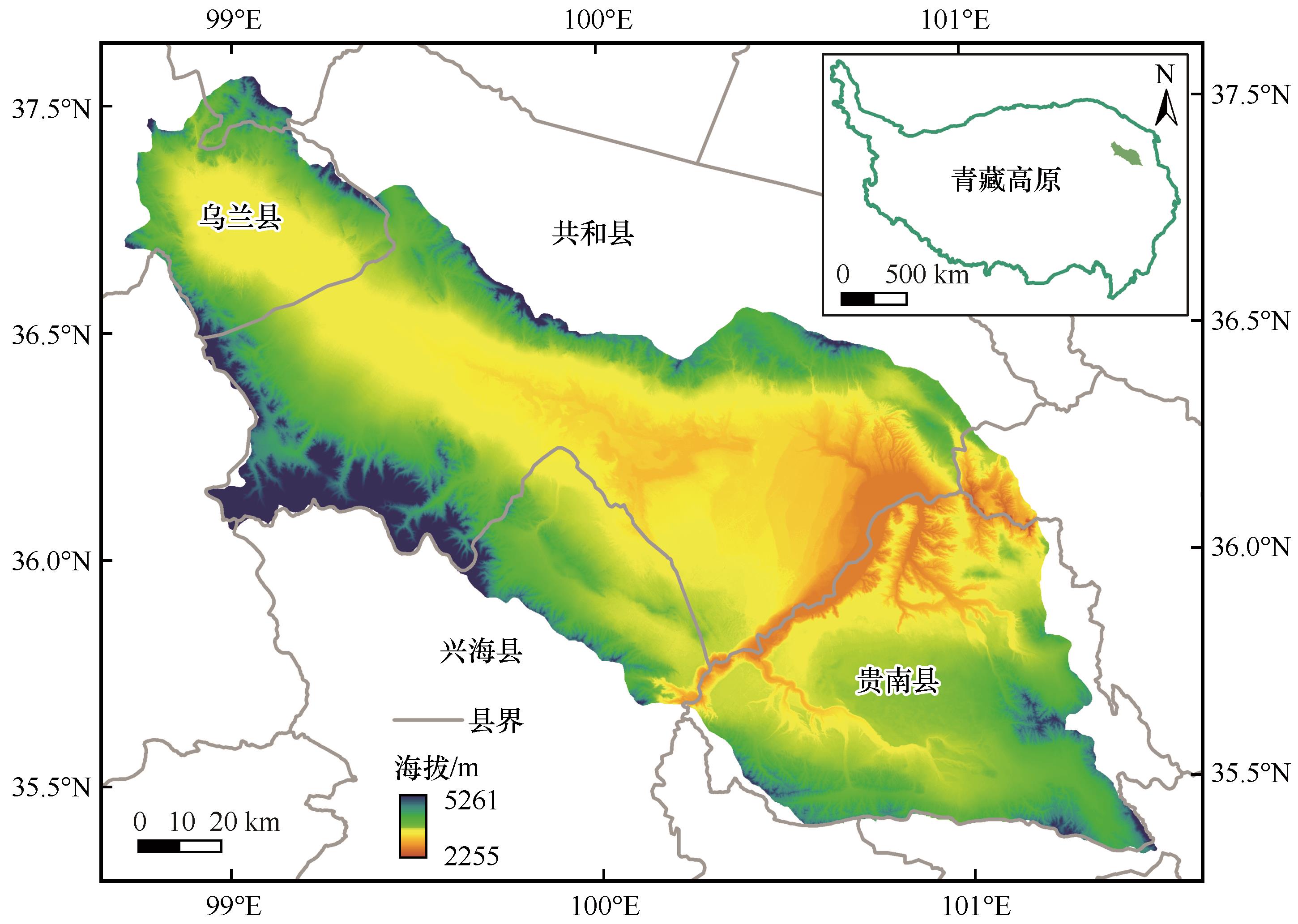
Fig.1 Location of the study area
| 数据类型 | 数据名称 | 空间分辨率/m | 来源 |
|---|---|---|---|
| 土地利用 | 2000—2020年土地利用数据 | 30 | 中国科学院资源环境科学数据平台(http://www.resdc.cn) |
| 自然因子 | DEM数据(海拔、坡度) | 30 | 地理空间数据云(http://www.gscloud.cn) |
| 年平均气温(气温) | 30 | 中国气象数据网(http://data.cma.cn) | |
| 年降水量(降水) | |||
| 年平均风速(风速) | |||
| 土壤类型 | 1 000 | 世界土壤数据库(HWSD V1.2, http://www.fao.org) | |
| NDVI | 250 | MOD13Q1 | |
| 社会因子 | 人口 | 1 000 | 中国科学院资源环境科学与数据中心(http://www.resdc.cn) |
| GDP、夜间灯光数据 | 1 000 | 中国科学院资源环境科学与数据中心(http://www.resdc.cn) | |
| 道路、居民点数据 | 1 000 | 全国地理信息资源目录服务系统(https:www.openstreetmap.org/) |
Table 1 Data and sources
| 数据类型 | 数据名称 | 空间分辨率/m | 来源 |
|---|---|---|---|
| 土地利用 | 2000—2020年土地利用数据 | 30 | 中国科学院资源环境科学数据平台(http://www.resdc.cn) |
| 自然因子 | DEM数据(海拔、坡度) | 30 | 地理空间数据云(http://www.gscloud.cn) |
| 年平均气温(气温) | 30 | 中国气象数据网(http://data.cma.cn) | |
| 年降水量(降水) | |||
| 年平均风速(风速) | |||
| 土壤类型 | 1 000 | 世界土壤数据库(HWSD V1.2, http://www.fao.org) | |
| NDVI | 250 | MOD13Q1 | |
| 社会因子 | 人口 | 1 000 | 中国科学院资源环境科学与数据中心(http://www.resdc.cn) |
| GDP、夜间灯光数据 | 1 000 | 中国科学院资源环境科学与数据中心(http://www.resdc.cn) | |
| 道路、居民点数据 | 1 000 | 全国地理信息资源目录服务系统(https:www.openstreetmap.org/) |
| 威胁因子 | 最大影响距离/km | 权重 | 衰退类型 |
|---|---|---|---|
| 耕地 | 4 | 0.5 | 线性 |
| 建设用地 | 8 | 0.9 | 指数 |
| 未利用地 | 5 | 0.2 | 指数 |
Table 2 Attributes of threat factors
| 威胁因子 | 最大影响距离/km | 权重 | 衰退类型 |
|---|---|---|---|
| 耕地 | 4 | 0.5 | 线性 |
| 建设用地 | 8 | 0.9 | 指数 |
| 未利用地 | 5 | 0.2 | 指数 |
| 土地利用类型 | 生境适宜度 | 耕地 | 建设用地 | 未利用地 |
|---|---|---|---|---|
| 耕地 | 0.5 | 0.3 | 0.4 | 0.3 |
| 林地 | 1.0 | 0.5 | 0.6 | 0.7 |
| 草地 | 0.7 | 0.3 | 0.4 | 0.3 |
| 水域 | 0.8 | 0.7 | 0.5 | 0.8 |
| 建设用地 | 0.0 | 0.0 | 0.0 | 0.0 |
| 未利用地 | 0.0 | 0.0 | 0.0 | 0.0 |
Table 3 Habitat suitability of different land use types and sensitivity to threat factors
| 土地利用类型 | 生境适宜度 | 耕地 | 建设用地 | 未利用地 |
|---|---|---|---|---|
| 耕地 | 0.5 | 0.3 | 0.4 | 0.3 |
| 林地 | 1.0 | 0.5 | 0.6 | 0.7 |
| 草地 | 0.7 | 0.3 | 0.4 | 0.3 |
| 水域 | 0.8 | 0.7 | 0.5 | 0.8 |
| 建设用地 | 0.0 | 0.0 | 0.0 | 0.0 |
| 未利用地 | 0.0 | 0.0 | 0.0 | 0.0 |
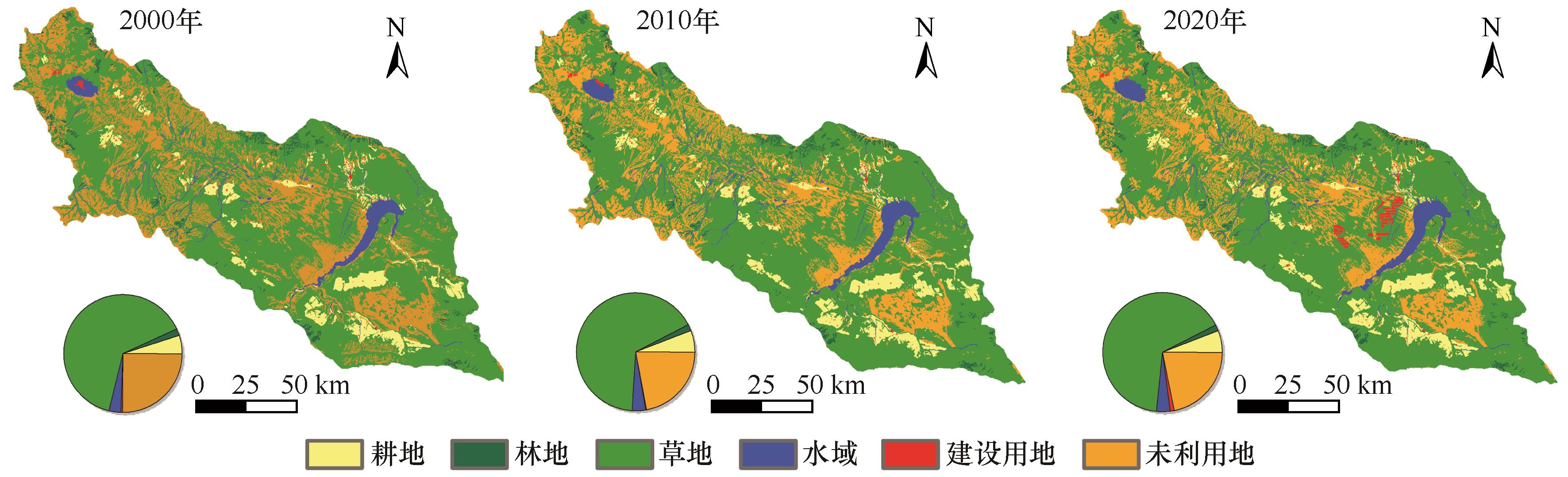
Fig.2 Land use types and area proportion in the Gonghe Basin from 2000 to 2020
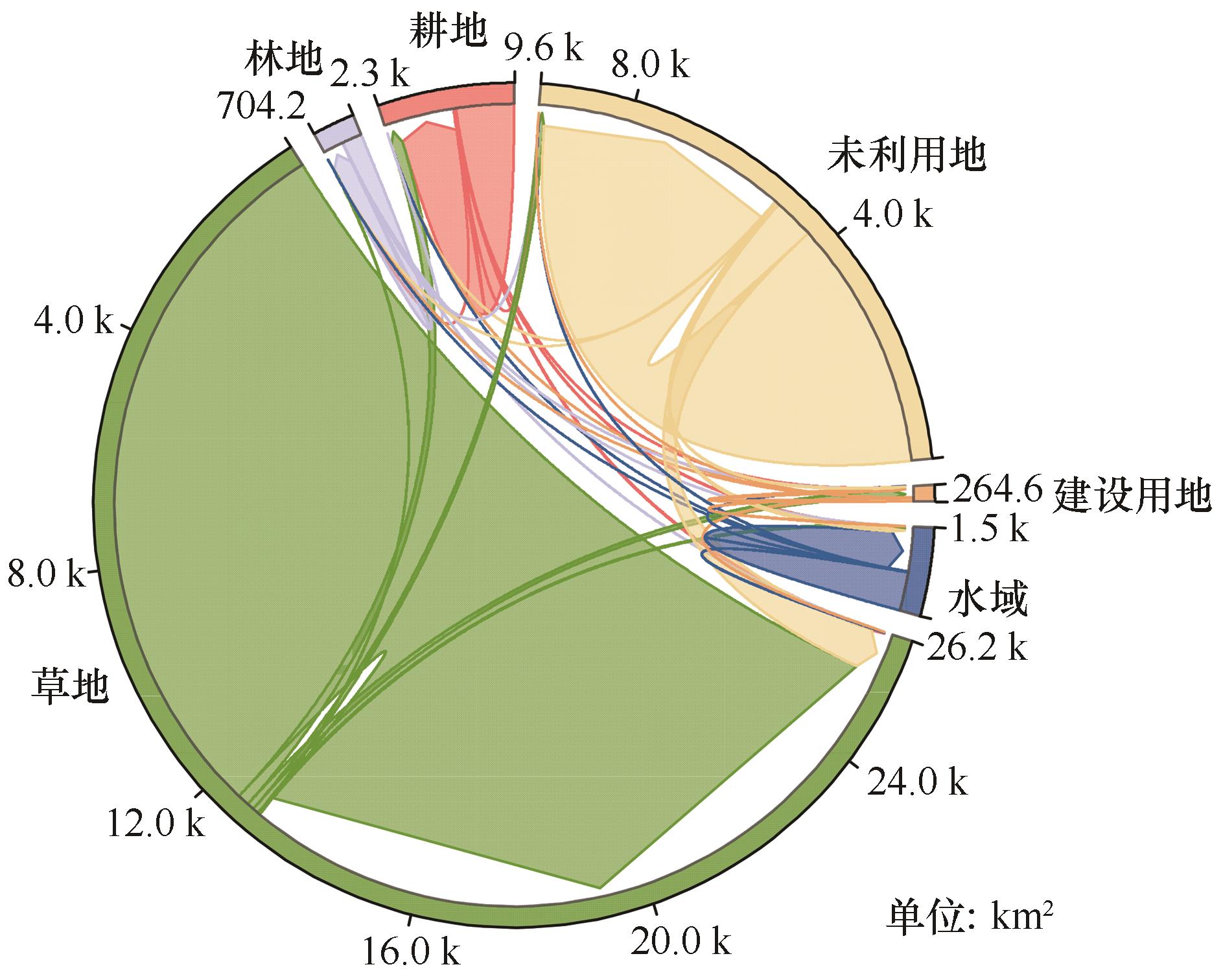
Fig.3 Land use transfer matrix from 2000 to 2020
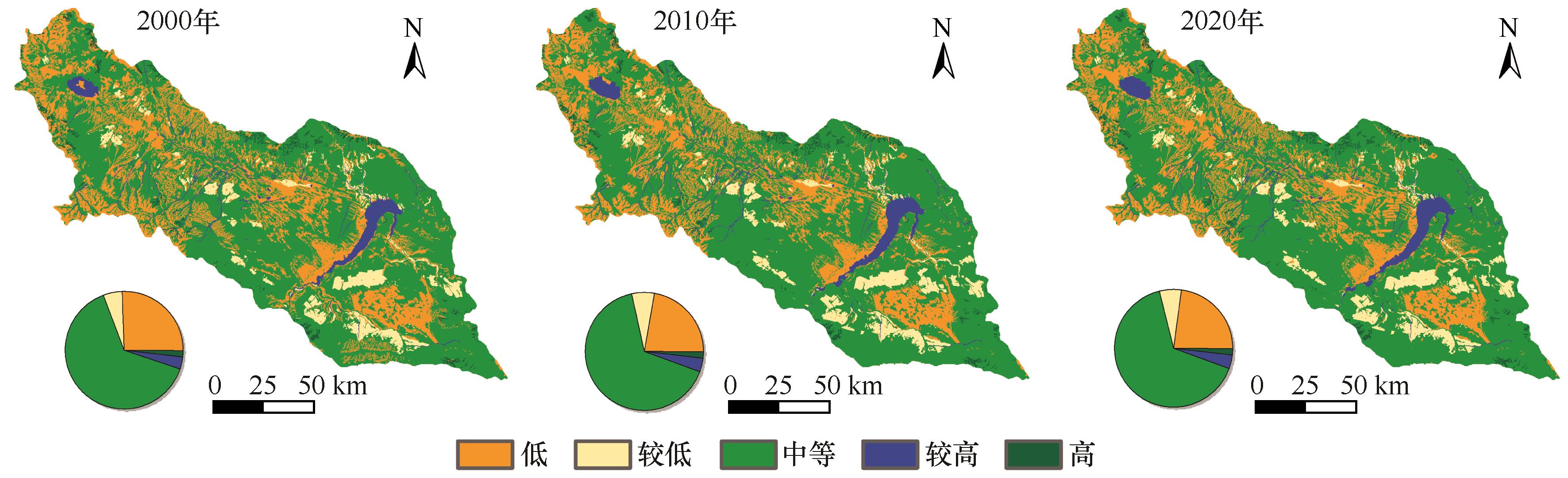
Fig.4 Spatial distribution and area proportion of habitat quality in the Gonghe Basin from 2000 to 2020
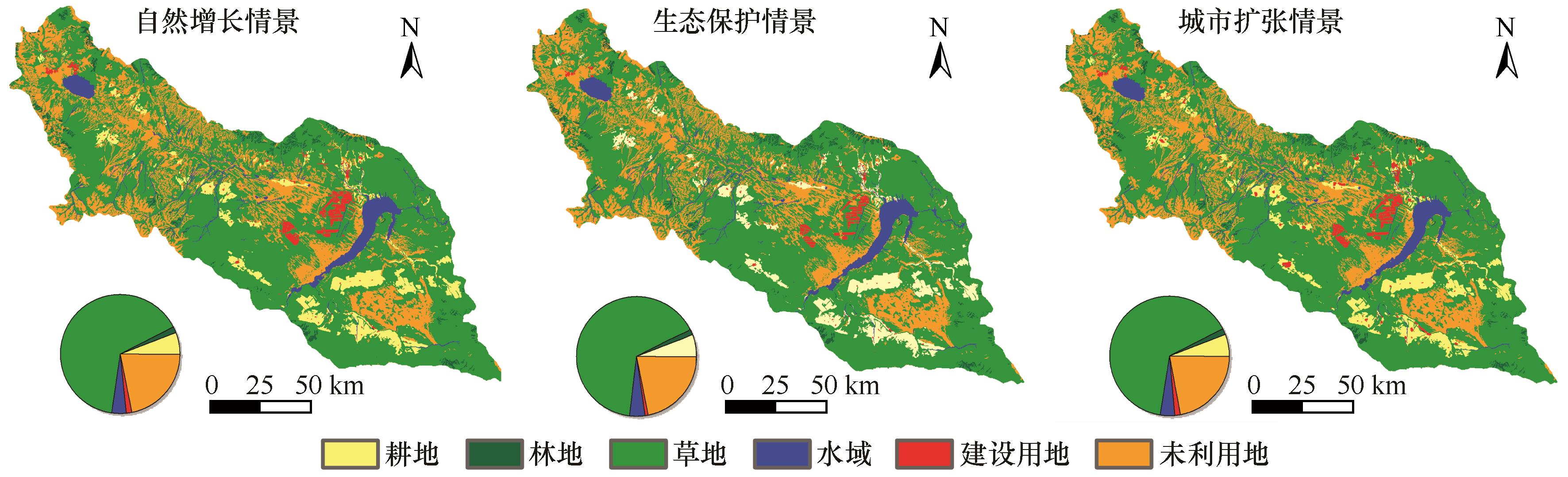
Fig.5 Spatial distribution and area proportion of land use in the Gonghe Basin under different development scenarios in 2030
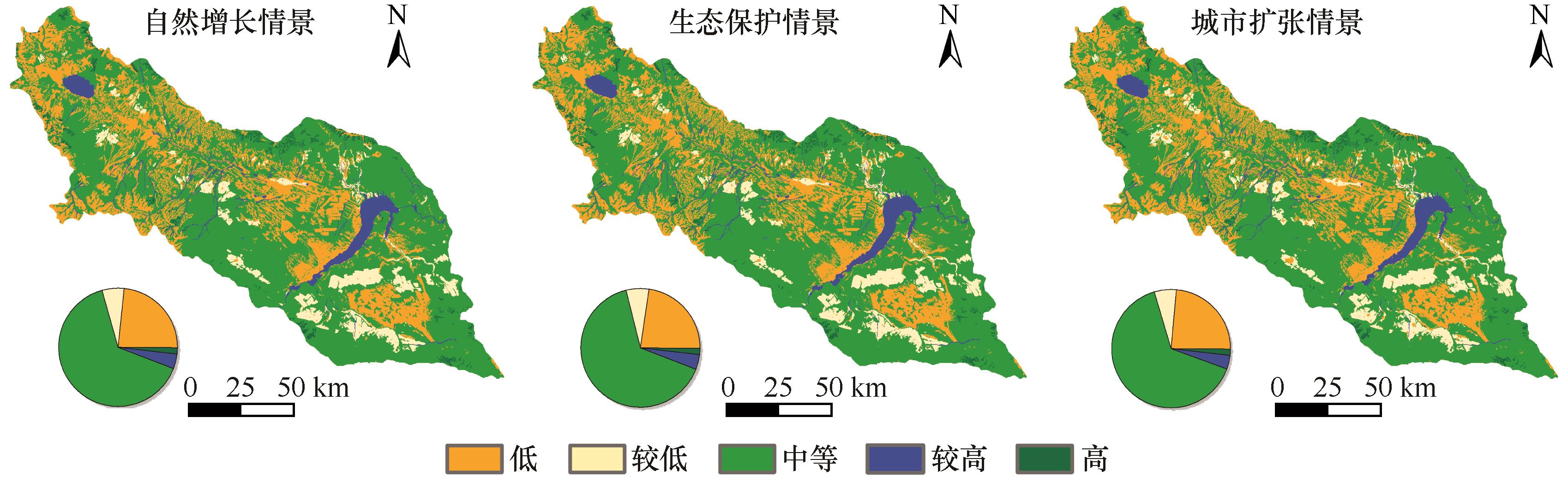
Fig.6 Spatial distribution and area proportion of habitat quality in Gonghe Basin under different development scenarios in 2030
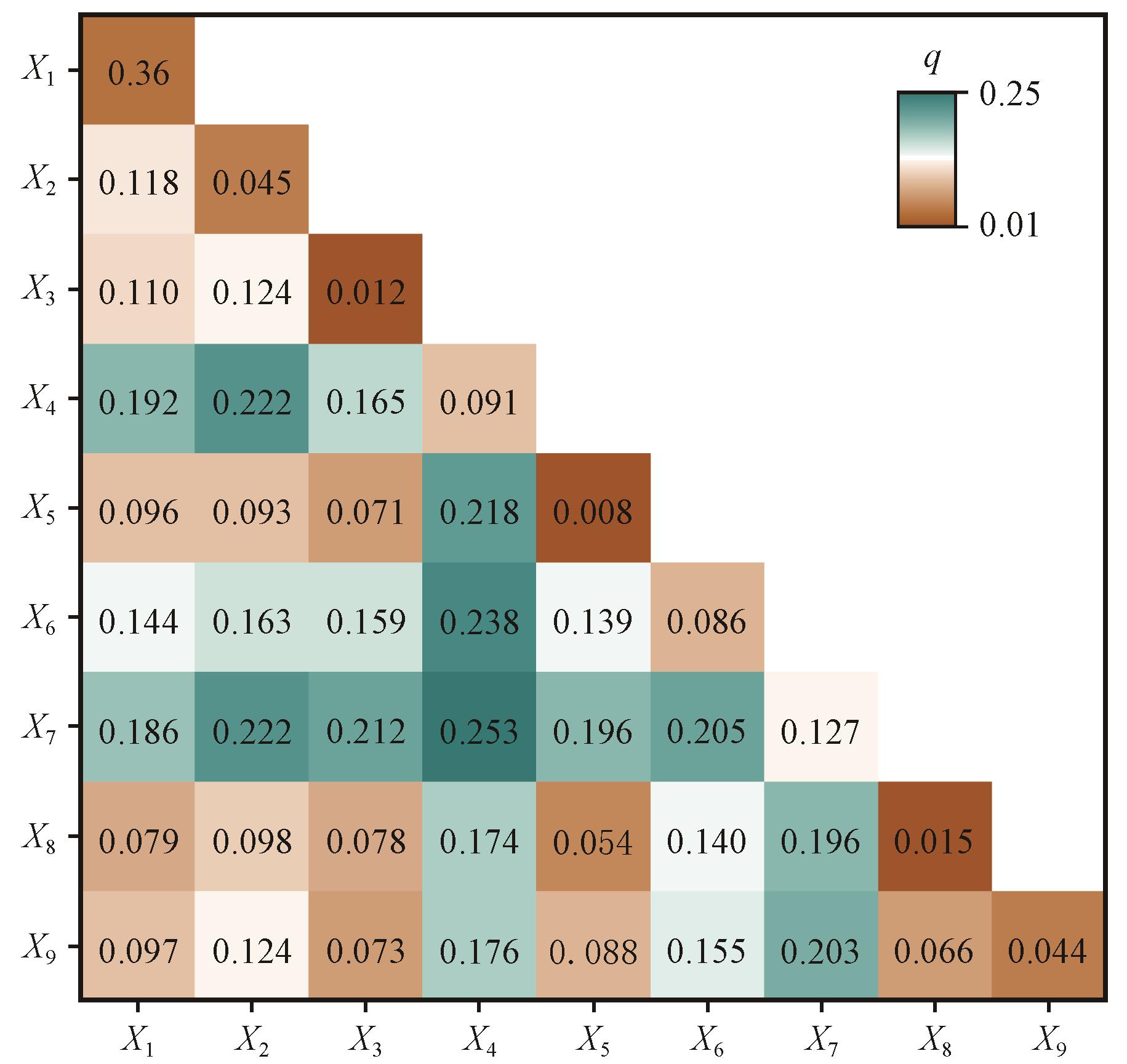
Fig.7 Interactive detection results of driving factors for habitat quality
| 1 | Hall L S, Krausman P R, Morrison M L.The habitat concept and a plea for standard terminology[J].Wildlife Society Bulletin,1997,25:173-182. |
| 2 | 杨洁,谢保鹏,张德罡.黄河流域生境质量时空演变及其影响因素[J].中国沙漠,2021,41(4):12-22. |
| 3 | Maes J, Paracchini M L, Zulian G,et al.Synergies and trade-offs between ecosystem service supply,biodiversity,and habitat conservation status in Europe[J].Biology Conservation,2012,155:1-12. |
| 4 | Li C J, Fu B J, Wang S,et al.Drivers and impacts of changes in China's drylands[J].Nature Reviews Earth & Environment,2021,2:858-873. |
| 5 | 邓晓红,宋玉琳,李宗省,等.河西地区生态敏感性演变格局及分区治理[J].中国沙漠,2023,43(5):232-240. |
| 6 | Wu J Y, Luo J G, Zhang H,et al.Projections of land use change and habitat quality assessment by coupling climate change and development patterns[J].Science of The Total Environment,2022,847:157491. |
| 7 | 刘旻霞.敦煌西湖自然保护区生物多样性特征及生境质量评价[J].干旱区资源与环境,2009,23(3):171-175. |
| 8 | Wang B X, Cheng W M.Effects of land use/cover on regional habitat quality under different geomorphic types based on InVEST model[J].Remote Sensing,2022,14:1279. |
| 9 | Tang F, Fu M C, Wang L,et al.Land-use change in Changli County,China:predicting its spatio-temporal evolution in habitat quality[J].Ecological Indicators,2020,117:106719. |
| 10 | Yang Y Y.Evolution of habitat quality and association with land-use changes in mountainous areas:a case study of the Taihang Mountains in Hebei Province,China[J].Ecological Indicators,2021,129:107967. |
| 11 | 乔治,蒋玉颖,贺曈,等.土地利用变化模拟研究进展[J].生态学报,2022,42(2):5165-5176. |
| 12 | Liang X, Guan Q F, Clarke K C,et al.Understanding the drivers of sustainable land expansion using a patch-generating land use simulation (PLUS) model:a case study in Wuhan,China[J].Computers,Environment and Urban Systems,2021,85:101569. |
| 13 | 胡丰,张艳,郭宇,等.基于PLUS和InVEST模型的渭河流域土地利用与生境质量时空变化及预测[J].干旱区地理,2022,45(4):1125-1136. |
| 14 | Tang F, Wang L, Guo Y Q,et al.Spatio-temporal variation and coupling coordination relationship between urbanisation and habitat quality in the Grand Canal,China[J].Land Use Policy,2022,117:106119. |
| 15 | 许宝荣,刘一川,董莹,等.基于InVEST模型的兰州地区生境质量评价[J].中国沙漠,2021,41(5):120-129. |
| 16 | 张登山.青海共和盆地土地沙漠化影响因子的定量分析[J].中国沙漠,2000,20(1):60-63. |
| 17 | 徐叔鹰,徐德馥,石生仁.青海共和盆地的风沙堆积[J].中国沙漠,1982,2(3):5-12. |
| 18 | Qiang M R, Jin Y X, Liu X X,et al.Late Pleistocene and Holocene aeolian sedimentation in Gonghe Basin,northeastern Qinghai-Tibetan Plateau:variability,processes,and climatic implications[J].Quaternary Science Reviews,2016,132:57-73. |
| 19 | 董光荣,高尚玉,金炯,等.青海共和盆地土地沙漠化与防治途径[M].北京:科学出版社,1993:166-173. |
| 20 | 严莉,曹广超,康利刚,等.基于InVEST模型的共和县生境质量时空变化及驱动因素[J].干旱区研究,2024,41(2):314-325. |
| 21 | Jia H, Yang S Q, Liu L Y,et al.Distinguishing the multifactorial impacts on ecosystem services under the long-term ecological restoration in the Gonghe Basin of China[J].Remote Sensing,2024,16(13):2460. |
| 22 | 王军,严有龙,王金满,等.闽江流域生境质量时空演变特征与预测研究[J].生态学报,2021,41(14):5837-5848. |
| 23 | 张学儒,周杰,李梦梅.基于土地利用格局重建的区域生境质量时空变化分析[J].地理学报,2020,75(1):160-178. |
| 24 | 张小瑜,周自翔,唐志雄,等.无定河流域生境质量时空变化及预测[J].中国沙漠,2024,44(3):75-84. |
| 25 | Xu W J, Song J X, Long Y Q,et al.Analysis and simulation of the driving mechanism and ecological effects of land cover change in the Weihe River Basin,China[J].Journal of Environmental Management,2023,344:118320. |
| 26 | 喇蕗梦,勾蒙蒙,李乐,等.三峡库区生态系统服务权衡时空动态与情景模拟:以秭归县为例[J].生态与农村环境学报,2021,37(11):1368-1377. |
| 27 | 付玮,夏文浩,樊童生,等.塔里木河流域生态系统碳储量的情景预测分析[J].干旱区地理,2024,47(4):634-647. |
| 28 | 王劲峰,徐成东.地理探测器:原理与展望[J].地理学报,2017,72(1):116-134. |
| 29 | 刘如龙,赵媛媛,陈国清,等.内蒙古黄河流域1990-2020年生境质量评估[J].干旱区研究,2024,41(4):674-683. |
| 30 | Zhang X R, Song W, Lang Y Q,et al.Land use changes in the coastal zone of China's Hebei Province and the corresponding impacts on habitat quality[J].Land Use Policy,2020,99:104957. |
| 31 | 刘孟竹,张红娟,王彦芳,等.基于土地利用的北方农牧交错带生境质量研究[J].水土保持研究,2021,28(3):156-162. |
| 32 | Song S X, Liu Z F, He C Y,et al.Evaluating the effects of urban expansion on natural habitat quality by coupling localized shared socioeconomic pathways and the land use scenario dynamics-urban model[J].Ecological Indicators,2020,112:106071. |
| 33 | 黄孟冬,肖玉,秦克玉,等.1980-2018年浑善达克地区防风固沙服务时空变化及其驱动因素[J].生态学报,2022,42(18):7612-7629. |
| 34 | 包玉斌,刘康,李婷,等.基于InVEST模型的土地利用变化对生境的影响:以陕西省黄河湿地自然保护区为例[J].干旱区研究,2015,32(3):622-629. |
| [1] | Hong Jia, Lianyou Liu, Jifu Liu. Desertification sensitivity assessment in the Gonghe Basin [J]. Journal of Desert Research, 2025, 45(1): 1-9. |
| [2] | Na Gao, Guangyin Hu, Zhibao Dong. Change characteristics of spatial distribution pattern of sandy land in Gonghe Basin [J]. Journal of Desert Research, 2025, 45(1): 204-214. |
| [3] | Juanjuan Wu, Jun Du, Xurigan, Wen Wang, Chenxin Miao, Xia Ren, Zhiru Yang, Fangyuan Cao, Mingyue Mao. Land use change characteristics and driving forces in the Ten Tributaries Basin, Inner Mongolia [J]. Journal of Desert Research, 2024, 44(6): 100-109. |
| [4] | Honghua Xia, Linshan Yang, Qi Feng, Yingqing Su, Xingyi Zou, Wanghan He. Spatio-temporal variation and driving factors of water supply and demand in Shiyang River Basin [J]. Journal of Desert Research, 2024, 44(6): 87-99. |
| [5] | Wanyun Luo, Mingqian Rong, Shihao Guo. A study on the differences and influencing factors of farmland utilization efficiency of farmers in desertified areas from the perspective of resource dependence:based on survey data of farmers in the four prefectures of southern Xinjiang [J]. Journal of Desert Research, 2024, 44(5): 105-115. |
| [6] | Xiao Wang, Bing Liu, Wenzhi Zhao, Weichun Qin, Bo Zhang, Rui Zhu, Wanxue You. Characteristics of ecological service value and ecological risk changes in Ningxia, China in 1980-2020 [J]. Journal of Desert Research, 2024, 44(5): 182-194. |
| [7] | Qunzhu Han, Lingyi Zhu, Yuting E, Fangbin Fu, Yingbo Zhang. Empirical analysis of spatiotemporal evolution of urban land use efficiency in the Shaanxi-Gansu-Ningxia region in 2004-2020 based on DEA model [J]. Journal of Desert Research, 2024, 44(5): 245-253. |
| [8] | Rong Zhu, Zejian Ao, Youyan Jiang. Assessment of ecological environment vulnerability in Tianshui city based on the CRITIC objective weighting method [J]. Journal of Desert Research, 2024, 44(3): 321-331. |
| [9] | Xiaoyu Zhang, Zixiang Zhou, Zhixiong Tang, Yanxu Sun. Spatio-temporal variation and prediction of habitat quality in Wuding River Basin [J]. Journal of Desert Research, 2024, 44(3): 75-84. |
| [10] | Chengwei Zheng, Xiaohong Deng, Zongxing Li, Jian Xue, Libang Ma, Juan He, Shuxiang Lu, Jianxiong Shao, Shiyu Cai, Peiyi Zhao. Analysis of the spatial and temporal evolution of water resources conservation and human activity intensity in the Hexi region of Gansu Province [J]. Journal of Desert Research, 2024, 44(1): 189-200. |
| [11] | Wanfeng Su, Guangzhao Han, Deli Ye, Guangchao Cao. Remote sensing evaluation and driving force analysis of ecological environment in Gonghe Basin [J]. Journal of Desert Research, 2023, 43(5): 74-84. |
| [12] | Weihong Zhang, Jiali Xie, Zhipeng Liu, Jie Hu, Yuan Ma, Hongyan Zhao, Wei Zhou. Assessment of the ecosystem service value change in Ningxia in 2000-2020 [J]. Journal of Desert Research, 2023, 43(4): 157-167. |
| [13] | Rui Guo, Wei Liu, Zongxing Li, Ya Wang, Yong Chen, Lihua Zhou. An analysis on the land use change characteristics and driving forces in Gansu part of the Qilian Mountain [J]. Journal of Desert Research, 2023, 43(3): 188-198. |
| [14] | Shengtang Wang, Yingchun Ge, Shaokun Wang, Xiaolong Zhang, Ying Yang. Responses of plant species diversity to land use change: a case study in the Heihe River Basin [J]. Journal of Desert Research, 2022, 42(6): 221-232. |
| [15] | Cuixia Wu, Yongzhong Feng, Hao Zhao, Qiong Bao, Yuanqi Lei, Jie Feng. Study on ecosystem service value of the Yellow River Basin in Gansu Province based on land use change [J]. Journal of Desert Research, 2022, 42(6): 304-316. |
| Viewed | ||||||
|
Full text |
|
|||||
|
Abstract |
|
|||||
©2018Journal of Desert Research
Tel:0931-8267545
Email:caiedit@lzb.ac.cn;desert@lzb.ac.cn
Support:Magtech
