中国沙漠 ›› 2026, Vol. 46 ›› Issue (2): 277-287.DOI: 10.7522/j.issn.1000-694X.2025.00202
• • 上一篇
收稿日期:2025-11-04
修回日期:2025-12-25
出版日期:2026-03-20
发布日期:2026-04-13
通讯作者:
张勃
作者简介:安迪(2000—),女,甘肃肃南人,硕士研究生,主要从事寒旱区生态系统演化与恢复研究。E-mail: 2023212880@nwnu.edu.cn
Di An(
), Bo Zhang(
), Xueying Zhang, Zhexi Wu
Received:2025-11-04
Revised:2025-12-25
Online:2026-03-20
Published:2026-04-13
Contact:
Bo Zhang
摘要:
在全球旱地生态脆弱性加剧的背景下,中国在干旱半干旱区实施了多项生态工程,形成了密集生态干预,但其对植被动态的影响机制尚不明确。本研究基于多源遥感数据,综合运用趋势分析、残差分析等方法,量化了2000—2020年生态工程重叠区植被生产力的变化及其驱动因素。结果表明:研究区植被生产力显著提升,气候呈暖湿化趋势,在生态工程重叠区尤为突出。驱动机制上,密集生态干预在适宜水热条件下具有协同增益效应。气候与非气候因素的共同作用是促进植被生产力增长的主导力量,且随着生态工程密度的增加,非气候因素的贡献显著增强,植被对气候波动的直接响应降低。本研究为优化生态工程的空间布局、实施基于水热条件的差异化恢复策略提供了科学依据。
中图分类号:
安迪, 张勃, 张雪盈, 伍哲希. 密集生态干预对中国干旱半干旱区植被生产力的影响[J]. 中国沙漠, 2026, 46(2): 277-287.
Di An, Bo Zhang, Xueying Zhang, Zhexi Wu. Implications of intensive ecological intervention for vegetation productivity in arid and semi-arid areas of China[J]. Journal of Desert Research, 2026, 46(2): 277-287.
| 数据名称 | 数据集名称 | 空间分辨率/m | 下载网址 |
|---|---|---|---|
| 土地利用 | MCD12Q1.061 | 1 000 | https://earthengine.geogle.com |
| NDVI | MOD13A1 | 500 | |
| GPP | MOD17A2H | 500 | |
| NPP | MOD17A2H | 500 | |
| 气温 | 中国1 km分辨率逐月气温数据集 | 1 000 | https://data.tpdc.ac.cn |
| 降水量 | 中国1 km分辨率逐月降水量数据集 | 1 000 | |
| 生态工程边界 | 中国重大生态工程生态效益评估数据集 | https://www.nesdc.org.cn |
表1 数据及来源
Table 1 Data and source
| 数据名称 | 数据集名称 | 空间分辨率/m | 下载网址 |
|---|---|---|---|
| 土地利用 | MCD12Q1.061 | 1 000 | https://earthengine.geogle.com |
| NDVI | MOD13A1 | 500 | |
| GPP | MOD17A2H | 500 | |
| NPP | MOD17A2H | 500 | |
| 气温 | 中国1 km分辨率逐月气温数据集 | 1 000 | https://data.tpdc.ac.cn |
| 降水量 | 中国1 km分辨率逐月降水量数据集 | 1 000 | |
| 生态工程边界 | 中国重大生态工程生态效益评估数据集 | https://www.nesdc.org.cn |
| 驱动因素 | 驱动因素的划分标准 | 驱动因素的贡献率/% | |||
|---|---|---|---|---|---|
| 气候因素 | 非气候因素 | ||||
| >0 | CC&NC | >0 | >0 | ||
| CC | >0 | <0 | 100 | 0 | |
| NC | <0 | >0 | 0 | 100 | |
| <0 | CC&NC | <0 | <0 | ||
| CC | <0 | >0 | 100 | 0 | |
| NC | >0 | <0 | 0 | 100 | |
表2 植被生产力变化的驱动因素划分标准及贡献率计算方法
Table 2 Criteria for classifying drivers of vegetation productivity change and calculation methods for contribution rates
| 驱动因素 | 驱动因素的划分标准 | 驱动因素的贡献率/% | |||
|---|---|---|---|---|---|
| 气候因素 | 非气候因素 | ||||
| >0 | CC&NC | >0 | >0 | ||
| CC | >0 | <0 | 100 | 0 | |
| NC | <0 | >0 | 0 | 100 | |
| <0 | CC&NC | <0 | <0 | ||
| CC | <0 | >0 | 100 | 0 | |
| NC | >0 | <0 | 0 | 100 | |
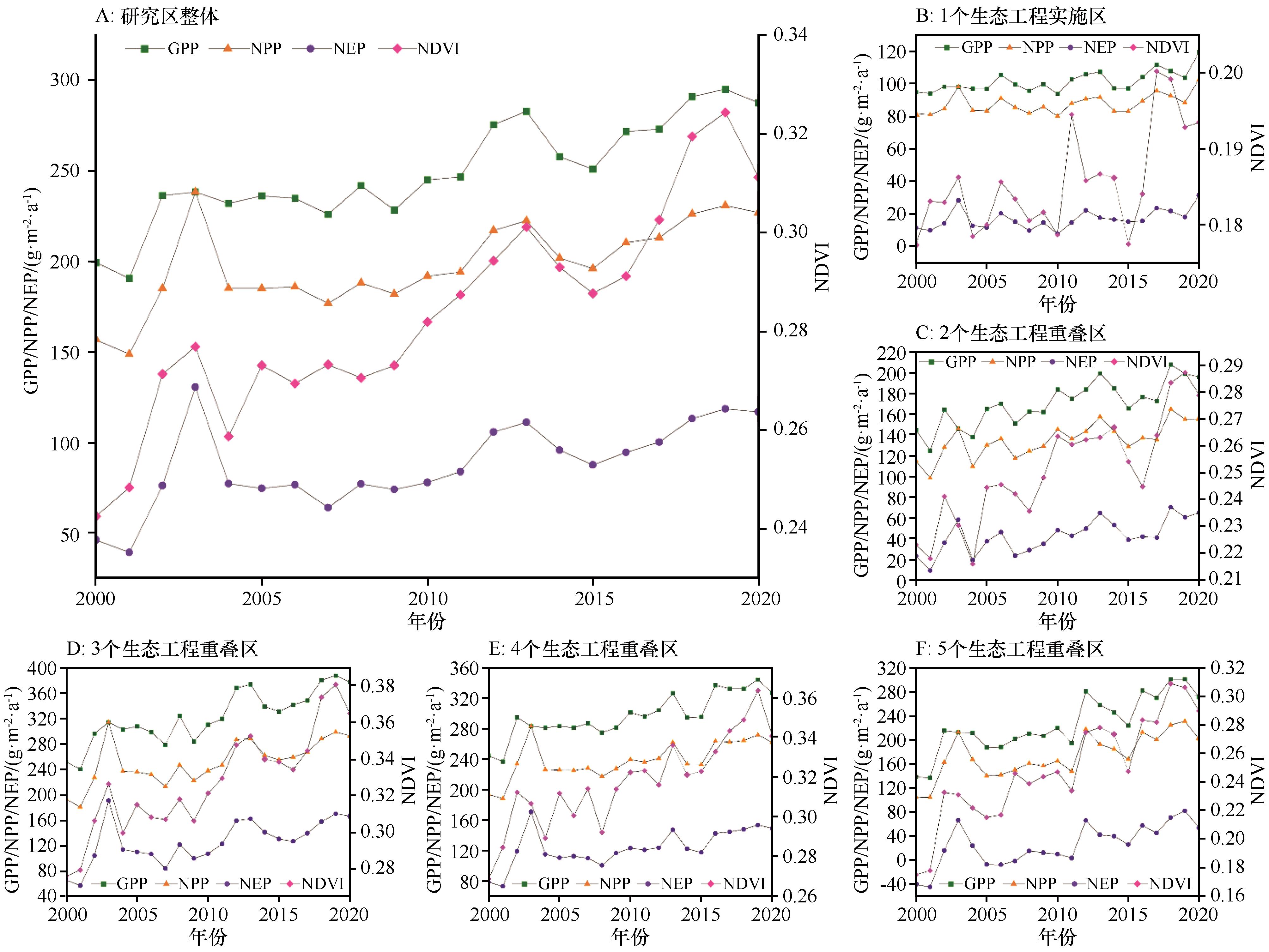
图2 植被生产力的年际变化趋势
Fig.2 Interannual trends of vegetation productivity in the study area as a whole (A) and regions with ecological projects overlaps ranging from 1 to 5 (B-F)
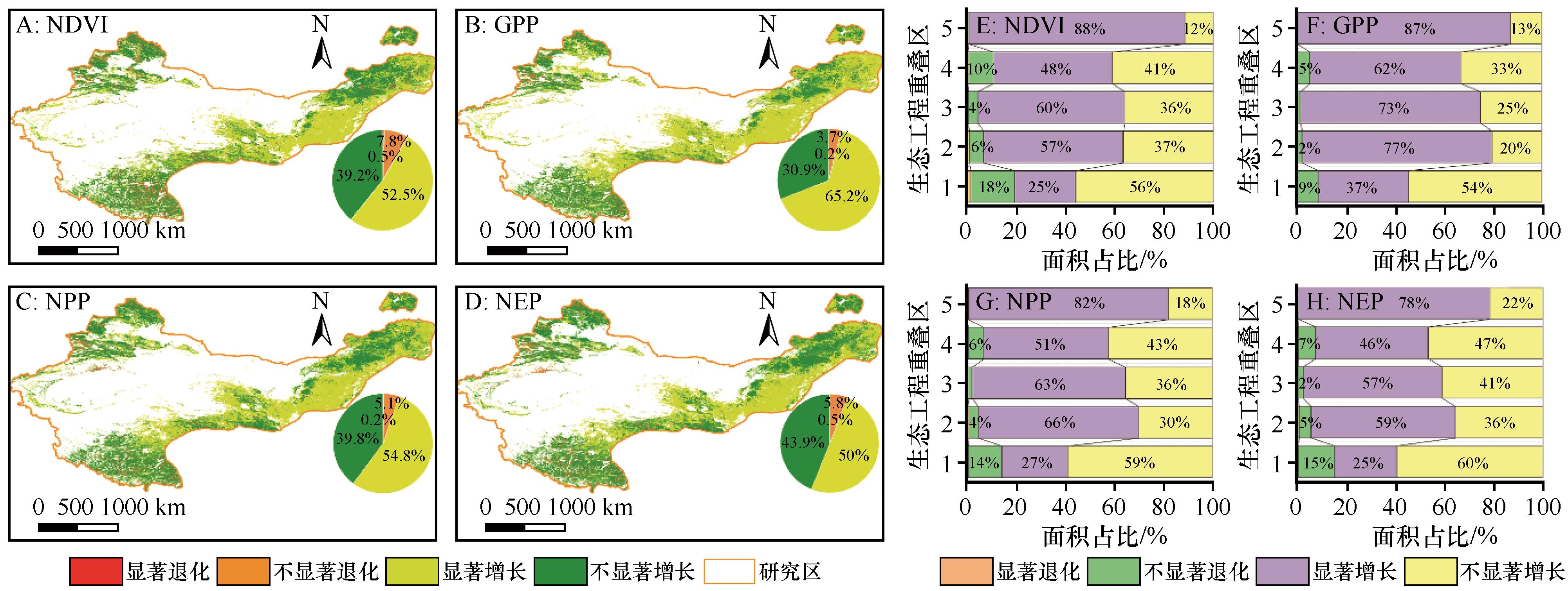
图3 研究区植被生产力的空间分布(A~D)以及生态工程重叠区植被生产力空间变化占比(E~H)注:A~D图基于自然资源部标准地图服务网站审图号GS(2022)1873号标准地图制作,底图边界无修改
Fig.3 Spatial distribution of vegetation productivity in the study area as a whole (A-D), and spatial distribution of vegetation productivity in ecological project overlapping areas (E-H)
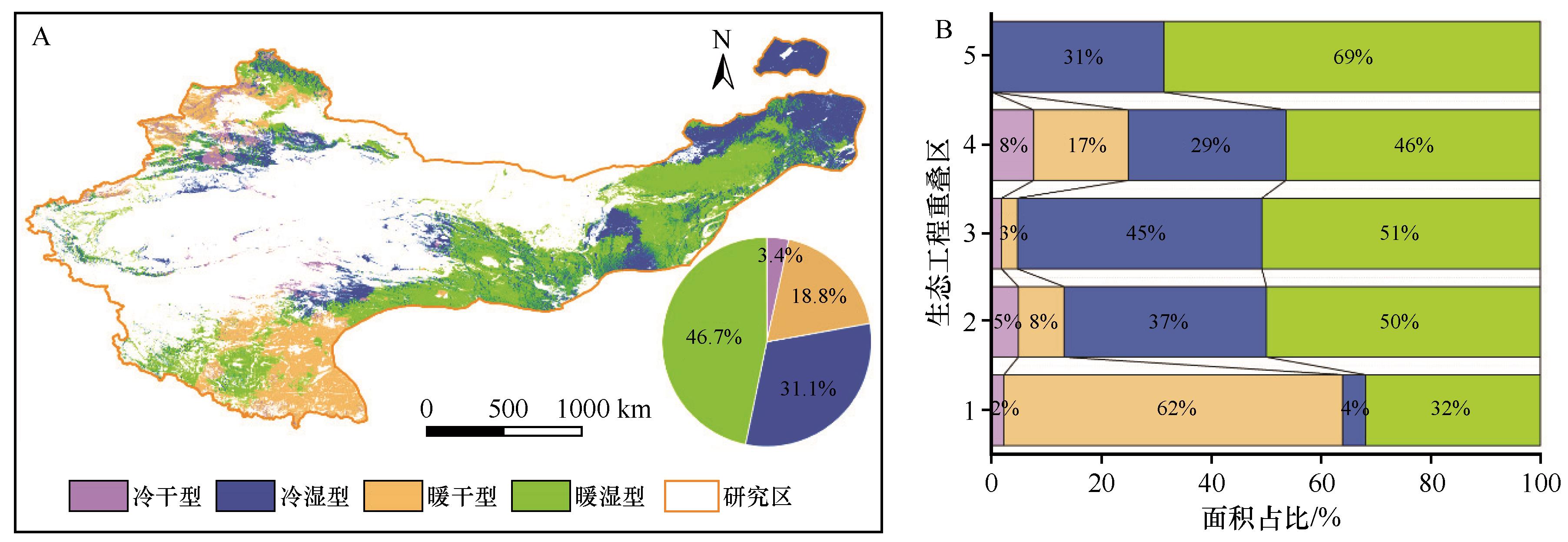
图5 研究区水热组合类型的空间分布(A)以及各生态工程重叠区中不同水热组合类型的面积占比(B)注:A图基于自然资源部标准地图服务网站审图号GS(2022)1873号标准地图制作,底图边界无修改
Fig.5 Spatial distribution of hydrothermal combination types in the study area as a whole (A), and area proportion of different hydrothermal combination types within each ecological project overlapping areas (B)
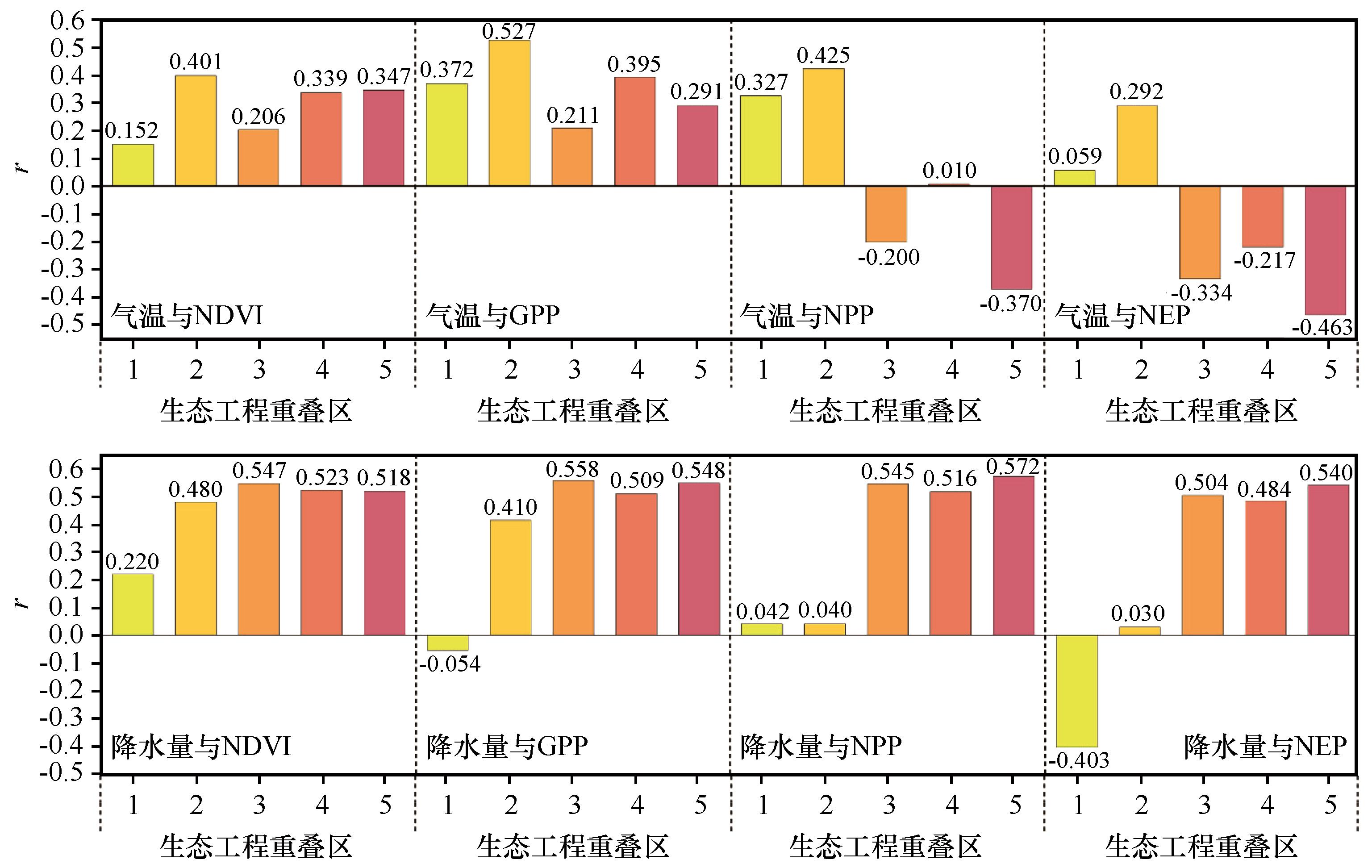
图6 各生态工程重叠区的植被生产力与气温和降水量的相关性
Fig.6 Correlation between vegetation productivity and air temperature and precipitation in ecological project overlapping areas
| 生态工程重叠区 | 主导水热组合类型 | 主导气候因子 | 植被生产力空间变化主导趋势 |
|---|---|---|---|
| 1 | 暖干型(62%) | 气温(57.72%) | 不显著增长 |
| 2 | 暖湿型(50%) | 气温(75.28%) | 显著增长 |
| 3 | 暖湿型(51%) | 降水量(83.16%) | 显著增长 |
| 4 | 暖湿型(46%) | 降水量(79.01%) | 显著增长 |
| 5 | 暖湿型(69%) | 降水量(68.80%) | 显著增长 |
表3 各生态工程重叠区主导水热类型、气候因子及植被生产力响应
Table 3 Dominant hydrothermal types, climatic factors, and vegetation productivity responses in ecological project overlapping areas
| 生态工程重叠区 | 主导水热组合类型 | 主导气候因子 | 植被生产力空间变化主导趋势 |
|---|---|---|---|
| 1 | 暖干型(62%) | 气温(57.72%) | 不显著增长 |
| 2 | 暖湿型(50%) | 气温(75.28%) | 显著增长 |
| 3 | 暖湿型(51%) | 降水量(83.16%) | 显著增长 |
| 4 | 暖湿型(46%) | 降水量(79.01%) | 显著增长 |
| 5 | 暖湿型(69%) | 降水量(68.80%) | 显著增长 |
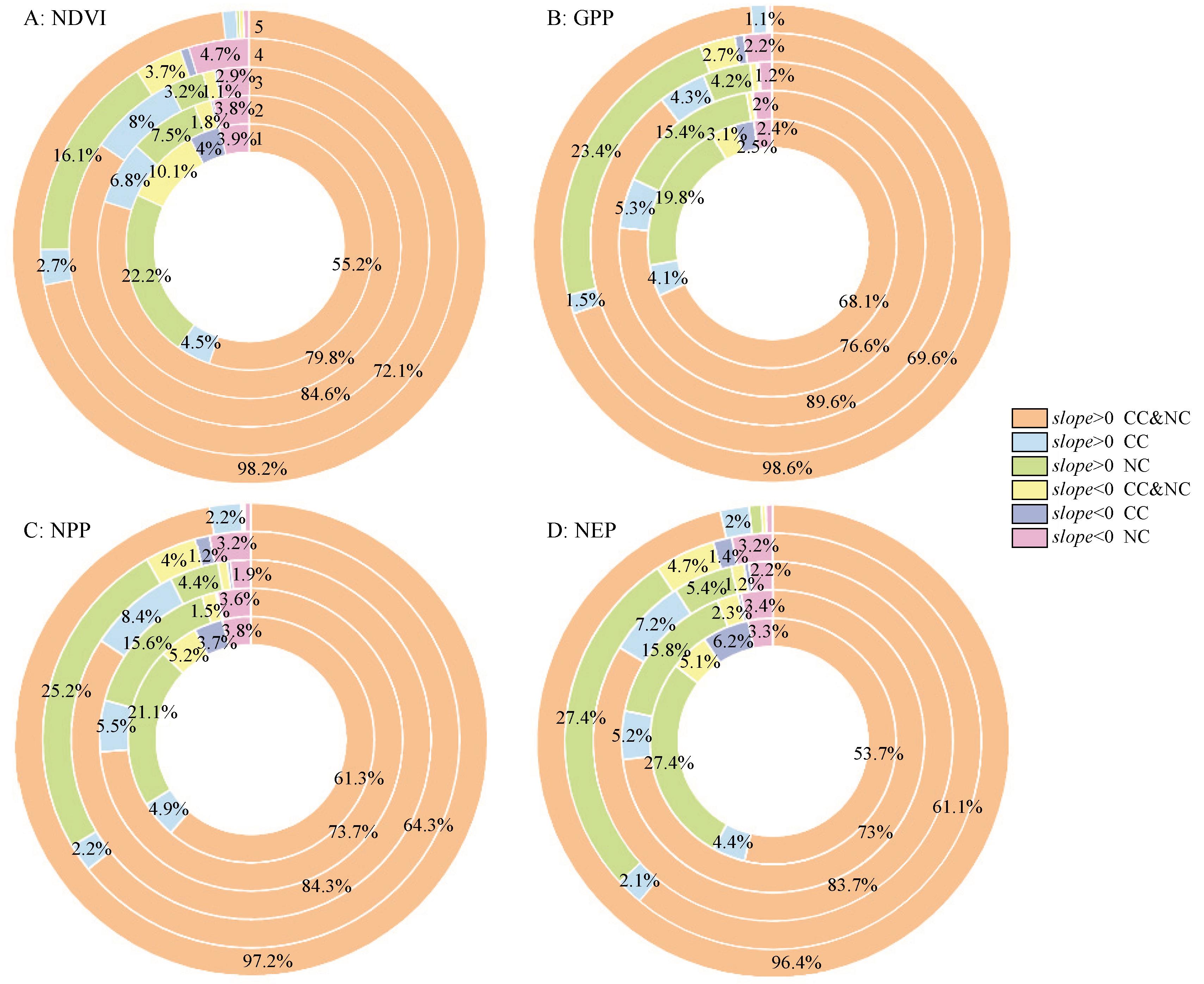
图7 各生态工程重叠区的驱动力占比注:圈层1~5代表1~5个生态工程重叠区。CC&NC代表气候因素和非气候因素共同作用,CC代表气候因素单独作用,NC代表非气候因素单独作用。slope>0代表驱动力对植被生产力起促进作用,slope<0代表驱动力对植被生产力起抑制作用
Fig.7 Proportion of driving forces in ecological project overlapping areas. Numbers 1-5 represent areas with 1-5 overlapping ecological projects
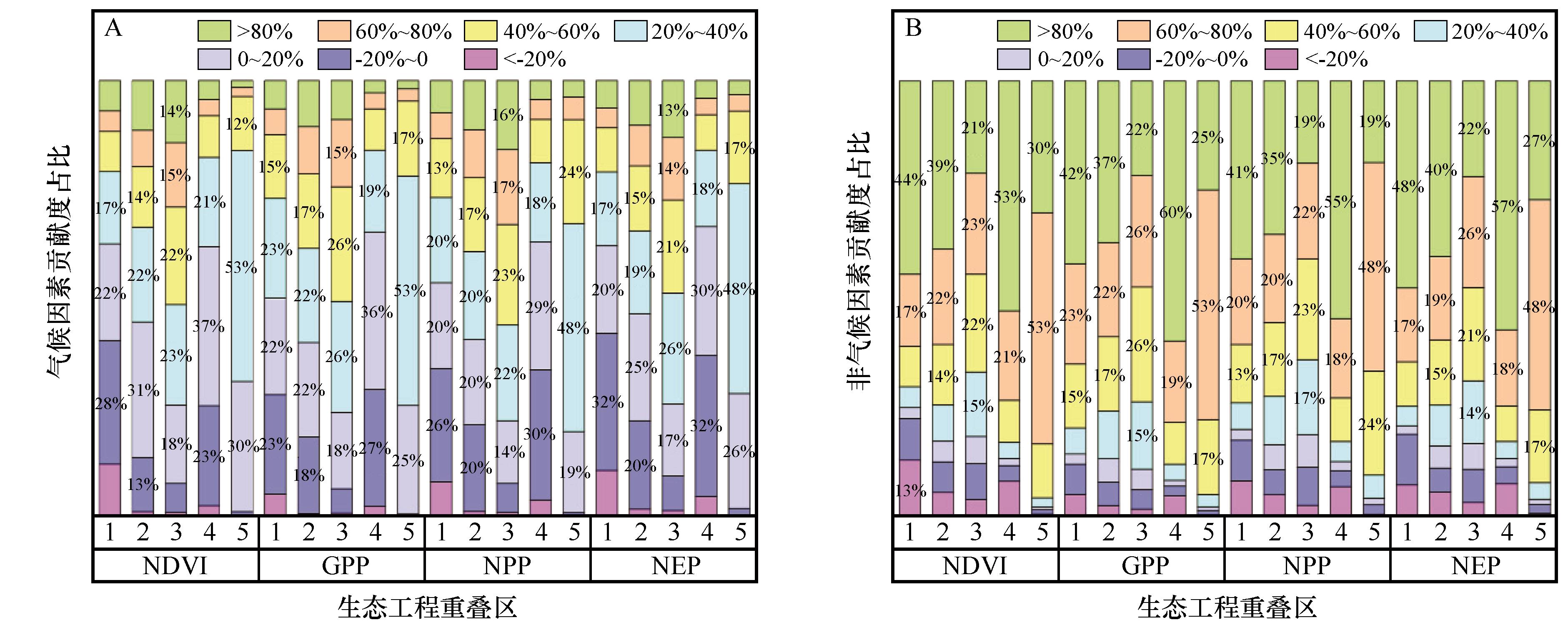
图8 各个生态工程重叠区气候因素和非气候因素对植被生产力变化贡献度的占比
Fig.8 Relative contributions of climatic and non-climatic factors to vegetation productivity changes in ecological project overlapping areas. Numbers 1-5 represent areas with 1-5 overlapping ecological projects
| [1] | Board M E A.Ecosystems and Human Well-Being:Desertification Synthesis[M].Millennium Ecosystem Assessment Board,2005. |
| [2] | Reynolds J F, Smith D M S, Lambin E F,et al.Global desertification:building a science for dryland development[J].Science,2007,316(5826):847-851. |
| [3] | Guan X, Ma J, Huang J,et al.Impact of oceans on climate change in drylands[J].Science China Earth Sciences,2019,62(6):891-908. |
| [4] | Huang J, Li Y, Fu C,et al.Dryland climate change:recent progress and challenges[J].Reviews of Geophysics,2017,55(3):719-778. |
| [5] | 陈亚宁,李玉朋,李稚,等.全球气候变化对干旱区影响分析[J].地球科学进展,2022,37(2):111-119. |
| [6] | Li H, Gao W, Liu Y,et al.Attributing the impacts of ecological engineering and climate change on carbon uptake in Northeastern China[J].Landscape Ecology,2023,38(12):3945-3960. |
| [7] | Chen Y, Yi G, Zhu X,et al.Quantifying the vegetation restoration mechanism of ecological projects on the Qingzang Plateau[J].International Journal of Digital Earth,2025,18(1). |
| [8] | Jiang H, Xu X, Guan M,et al.Simulation of spatiotemporal land use changes for integrated model of socioeconomic and ecological processes in China[J].Sustainability,2019,11(13):3627. |
| [9] | 张耀文,张勃,姚荣鹏,等.2000-2020年渭河流域植被覆盖度及产水量时空变化[J].中国沙漠,2022,42(2):223-233. |
| [10] | Yan Y, Liu X, Wen Y,et al.Quantitative analysis of the contributions of climatic and human factors to grassland productivity in Northern China[J].Ecological Indicators,2019,103:542-553. |
| [11] | 陈珊珊,温兆飞,马茂华,等.气候变化背景下定量解析生态工程对植被动态的影响研究方法概述[J].生态学报,2022,42(15):6439-6449. |
| [12] | 邵全琴,刘树超,宁佳,等.2000-2019年中国重大生态工程生态效益遥感评估[J].地理学报,2022,77(9):2133-2153. |
| [13] | Zhang J, Meng F, Luo M,et al.Investigating spatiotemporal variability of drought and its impact on grassland GPP in Inner Mongolia[J].Journal of Arid Environments,2025,230:105425. |
| [14] | Hou X, Zhang B, Chen J,et al.Response of vegetation productivity to greening and drought in the Loess Plateau based on VIs and SIF[J].Forests,2024,15(2):339. |
| [15] | 邵全琴.2000-2019年中国重大生态工程生态效益评估数据集[DB/OL].国家生态科学数据中心,2022. |
| [16] | 彭守璋.中国1 km分辨率逐月降水量数据集(1901-2022) [DB/OL].国家青藏高原数据中心,2023. |
| [17] | 彭守璋.中国1 km分辨率逐月气温数据集(1901-2022) [DB/OL].国家青藏高原数据中心,2023. |
| [18] | Piao S, Fang J, Ciais P,et al.The carbon balance of terrestrial ecosystems in China[J].Nature,2009,458(7241):1009-1013. |
| [19] | 裴志永,周才平,欧阳华,等.青藏高原高寒草原区域碳估测[J].地理研究,2010,29(1):102-110. |
| [20] | Zhang X, Liu C, Jiang Y.Spatiotemporal dynamics of terrestrial vegetation carbon sinks and its response to climate change in Northwest China[J].Frontiers in Environmental Science,2025,13(13):1550501. |
| [21] | Hou X, Zhang B, He Q Q,et al.Spatial-temporal variations in the climate,net ecosystem productivity,and efficiency of water and carbon use in the middle reaches of the Yellow River[J].Remote Sensing,2024,16(17):3312. |
| [22] | Xue H, Chen Y, Dong G,et al.Quantitative analysis of spatiotemporal changes and driving forces of vegetation net primary productivity (NPP) in the Qimeng region of Inner Mongolia[J].Ecological Indicators,2023,154:110610. |
| [23] | Hirsch R M, Slack J R, Smith R A.Techniques of trend analysis for monthly water quality data[J].Water Resources Research,1982,18(1):107-121. |
| [24] | 徐勇,黄雯婷,郭振东,等.2000-2020年我国西南地区植被NEP时空变化及其驱动因素的相对贡献[J].环境科学研究,2023,36(3):557-570. |
| [25] | Evans J, Geerken R.Discrimination between climate and human-induced dryland degradation[J].Journal of Arid Environments,2004,57(4):535-554. |
| [26] | 修丽娜,颜长珍,钱大文,等.生态工程背景下黄土高原植被变化时空特征及其驱动力[J].水土保持通报,2019,39(4):214-221. |
| [27] | 金凯,王飞,韩剑桥,等.1982-2015年中国气候变化和人类活动对植被NDVI变化的影响[J].地理学报,2020,75(5):961-974. |
| [28] | Sun W, Song X, Mu X,et al.Spatiotemporal vegetation cover variations associated with climate change and ecological restoration in the Loess Plateau[J].Agricultural and Forest Meteorology,2015,209/210:87-99. |
| [29] | 张强,黄建平,杨金虎,等.中国干旱、半干旱区气候变化及影响研究百年进展[J].气象学报,2025,83(3):699-715. |
| [30] | 张强,杨金虎,王朋岭,等.西北地区气候暖湿化的研究进展与展望[J].科学通报,2023,68(14):1814-1828. |
| [31] | 郑艺,张丽,周宇,等.1982-2012年全球干旱区植被变化及驱动因子分析[J].干旱区研究,2017,34(1):59-66. |
| [32] | 王明宇,吴成永,陈克龙.青海湖流域植被绿度时空变化及影响因素[J].中国沙漠,2025,45(5):289-300. |
| [33] | Qi S, Zhang H, Zhang M.Evolutionary characteristics of carbon sources/sinks in Chinese terrestrial ecosystems regarding to temporal effects and geographical partitioning[J].Ecological Indicators,2024,160:111923. |
| [34] | 翟盘茂,余荣,郭艳君,等.2015/2016年强厄尔尼诺过程及其对全球和中国气候的主要影响[J].气象学报,2016,74(3):309-321. |
| [35] | WMO.WMO Statement on the Status of Global Climate in 2015[R].WMO,2016. |
| [36] | 钟诗瑶,李传华,乔鹏飞.2000-2020年干旱梯度下西北干旱半干旱区植被突变及归因[J].中国沙漠,2025,45(2):275-283. |
| [37] | 肖生春,司建华,彭小梅,等.雅布赖山周边沙害现状与防风固沙林草带构建技术体系集成[J].中国沙漠,2025,45(5):209-216. |
| [38] | 李森,杨宗英,赵鸿雁,等.1975-2020年黄河“几字弯”沙漠化时空变化[J].中国沙漠,2024,44(5):13-22. |
| [1] | 王世宇, 王雪松. 2001—2020年中国北方干旱半干旱区土壤风蚀的时空变化及驱动因素[J]. 中国沙漠, 2026, 46(2): 164-176. |
| [2] | 周涛, 任珩, 张喜风, 赵文智. 祁连山山水林田湖草沙时空演变特征及影响因素[J]. 中国沙漠, 2026, 46(1): 291-305. |
| [3] | 王海仙, 张勇勇, 康文蓉, 肖建华, 王淑敏, 魏淑娥, 吴绍雄. 干旱半干旱区典型植被类型蒸散比及土壤水分阈值[J]. 中国沙漠, 2025, 45(6): 289-299. |
| [4] | 程姗岭, 于海鹏, 任钰, 周洁, 罗红羽, 刘晨汐, 龚咏琪. 中国干旱半干旱区气候异常影响机理研究进展[J]. 中国沙漠, 2023, 43(3): 21-35. |
| [5] | 张越, 陈思宇, 毕鸿儒, 曹佳慧, 罗源, 龚咏琪, 陈渔. 干旱半干旱区农田土壤风蚀特征及参数化研究进展[J]. 中国沙漠, 2022, 42(3): 105-117. |
| [6] | 王娜, 春喜. 乌兰布和沙漠晚第四纪以来环境演化研究进展[J]. 中国沙漠, 2022, 42(1): 175-183. |
| [7] | 王同亮, 马绍休, 高扬, 宫毓来, 安志山. 小波包分解与多个机器学习模型耦合在风速预报中的对比[J]. 中国沙漠, 2021, 41(2): 38-50. |
| [8] | 常学尚, 常国乔. 干旱半干旱区土壤水分研究进展[J]. 中国沙漠, 2021, 41(1): 156-163. |
| [9] | 赵多平, 安烁, 苗红, 耿一睿, 赵伟佚, 谢利娟. 沙漠非传统节事旅游的影响因素及驱动机制——以阿拉善沙漠e族英雄会为例[J]. 中国沙漠, 2019, 39(5): 80-87. |
| [10] | 薛文萍, 靳鹤龄, 刘冰, 孙良英, 刘振宇. 中国季风边缘区全新世沙地演化及其驱动机制研究进展[J]. 中国沙漠, 2019, 39(3): 163-171. |
| [11] | 马松尧, 陈龙, 滕泽宇, 丁爱军, 何子豪. 荒漠草原区风力发电场建设前后的植被变化[J]. 中国沙漠, 2019, 39(2): 186-192. |
| [12] | 万炜, 颜长珍, 肖生春, 谢家丽, 钱大文. 1975-2015年阿拉善高原沙漠化过程、格局与驱动机制[J]. 中国沙漠, 2018, 38(1): 17-29. |
| [13] | 肖生春, 陈小红, 丁爱军. 近现代阿拉善荒漠气候变化与环境演变机制研究进展[J]. 中国沙漠, 2017, 37(6): 1102-1110. |
| [14] | 张明艳, 贾昕, 查天山, 秦树高, 吴雅娟, 任才. 油蒿(Artemisia ordosica)光系统Ⅱ光化学效率对去除降雨的响应[J]. 中国沙漠, 2017, 37(3): 475-482. |
| [15] | 李晓英, 姚正毅, 王宏伟, 肖建华. 青海省贵南县土地沙漠化驱动机制[J]. 中国沙漠, 2016, 36(6): 1539-1546. |
| 阅读次数 | ||||||
|
全文 |
|
|||||
|
摘要 |
|
|||||
©2018中国沙漠 编辑部
地址: 兰州市天水中路8号 (730000)
电话:0931-8267545
Email:caiedit@lzb.ac.cn;desert@lzb.ac.cn